

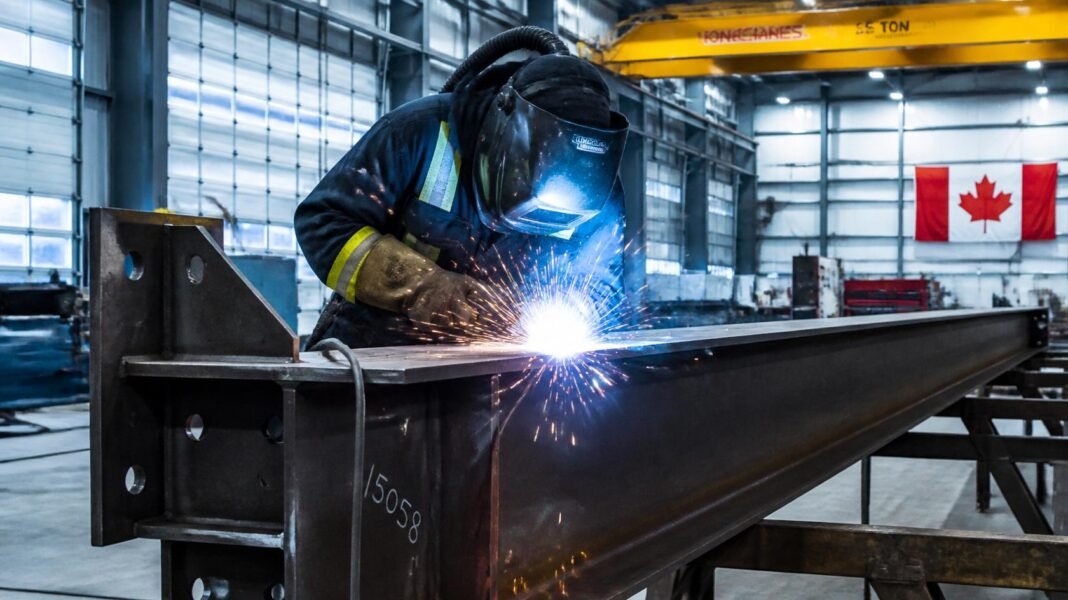
Canada’s welding and metal fabrication trades are staring down a shortage that has been building for years and is now colliding with an aging workforce, a national infrastructure push, and a federal government prepared to spend billions to fix it.
From cobots on shop floors in Ontario to a nationwide apprenticeship overhaul unveiled this spring, the response is broader and better funded than anything the sector has seen in decades.
The Scale of the Problem
Employment and Social Development Canada’s Job Bank rates welders as facing a moderate risk of labour shortage nationally through 2033.
That forecast sits on top of a decade of decline: welding-related employment has fallen at an average annual rate of roughly 1.3% over the past ten years, and headcounts remain below pre-pandemic levels even after a post-2020 recovery, according to the Canadian Welding Bureau (CWB) Group’s welding industry research.
The demographic math is unforgiving. As of 2023, 26% of Canadian welders were 50 or older, with the average retirement age sitting at 64.
CWB Group’s own analysis warns that welding certification requirements will outpace program completions between 2024 and 2028, putting most provinces at risk of shortfalls just as retirements accelerate.
Women remain almost entirely absent from the trade, making up only 3.9% of the workforce — a labour pool the industry has barely begun to tap.
The cost of inaction is already showing up on balance sheets. A Canadian Manufacturers & Exporters survey found labour and skills shortages cost the Canadian economy roughly $13 billion in a single year through lost sales, late-delivery penalties, and shelved capital projects.
Deloitte has projected as many as 2.1 million unfilled manufacturing jobs nationally by 2030 if current trends hold.
Ottawa’s $6-Billion Bet: Team Canada Strong
The most significant response so far came in April 2026, when Prime Minister Mark Carney unveiled Team Canada Strong as the centrepiece of the Spring Economic Update — a $6-billion, five-year plan to recruit, train, and certify 80,000 to 100,000 new Red Seal trades workers, welders prominent among them.
The package is built to remove friction at every stage of the apprenticeship pipeline:
- Recruitment: $2 billion over five years for paid, job-ready placements for young Canadians aged 15-30 that lead directly into registered apprenticeships, delivered through a new Build Canada Apprenticeship Service.
- Employer incentives: wage subsidies of up to $10,000 toward an apprentice’s first-year salary for small and medium-sized employers who hire and train.
- Training support: a $400 weekly top-up for apprentices attending mandatory in-class technical training, worth up to $16,000 total on top of Employment Insurance, backed by $3.4 billion in ongoing funding to keep apprentices from dropping out between training and permanent work.
- Completion incentives: a one-time $5,000 bonus for apprentices who complete Red Seal certification.
- Faster certification: $331 million to modernise the Red Seal Program itself, introducing online exams, digital logbooks, and a single national apprenticeship number, with a stated goal of cutting certification time in half.
The government has also earmarked $250 million to expand skilled trades training through the Canadian Armed Forces, including a new Reserve Trades Experience Pilot Program offering fully funded training in exchange for a period of reserve service — a direct pipeline aimed at fabrication, welding, and related trades on defence and infrastructure projects.
Industry groups have welcomed the scale of the commitment while flagging that the real test is implementation.
The Construction Labour Relations Association of BC has noted that Canada will need more than 1.4 million new tradespeople by 2033, describing the funding as a signal that the federal government is serious about building the workforce pipeline — while cautioning that many programme details are still being finalised.
Automation Steps In Where Labour Falls Short
While Ottawa works the policy side, fabrication shops are adapting on the floor. Rather than replacing welders, most shops are deploying collaborative robots — cobots — to extend the output of the skilled workers they already have, running repeatable high-volume welds while human welders handle complex, variable, or code-critical joints that robots still cannot reliably replicate.
Industry analysts tracking the sector into 2026 describe this as a shift from simple automation to what some call hyper-automation: CNC simulation, digital twins of complex parts before a single cut is made, and energy-efficient equipment aligned with Canada’s net-zero manufacturing commitments.
For small and mid-sized shops, this technology is becoming more accessible rather than remaining the preserve of large fabricators, narrowing the gap between shop floors that can absorb a labour shortage and those that cannot.
Reshoring pressure is compounding the effect. As global supply chains remain unsettled, more Canadian buyers are sourcing structural steel fabrication and CNC machining domestically rather than offshore — pushing additional volume onto a workforce that is already stretched, and adding urgency to the automation push.
Immigration and Credential Recognition
Immigration remains one of the fastest levers available. CWB Group data shows immigrants already make up about 18% of Canada’s roughly 80,900 welders, and industry lobby groups including Canadian Manufacturers & Exporters have pushed government to expand immigration pathways and speed up foreign credential recognition.
The Canadian Standards Association and CWB certify welders trained abroad, and a rising number of internationally certified welders are arriving in Canada already qualified to work — provided employers and provincial bodies can verify and place them efficiently.
Rebuilding the Training Pipeline
Team Canada Strong builds on an existing base of federal and provincial support: interest-free Canada Apprentice Loans of up to $20,000, Employment Insurance access during technical training blocks, and the Union Training and Innovation Program, which is being expanded to let union-run training centres upgrade facilities and equipment.
Provincial college programs — three-year apprenticeship tracks combining in-school blocks with on-the-job training, common across Ontario, British Columbia, and Atlantic Canada — remain the backbone of new welder certification, with CWB certification increasingly built into the curriculum so graduates leave job-ready.
Skills competitions run through Skills Canada and provincial affiliates such as Skills Ontario are also playing a recruitment role, giving high school and college students early, hands-on exposure to welding and fabrication careers before they commit to a training path.
What It Means for Fabricators and Shop Owners
- Budget for wage growth. CWB Group data shows average welder wages have been rising steadily since 2017, now averaging roughly $29.01 per hour, or about $62,200 annually — a trend likely to continue as demand outpaces supply.
- Engage early with Build Canada Apprenticeship Service subsidies once rolled out; the $10,000 first-year wage offset materially changes the economics of training your own workforce rather than competing for scarce certified hires.
- Evaluate cobots for repeatable, high-volume welds now, rather than waiting for a full labour crunch to force the decision — lead times on equipment and integration can run months.
- Build relationships with provincial apprenticeship bodies and union training centres benefiting from expanded federal funding; capacity at these centres is set to grow over the next five years.
The Road Ahead
None of these measures will close Canada’s welding and fabrication gap overnight. Red Seal certification still takes years, cobot integration requires capital most small shops must plan for carefully, and the success of Team Canada Strong depends on execution across provinces, unions, and employers that federal announcements cannot guarantee on their own.
But the combination of unprecedented federal funding, a maturing automation toolkit, and sustained immigration inflow marks the most coordinated response the sector has mounted in decades — and one that fabrication and manufacturing operators across Canada will be watching closely as it moves from announcement to implementation over the next twelve months.
Also Read
Top Robotic Welding Brands Leading Industrial Automation
Top Welding Certifications Required for Construction Projects in 2026

- From Operator to Algorithm: Bedrock Puts Autonomous Excavators to Work on Live Construction Sites - September 7, 2026
- Built For The Rough Stuff: Inside Titan’s new ForestEDGE™ Tyre Line - September 4, 2026
- South Africa Has R395 Billion in Infrastructure Projects — But Can the Industry Deliver Them? - August 26, 2026
