

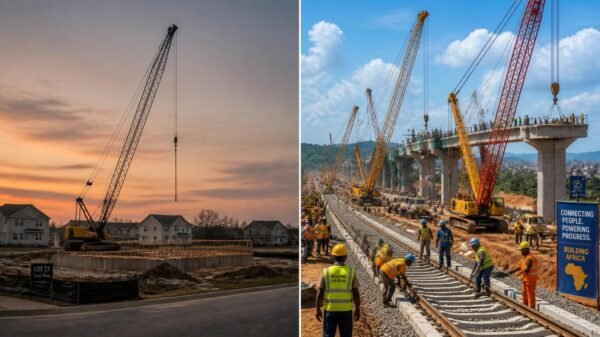
July 2026: US construction spending edged up 0.1% in May 2026 to a seasonally adjusted annual rate of $2.21 trillion, according to the latest US Census Bureau data. It sounds like a rounding error — because it is one.
The bigger story is what sits beneath it: spending remains 1.5% below where it stood a year ago, and the January-to-May total is running 2.7% behind the same stretch of 2025.
On paper, this is a US story. In practice, it’s a signal every African contractor, fleet manager and procurement officer should be watching closely.
The Numbers Behind the Slowdown
| Segment | May 2026 (SAAR) | Monthly Change | Year-over-Year |
|---|---|---|---|
| Total Construction Spending | $2.21 trillion | +0.1% | -1.5% |
| Private Construction | $1.67 trillion | ~ Flat | — |
| Residential | $930.2 billion | +0.3% | — |
| Non-residential | $738.7 billion | -0.3% | — |
| Public Construction | $541.2 billion | +0.5% | — |
| Highway | $150.6 billion | +0.6% | — |
| Education | $113.4 billion | +0.6% | — |
Source: U.S. Census Bureau. Seasonally Adjusted Annual Rate (SAAR), May 2026.
The breakdown tells a split story. Residential spending actually rose 0.3% to $930.2 billion, while non-residential construction slipped 0.3% to $738.7 billion — a sign that commercial and industrial building activity, the segment most tied to heavy equipment demand, is the softer half of the market.
Public construction fared better, up 0.5% to $541.2 billion, with highway spending and education projects both posting 0.6% gains as infrastructure funding continues to outperform private capital investment.
Why a Soft US Market Matters on This Side of the Atlantic
Equipment manufacturers — Caterpillar, Komatsu, Deere, and the dealer networks that supply African fleets — plan production, pricing and allocation around demand signals from their largest markets.
The United States remains the single largest construction equipment market in the world.
When American demand for machinery softens even modestly, manufacturers historically respond in one of two ways: they hold prices and absorb the margin hit, or they look to growth markets to fill the gap.
Africa increasingly looks like that growth market. The continent’s infrastructure pipeline is not slowing down — it is accelerating.
The Lobito Corridor rail project, Kenya’s Standard Gauge Railway extensions, Cameroon’s railway modernisation programme, South Africa’s Senqu Bridge works, and the wave of World Cup 2026-adjacent construction across multiple markets are all drawing on the same global pool of excavators, cranes, graders and haul trucks that American contractors are currently ordering less of.
What This Could Mean for African Buyers
Shorter Lead Times
Softer U.S. commercial equipment demand could ease pressure on global manufacturing order books, potentially shortening delivery times for new machinery through late 2026.
Stronger Buying Power
Manufacturers aiming to protect sales volumes may become more flexible on dealer financing, fleet discounts, and bulk purchase negotiations for African customers.
Selective Pricing Opportunities
Demand for highway and public infrastructure equipment remains resilient, meaning any pricing relief is more likely to be seen on earthmoving and commercial machinery than on road construction equipment.
A Counter-Cyclical Africa
What makes this moment notable is the divergence itself. US construction spending typically sets the tone for global equipment markets — when America builds, the world’s manufacturers follow.
But Africa’s infrastructure investment cycle, driven by sovereign infrastructure programmes, multilateral development financing, and mining and agriculture-linked logistics build-outs, is running on a different clock than US private commercial investment.
That decoupling is worth watching closely over the second half of 2026.
If US non-residential spending continues to soften while African rail, port and road programmes keep advancing on schedule, African markets could start to carry more weight in how global equipment makers allocate supply — a shift that would have been unthinkable a decade ago, and one that puts African procurement teams in a stronger negotiating position than they may realise.
What to Watch Next
The next US Census Bureau construction spending release, alongside second-quarter earnings from Caterpillar, Deere, and United Rentals, will show whether May’s softness is a blip or the start of a trend.
CCE News will track how any pricing or allocation shifts from major manufacturers flow through to African dealer networks in the coming months.
Also Read
South Africa’s Construction Sector Shows Tentative Signs of Recovery as Afrimat Index Edges Higher
The R33 Billion Rare Earth Opportunity: Why Investors Are Watching South Africa

She brings insightful analysis and in-depth reporting to the sector, highlighting innovations and developments that shape Africa’s built environment.
- Moldtech: Engineering Africa’s Next Generation of Precast Concrete Production - September 23, 2026
- How They Were Built: Inside the Construction of the Grand Ethiopian Renaissance Dam - September 4, 2026
- CNH Construction Sales Rise 12% as North American Demand Offsets Tariff Headwinds - August 3, 2026