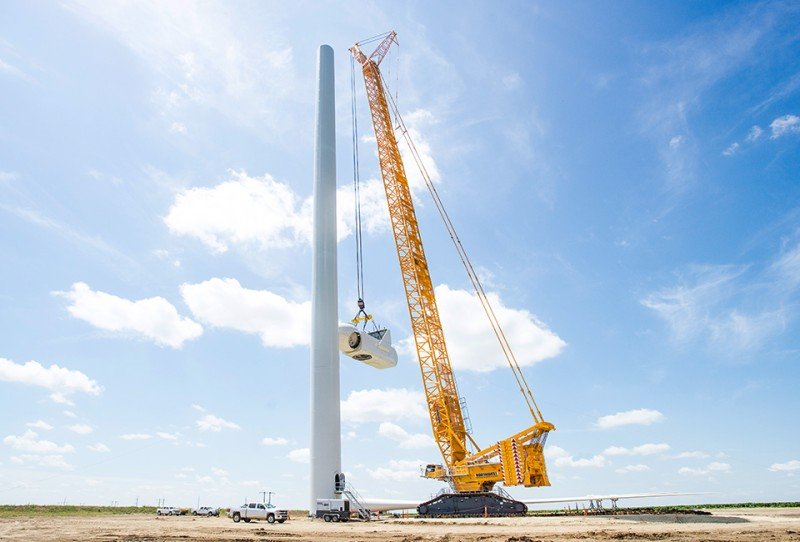
In the vocabulary of heavy construction, a crane is only mega when it does what no other machine on site can.
When a nuclear reactor dome must be lifted as a single prefabricated unit, when a 270-metre wind turbine blade needs threading into a hub at 150 metres above the ground, or when a 2,000-tonne petrochemical column must be placed with 20-millimetre tolerance — these are the moments that define the world’s largest crawler cranes.
Crawler cranes are the heaviest and most powerful mobile lifting machines in existence. Unlike tower cranes fixed to a single spot or mobile cranes that move on rubber tyres, crawler cranes move on continuous steel tracks, distributing immense weight across a broader footprint while retaining the ability to self-propel under load.
At the mega scale, they are complemented by ring cranes — fixed-ring machines that combine even greater lifting moments with the ability to travel along rail tracks, fully rigged, between lift positions.
The global mobile crane market was valued at USD 17.2 billion in 2024 and is forecast to reach USD 30.83 billion by 2033, driven by renewable energy megaprojects, nuclear new-build programmes, offshore oil and gas modularisation, and the accelerating scale of infrastructure construction worldwide.
At the very top of this market sits a small, elite class of machines with capacities measured in the thousands of tonnes — the true giants of lifting engineering.
This article goes inside those machines: how they work, where they work, who builds them, and what the future holds for the industry’s most spectacular heavy equipment.
2. The Machines at a Glance — Key Specifications
The world’s largest lifting machines span two design families — ring cranes and conventional crawler cranes.
Ring cranes achieve higher lifting moments through a circular rail system; conventional crawlers offer greater mobility across diverse terrain. Both push the boundaries of structural engineering.
| Crane | Type | Max Capacity | Max Hook Height | Notable Feature |
| Mammoet SK6000 | Ring crane | 6,000 t | ~220 m (at 3,000 t) | World’s strongest land crane; full electric |
| Sarens SGC-250 ‘Big Carl’ | Ring crane | 5,000 t | 250 m | Rail-mounted; 6 km of track at HPC |
| XCMG XGC88000 | Crawler crane | 3,600–4,000 t | 200+ m | Largest tracked mobile crane; dual-section |
| Liebherr LR 13000 | Crawler crane | 3,000 t | 248 m | Largest conventional crawler crane |
| Terex/Demag CC 8800-1 Twin | Crawler crane | 3,200 t (twin) | ~200 m | Twin configuration doubles capacity |
| Manitowoc 31000 | Crawler crane | 2,300 t | 220 m | Innovative Variable Position Counterweight |
| Liebherr LR 12500-1.0 | Crawler crane | 1,250 t | ~190 m | Compact; ships in standard containers |
Note: Ring crane capacities (SK6000, SGC-250) reflect maximum lifting moment ratings and differ from conventional crawler specifications. Actual lift capacities vary significantly by radius, boom configuration, and ground conditions.
3. How It Works — The Technology in Simple Terms
A crawler crane lifts through the interaction of four fundamental systems: the superstructure (slewing body, boom, and hoisting mechanism), the carrier (the tracked undercarriage that supports and moves the machine), the counterweight system (which balances the load), and the lattice boom (a steel framework that transmits load forces to the ground through the mast and back stays).
At the mega scale, each of these systems faces engineering challenges that require novel solutions. The key technologies that define the world’s largest machines include:
- Lattice boom systems: Unlike the telescopic booms on smaller cranes, mega crawlers use interlocking steel lattice sections bolted together on site. The lattice distributes bending forces across a wider cross-section, allowing boom lengths exceeding 160 metres without catastrophic buckling. The XCMG XGC88000, for example, supports a main boom of up to 144 metres and a total system length — including the counterweight radius — of 173 metres.
- Ring crane design: The Mammoet SK6000 and Sarens SGC-250 use a large-diameter steel ring track as their foundation. The superstructure rotates around the ring, distributing ground pressure across a dramatically larger footprint than conventional crawlers. The SK6000 innovates further by placing its 4,200-tonne ballast at the centre of the ring and rotating around it — cutting the crane’s working footprint in half compared to traditional ring crane designs.
- Variable Position Counterweight (VPC): Manitowoc’s 31000 pioneered this technology, where the counterweight moves dynamically along the rotating bed based on boom angle and load weight. Rather than a fixed counterweight sized for the worst-case lift, the VPC provides exactly the stabilising moment required for each configuration — improving safety, reducing ground preparation requirements, and enabling a smaller crane footprint.
- Multi-engine hydraulic systems: The XGC88000 uses three 641 kW Cummins engines producing a combined 1,923 kW (2,579 HP). This triple-engine configuration provides both propulsion and hydraulic lifting force, with each engine capable of serving as a backup power source during critical lifts. The redundancy is essential: losing power mid-lift with thousands of tonnes suspended overhead is not an option.
- Ground bearing pressure management: A 6,000-tonne crane cannot simply stand on unprepared ground. The SK6000 is engineered to a maximum ground bearing pressure of 30 tonnes per square metre — requiring extensive temporary works (crane mats, cribbing, and ground improvement) at most sites. The SGC-250 at Hinkley Point C required 6 kilometres of permanent rail track, allowing it to travel between three lifting zones fully rigged.
| HOW BIG IS BIG CARL?
At 50 metres radius, the Sarens SGC-250 can lift the equivalent of 32 single-storey houses or 1,600 cars simultaneously. Its counterweight system uses 52 shipping containers, each filled with 100 tonnes of locally-sourced material — the same containers used to transport the crane to site. The crane travelled to Hinkley Point C in 280 lorry loads from its base in Antwerp, via Avonmouth Docks. |
4. Where It’s Used — Projects and Industries
The world’s largest crawler and ring cranes are purpose-built for a narrow but growing category of project — where loads exceed what any standard crane fleet can achieve, and where prefabricated modular construction demands the ability to lift entire building sections into place as single units.
Nuclear power construction is the most demanding application, and the one that drove the creation of Big Carl.
At EDF’s Hinkley Point C in Somerset, UK — the UK’s largest infrastructure project — the Sarens SGC-250 is lifting over 700 prefabricated components, including three 47-metre-diameter steel rings, each forming part of the reinforced containment cylinder around a nuclear reactor.
The largest of these lifts weighs over 1,000 tonnes. Prefabrication at this scale is only possible because of the crane’s capacity; without it, each ring would need to be assembled piece-by-piece in situ at far greater time and cost.
Petrochemical and refinery megaprojects are the primary market for China’s giant crawlers.
The XCMG XGC88000 has worked across China’s largest refining and chemical integration projects, including lifting a 2,000-tonne washing tower — 102 metres tall and 9 metres in diameter — at the Gulei Refining and Chemical Integration Project in Zhangzhou.
It completed the world’s heaviest washing tower installation by a crawler crane, placing the upper half onto the lower section at 50 metres height with a maximum tolerance of 20 millimetres.
Offshore wind energy is the fastest-growing new market for mega cranes.
As wind turbine components grow in scale — the XGC88000 lifted an 18 MW turbine in a coastal shipyard in 2024, with a blade tip height of nearly 270 metres and a hub weight of 800 tonnes — conventional cranes no longer have the reach or capacity to handle assembly.
The Mammoet SK6000 was specifically designed with next-generation offshore wind in mind: its ability to lift 3,000 tonnes to 220 metres ensures it can handle turbine foundations and nacelles that do not yet exist commercially but are in planning today.
Oil and gas floating production (FPSO and FLNG): Topsides for floating production vessels are among the heaviest single-lift objects in offshore construction, often weighing several thousand tonnes.
Modular construction — building the topsides in multiple large sections ashore, then lifting them into position — requires exactly the capacity the SK6000 and its predecessors offer. Reducing the number of lifts reduces offshore installation time, which is the most expensive phase of any FPSO project.
Infrastructure megaprojects — bridge sections, tunnel boring machine components, stadium roof elements, and large-span structural modules — increasingly demand crawler cranes in the 500 to 1,500-tonne class.
The Liebherr LR 12500-1.0 has demonstrated this capability by lifting 1,400-tonne monopiles for offshore wind farms in Germany, while fitting within 3.5-metre transport width constraints.
5. Notable Manufacturers — The Companies Behind the Giants
The market for mega crawler cranes is dominated by a handful of highly specialised manufacturers operating at the intersection of structural engineering, hydraulics, and global project management.
Their machines are rarely purchased outright; instead, they are operated by specialist heavy lift contractors who deploy them on specific projects under long-term contracts.
Mammoet (Netherlands) — Founded in 1807 and headquartered in Schiedam, Mammoet is the world’s largest engineered heavy lifting and transport company.
Its SK6000 ring crane, launched in August 2024 after a production programme that began in late 2022, claims the title of the world’s strongest land-based crane with a 6,000-tonne maximum capacity.
Production involved hundreds of engineers and specialists across Mammoet’s global network. The crane features full electric capability, operating either from grid power or large battery packs — a first for a machine at this scale.
Gavin Kerr, Director of Global Services at Mammoet, said the SK6000 was a feat with ‘a production schedule to match’ and that ‘there are very few companies on Earth — if any — that could have brought this crane into reality.’
Sarens (Belgium) — Founded in 1921 as a forestry transport company and headquartered in Wolvertem, Sarens has grown into a global heavy lift specialist.
The SGC-250 ‘Big Carl’ — named after Carl Sarens, Director of Technical Solutions and great-grandson of founder Frans Sarens — involved 16,000 hours of R&D, 6,000 hours of CAD design, and more than 25,000 hours of specialist design work before construction began in August 2017.
It was completed 14 months later and officially launched in November 2018. Wim Sarens, CEO, described the SGC-250 as ‘the largest crane in the world in terms of size and capacity’ in terms of the combination of those two factors. The company is developing a fourth-generation SGC crane, details of which remain confidential.
XCMG — Xuzhou Construction Machinery Group (XCMG) is a Chinese state-linked OEM and one of the largest construction equipment manufacturers in the world.
The XGC88000 was developed jointly with Sinopec following an agreement signed in 2010 and debuted in production in 2013, where it surpassed the Liebherr LR 13000 as the largest mobile crawler crane by rated capacity.
XCMG invested in 80-plus national patents and three world-leading technological innovations to bring the machine to production.
In 2024, the company deployed the XGC88000 in offshore wind turbine installation for the first time, lifting an 18 MW turbine in Yingkou — the first instance of a 4,000-tonne class crane operating in luffing jib configuration.
Liebherr (Germany/Switzerland) — The German-Swiss multinational is the global market leader for mobile and conventional crawler cranes across standard capacity classes.
Its LR 13000 — with a 3,000-tonne maximum lifting capacity and 248-metre maximum hook height — is described by Liebherr as ‘the most powerful conventional crawler crane in the world.’
The LR 12500-1.0 followed in 2022, featuring Liebherr’s HighPerformance Boom and a shipping configuration compact enough to fit in standard 20-foot containers. Major heavy lift operators including Sarens and Mammoet have added the LR 12500-1.0 to their fleets.
Manitowoc (USA) — Headquartered in Manitowoc, Wisconsin, the company has over a century of crane manufacturing history.
Its 31000 model — the largest crawler crane ever built by Manitowoc, with a 2,300-tonne capacity — pioneered the Variable Position Counterweight system now widely regarded as an industry benchmark.
The crane is widely used in heavy industrial projects, including power plant construction, and is driven by twin Cummins QSX15 diesel engines producing 600 horsepower each.
6. Record-Breaking Facts — Biggest, Tallest, Heaviest
| WORLD’S STRONGEST LAND-BASED CRANE (2024–PRESENT)
The Mammoet SK6000, launched August 2024, holds the title with a 6,000-tonne maximum capacity and the ability to lift 3,000 tonnes to 220 metres. It uses 4,200 tonnes of ballast and operates on full electric power. Assembly was completed at Mammoet’s Westdorpe facility in the Netherlands during Q4 2024. |
| WORLD’S LARGEST RING CRANE BY SIZE AND CAPACITY COMBINATION (2018–2024)
The Sarens SGC-250 ‘Big Carl’ stood as the largest crane in the world from its 2018 launch until the SK6000 arrived. It stands up to 250 metres tall — taller than One Canada Square at Canary Wharf — and can carry 5,000 tonnes. At Hinkley Point C, it will complete over 700 lifts during a contract running across the entire construction programme. |
| WORLD’S LARGEST TRACKED MOBILE CRANE
The XCMG XGC88000, in production since 2013, holds the record for the largest capacity tracked mobile crawler crane, with a rated capacity of 3,600–4,000 tonnes and a total operating weight of 5,350 tonnes. During commissioning tests in November 2012, it successfully lifted a 4,500-tonne test load — 500 tonnes above its rated capacity — at 60 metres of main boom. |
| HEAVIEST WASHING TOWER INSTALLATION BY A CRAWLER CRANE
In May 2020, the XGC88000 installed a 2,000-tonne EO/EG washing tower — 102 metres tall and 9 metres in diameter — at the Gulei Refining and Chemical Integration Project in Zhangzhou, China. The upper half was positioned onto the lower section at 50 metres height with a maximum allowable gap of 20 millimetres between sections. |
| FIRST 4,000-TONNE CRAWLER CRANE IN OFFSHORE WIND (2024)
In July 2024, the XCMG XGC88000 completed the first-ever installation of an 18 MW offshore wind turbine at a shipyard in Yingkou, China. The turbine had a hub centre height of 145 metres and a blade tip height of nearly 270 metres. The 126-metre blade required precise insertion of over 170 bolts at 150 metres above ground — described as ‘threading a needle at high altitude.’ |
| LONGEST CONTINUOUS LIFT CONTRACT FOR A MEGA CRANE
The Sarens SGC-250 was contracted to Hinkley Point C for a minimum of four years at a contract value of £20 million, operating across 6 km of permanent rail track — an industry first for a fully rigged crane at this scale. The rail enables the crane to travel between three lifting zones without disassembly. |
| LARGEST CONVENTIONAL CRAWLER CRANE
The Liebherr LR 13000, with its 3,000-tonne maximum capacity and maximum hook height of 248 metres, is the most powerful conventional crawler crane in the world — meaning it does not require a derrick system, giving it a more compact configuration for sites where space is constrained. It has been deployed extensively in nuclear power plant and petrochemical construction. |
7. The Future — Electrification, AI, and the Next Generation of Giants
The world’s largest crawler cranes are being shaped by the same forces transforming every sector of heavy construction: decarbonisation mandates, the explosive growth of offshore wind, and the integration of digital and autonomous systems. The trajectory is unmistakable — future mega cranes will be cleaner, smarter, and larger still.
Electrification is already here at the mega scale. The Mammoet SK6000 was designed from the outset for full electric operation, drawing from the grid or from large battery packs — eliminating diesel exhaust entirely on sensitive construction sites.
The SGC-90 (‘Little Celeste’), Sarens’ fourth SGC-series crane built during the COVID-19 period, is a fully electric crane capable of lifting 1,650 tonnes that can generate its own power on site.
At the 300-tonne class, Liebherr debuted the LR 1300.2 SX Unplugged at Bauma 2025 in Munich — the first fully battery-powered version of its LR 1300 series, one of the most commercially successful crawler cranes in history with nearly 1,000 units deployed globally.
The 300-tonne electric machine carries a 392 kWh battery and a 438 kW electric motor, delivering up to 13 hours of operation on a single charge with a recharge time of between 4.5 and 8.5 hours. Critically, the crane continues operating during charging.
Liebherr’s Holger Streitz noted that customers appreciated ‘the quietness of the machine, the local zero emissions’ as much as its performance characteristics — signalling that electrification is becoming a procurement requirement, not just an option.
Digital and autonomous systems are advancing rapidly across the crane sector. Liebherr won the Bauma 2025 innovation award in the digitalisation category for its ‘Liebherr Autonomous Operations’ system, which enables wheel loaders — and in development, cranes — to perform repetitive tasks without a driver.
Load moment monitoring, anti-sway control, real-time centre-of-gravity calculation, and collision avoidance are becoming standard on new machines, reducing operator error in the most critical moments of a lift.
The scale of components driving demand continues to grow. Next-generation offshore wind turbines are approaching 25 MW capacity, with rotor diameters exceeding 300 metres and nacelle weights that no crane in existence can currently install.
The SK6000 was designed precisely to address this incoming demand — ensuring that wind farms planned today can be executed when turbines reach commercial production.
The nuclear sector is expanding globally, with new plants approved across the UK, France, India, Poland, and multiple African nations, each requiring the kind of mega-lift capability that only ring cranes can deliver.
There are strong indications that the next generation of mega cranes will exceed the SK6000’s 6,000-tonne capacity.
A Sarens representative hinted at a new SGC crane in development during 2025, and XCMG has continued iterating on the XGC88000 platform with new configurations for offshore and wind applications.
The global crane market is expected to grow from USD 18.35 billion in 2025 to USD 30.83 billion by 2033 — and at the apex of that market, the machines are only getting bigger.
Also Read
Mega Machines: The World’s Largest Motor Graders
Mega Machines: The World’s Most Powerful Drilling Rigs

- How They Were Built: Inside the Engineering of the Lesotho Highlands Water Project - October 11, 2026
- Africa’s Water Reuse Opportunity: Building the Infrastructure for a Water-Secure Future - September 28, 2026
- Why Water Reuse Is Becoming a Business Imperative for African Industry - September 28, 2026