

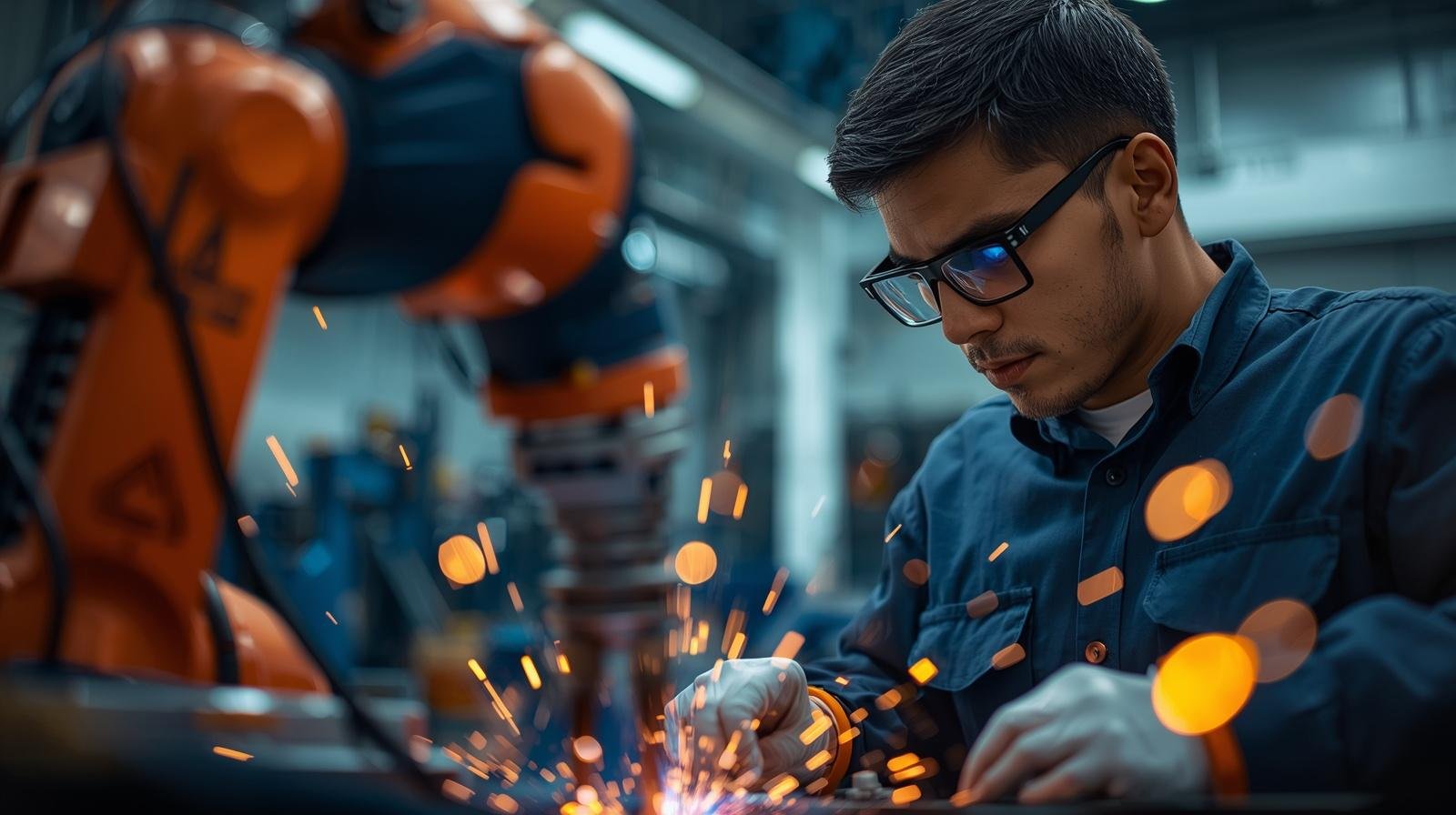
Walk through a forward-thinking metal fabrication shop today and the differences from a decade ago are striking. CNC laser cutters run overnight with no operator in sight.
Collaborative robots share floor space with human technicians, handling the repetitive torch passes that once caused injury and fatigue.
Quality cameras inspect every weld bead in real time. And a manufacturing execution system ties the entire operation together, pushing live data into the front office within seconds of a job completing.
This is not a vision of a distant future — it is the competitive baseline that progressive fabricators are establishing right now.
For owners and production managers evaluating their next capital investment, the question is no longer whether to automate, but how to sequence that journey intelligently.
The Business Case Has Never Been Stronger
Two converging pressures are pushing fabrication shops toward automation at an accelerating pace: a persistent skilled-labour shortage and relentless margin compression.
According to data from the American Welding Society, the United States alone was projected to face a shortage of 314,000 welders by 2024 — a deficit that has not eased as demand for fabricated steel in construction, infrastructure and renewable energy continues to climb.
Globally, the industrial robot installation count reached 542,076 units in 2024 and is forecast to surpass 700,000 annual installations by 2028, according to the International Federation of Robotics.
Welding remains one of the top three application segments for industrial robotics, alongside material handling and assembly.
The market for robotic welding systems alone is projected to grow from USD 10.38 billion in 2025 to USD 16.87 billion by 2030 — a compound annual growth rate of 10.2%.
Fabricators that embrace AI-driven automation are reporting higher margins, fewer defects and stronger positioning with OEM customers.
These are not abstract market statistics. They translate directly into competitive dynamics on the shop floor.
Fabricators that invest in automation are shortening lead times, tightening tolerances and quoting with greater confidence — and winning contracts from competitors still reliant on manual processes.
Robotic Welding: From Automotive Niche to Mainstream Fabrication
Robotic welding has its origins in the automotive industry of the 1960s, but the technology has matured enormously.
Modern robotic welding systems divide broadly into three categories: fully automated industrial robot cells for high-volume, low-mix production; semi-automated positioning and fixture systems that augment a skilled welder’s reach; and collaborative robots — cobots — that work safely alongside human operators without requiring extensive guarding infrastructure.
Cobots represent the most accessible entry point for small and mid-sized fabrication shops. Unlike their caged industrial predecessors, cobots can be programmed intuitively, repositioned quickly and deployed in high-mix, lower-volume environments where jobs change frequently.
Their ability to perform continuous welds without fatigue directly addresses the throughput bottleneck that labour shortages create, while their advanced sensors allow them to adapt in real time to minor variations in part fit-up — a capability that was previously the exclusive domain of an experienced welder.
The safety dividend is equally significant. With over 560,000 welding-related injuries occurring annually in the United States, putting robots on the torch for high-exposure passes reduces workers’ compensation liability and helps shops retain the skilled technicians they do have.
Laser Cutting: Where Automation Delivers the Fastest ROI
For many fabrication shops, automated laser cutting is where the automation journey begins — and for good reason.
Modern fibre laser systems paired with automated loading, unloading and stacking towers can transform a two-shift, three-person operation into a single-operator cell running lights-out across extended hours.
One operator overseeing a system that previously required three to five workers is a realistic outcome with current technology.
The economics are compelling at moderate utilisation levels.
If a laser cutter is running two or more shifts per day, five or more days per week, the ROI case for automation is strong: reduced labour cost per part, faster cycle times, lower scrap through AI-powered nesting algorithms that optimise how parts are laid out on the sheet, and dramatically reduced downtime through predictive maintenance that identifies potential failures before they interrupt production.
Tube laser cutting systems offer an additional efficiency layer by consolidating drilling, notching and coping into a single automated process — eliminating multiple setups and the material handling between them.
For structural steel fabricators serving the construction sector, this is a direct route to reducing job costs and shortening delivery schedules.
AI and the Intelligent Shop Floor
Artificial intelligence is no longer confined to research labs or large-scale automotive plants.
In 2025 and 2026, AI applications have moved squarely into production cells at fabrication shops of all sizes. The most impactful use cases include:
- Vision-based quality control that inspects every bend, weld and cut in real time — catching defects before they reach the next operation and generating traceability data that customers increasingly require.
- Predictive maintenance algorithms that monitor vibration, temperature and power consumption to identify equipment degradation patterns before unplanned stoppages occur, cutting downtime by double digits at early adopters.
- AI-powered nesting software that reduces material waste in laser cutting and punching operations by dynamically optimising part layouts based on real-time material inventory and job priority.
- Smart production planning systems that sequence jobs to account for downstream bottlenecks — ensuring the output of an automated laser cell does not overwhelm the press brake or welding stations it feeds.
This last point is critical and often overlooked. Investing in laser automation without mapping the entire value stream can simply move the bottleneck rather than eliminate it.
A new fibre laser doubling output is only valuable if bending, welding and finishing capacity can absorb the surge.
Digital Integration: Connecting the Shop Floor to the Front Office
The most transformative automation investments are those that close the information loop between machines, production management and business systems.
Modern fabrication shops are integrating CNC machines and robotic cells with Manufacturing Execution Systems and Enterprise Resource Planning platforms to create a continuous flow of data across the entire operation.
The practical benefits are substantial. Real-time machine data enables accurate job costing — because quotes are based on actual machine performance rather than historical estimates.
Production managers gain live visibility into queue lengths, bottlenecks and downtime events. Inventory systems automatically update as material is consumed. Customer orders trigger production jobs without manual data re-entry.
The ERP software market serving the metal fabrication industry is projected to grow at a CAGR of 6.8% through 2033, reflecting accelerating adoption as shops recognise that digital integration amplifies the value of every hardware investment.
A robotic welding cell operating in isolation delivers incremental throughput. The same cell connected to an MES and ERP delivers that throughput with full traceability, accurate job costing and real-time scheduling visibility.
Workforce: Automation Changes the Roles, Not the Headcount
One of the most persistent concerns about automation among fabrication shop owners is its impact on employment.
The operational evidence from shops that have automated suggests the reality is more nuanced than the fear. Automation does not remove the need for skilled labour — it changes where that labour adds the most value.
Laser operators move from manual sheet handling to system oversight, quality verification and production coordination.
Welders transition from repetitive torch passes to programming, fixture design and supervising robotic cells handling complex assemblies.
A more automated shop requires higher-skilled programming and maintenance capability — roles that are better compensated, more sustainable as careers and more effective at attracting the next generation of manufacturing talent.
Shops that communicate this strategic shift clearly tend to find that automation investments strengthen their ability to hire and retain staff, rather than undermining it.
A Practical Roadmap for Fabricators
For fabrication shops at the beginning of their automation journey, a phased approach reduces risk while delivering measurable returns at each stage:
- Phase 1 — Software first: Deploy AI nesting software and integrate existing machines with an MES. Immediate gains in material utilisation and production visibility with minimal capital outlay.
- Phase 2 — Targeted hardware: Add automated loading and unloading to the highest-utilisation laser or punch. Address the single largest manual handling bottleneck in the current flow.
- Phase 3 — Robotic welding: Introduce a cobot welding cell on the highest-volume, most repeatable weld sequences. Capture throughput gains while building in-house programming competency.
- Phase 4 — Full integration: Connect all machines and cells to a unified MES/ERP environment. Implement digital twins for virtual prove-outs, energy monitoring and closed-loop optimisation.
The order matters. Automating a process that is not yet stable or standardised simply accelerates the production of defects.
The discipline of identifying the highest-value, most repeatable operations and addressing software before hardware is what separates successful automation projects from costly ones.
Conclusion
The fabrication shops that will define the industry in the next decade are not waiting for automation to become cheaper or simpler.
They are building the capability now — incrementally, deliberately and with a clear-eyed understanding of where technology delivers the highest return.
From robotic welding and fibre laser automation to AI quality control and full digital integration, the tools exist today to build a fabrication operation that is faster, safer and more profitable than anything that manual processes alone can sustain.
For decision-makers evaluating capital investments in 2026, the central question is not whether automation makes business sense — the data is unambiguous on that point.
The question is which part of the value chain to address first, and how to sequence the journey to capture the fastest returns while building the organisational competency to sustain continuous improvement.
Also Read
Novarc and Hanwha Ocean Partner to Advance AI-Powered Shipbuilding and Welding Automation
Top Robotic Welding Brands Leading Industrial Automation

- Accurate and Reliable Measurement and Monitoring of Industrial Plant Water Treatment - October 21, 2026
- SODECA Highlights Industrial Ventilation Technology at Mega Clima Expo Kenya 2026 - October 14, 2026
- How They Were Built: Inside the Engineering of the Lesotho Highlands Water Project - October 11, 2026