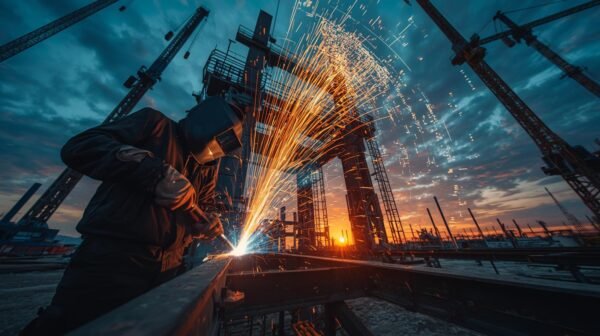
Construction is unforgiving. A single compromised weld on a steel-framed high-rise, a pipeline under thousands of PSI, or a bridge bearing thousands of tons of daily traffic can lead to catastrophic failure.
That is why the demand for certified welders — professionals who have been rigorously tested and verified — has never been higher than it is in 2026.
Across the globe, construction projects are growing larger, more complex, and more technically demanding.
From mega-infrastructure corridors in East Africa to offshore wind farms in the North Sea and liquefied natural gas terminals in the Middle East, structural welding is at the heart of it all.
And with stricter international safety codes, tighter insurance requirements, and growing regulatory scrutiny, welding certifications are no longer just a professional credential — they are a contractual and legal requirement on most major projects.
In 2026, construction companies that fail to field certified welders on site risk contract disqualification, costly project delays, and potential liability for structural failures.
This guide breaks down the most critical welding certifications required today, the sectors driving demand, and what construction and fabrication companies need to know to stay competitive and compliant.
Why Welding Certifications Matter in Construction
Safety First — and Always
Welding on construction sites involves extreme heat, high-pressure materials, electrical hazards, and working in confined or elevated spaces.
The welding safety standards enforced by bodies like the American Welding Society (AWS), OSHA in the United States, and the ISO internationally exist because the consequences of poor welding are not just structural — they are life-threatening.
A certified welder has demonstrated, through standardized testing, that they can execute welds consistently to specification under real-world conditions.
Structural Integrity and Load Bearing Reliability
In steel fabrication and structural construction, the quality of a weld directly determines whether a structure meets its load-bearing design.
Poor penetration, porosity, or cracking in a weld can compromise an entire joint — and joints are where stress concentrates. Welding certification verifies that professionals understand metallurgy, heat input control, filler material selection, and post-weld treatment requirements.
Regulatory Compliance and Legal Liability
Most national building codes and international project specifications now mandate that welders on structural projects hold current, verifiable certifications.
In the European Union, EN ISO 9606 is increasingly required on public contracts. In North America, AWS D1.1 structural welding compliance is standard.
Non-compliance can void project warranties, trigger insurance disputes, and expose contractors to legal action in the event of failure.
Project Quality Assurance and Reputation
For contractors bidding on high-value industrial welding projects, the ability to demonstrate a workforce of certified welders is a competitive differentiator. Clients — particularly government bodies, multinational energy companies, and institutional developers — increasingly audit welding compliance documentation before awarding contracts.
The Most Important Welding Certifications in 2026
AWS Certified Welder Program
The AWS Certified Welder program, administered by the American Welding Society, is the most widely recognized welding credential in North America and is increasingly accepted on international projects.
It tests welders on specific processes — including Shielded Metal Arc Welding (SMAW), Gas Metal Arc Welding (GMAW), Flux-Cored Arc Welding (FCAW), and Gas Tungsten Arc Welding (GTAW) — across various positions and material types.
AWS certifications are process- and position-specific, meaning a welder certified for flat-position GMAW on carbon steel must test separately for overhead or vertical work.
This granularity is intentional: it ensures that every certified welder has proven competency in the exact conditions they will encounter on site.
AWS Certified Welding Inspector (CWI)
The AWS Certified Welding Inspector credential is arguably one of the most valuable in the entire construction welding ecosystem.
CWIs are responsible for reviewing weld procedures, inspecting completed welds for defects, ensuring welding inspection documentation is accurate, and verifying that projects comply with applicable codes.
On any major structural or industrial project, an independent or in-house CWI is typically required.
Candidates must pass a rigorous three-part exam covering fundamentals, practical inspection, and code knowledge, as well as meet minimum education and experience thresholds.
In 2026, CWIs are in exceptionally high demand given the global construction boom and tightening compliance requirements.
ASME Welding Certifications
For pressure vessels, boilers, and piping systems — common in industrial plants, refineries, and power generation — the American Society of Mechanical Engineers (ASME) certification framework under Section IX of the Boiler and Pressure Vessel Code is the global standard.
ASME-certified welders and welding procedures are required on virtually every pressure-rated system in the world.
Companies operating in the energy, chemical processing, and heavy manufacturing sectors cannot legally commission systems without ASME-compliant welding documentation.
ISO 9606: International Welder Qualification
ISO 9606 is the international standard for qualification testing of welders, covering fusion welding of steels (Part 1) through nickel alloys and other specialty materials.
As construction welding increasingly crosses borders, ISO 9606 has become the preferred international framework, especially in the European Union, the Middle East, and across Africa where international project financing often mandates globally recognized credentials.
The standard assesses welders on specific welding processes, joint configurations, material groups, filler materials, and position requirements — producing a qualification document that is transferable and verifiable across countries.
API 1104: Pipeline Welding Certification
The American Petroleum Institute’s API 1104 standard governs welding on oil and gas pipelines.
With massive pipeline infrastructure projects underway in Africa, the Caspian region, and Southeast Asia, API 1104-qualified welders are among the highest-paid and most sought-after professionals in industrial welding.
The standard covers both onshore and offshore pipeline welding, automated processes, and repair procedures, and requires periodic re-qualification to remain valid.
Structural Welding Certification (AWS D1.1)
AWS D1.1 is the Structural Welding Code for steel, and structural welding certification under this code is required for welders working on steel-framed buildings, bridges, stadiums, and similar load-bearing structures.
It covers qualification requirements for both welders and welding procedures, and is referenced by building codes across North America and increasingly adopted internationally. In 2026, any welder on a structural steel project without D1.1 qualification is a compliance liability.
Underwater Welding Certification
Underwater or hyperbaric welding is one of the most specialized and hazardous disciplines in the industry, required for offshore platforms, subsea pipelines, port infrastructure, and bridge foundations.
Certification typically requires commercial diving qualifications combined with welding credentials from bodies such as the AWS, the Association of Diving Contractors International (ADCI), or the International Marine Contractors Association (IMCA).
Given the physical and technical risks, underwater welding certification programs are among the most demanding available.
Robotic and Automated Welding Certifications
As manufacturing and prefabrication facilities integrate robotic welding cells, a new certification category has emerged: robotic welding operators and programmers.
Credentials offered through AWS, the Robotic Industries Association (RIA), and equipment manufacturers like FANUC and ABB verify that technicians can program, monitor, and maintain automated welding systems.
In 2026, these certifications are increasingly required in steel fabrication shops and modular construction yards where automated systems handle high-volume repetitive welds.
Growing Demand for Certified Welders Across Key Sectors
Infrastructure Expansion
Governments globally are investing heavily in transport, energy, and water infrastructure. The U.S. Infrastructure Investment and Jobs Act, the EU’s infrastructure modernization agenda, and national development plans across Asia and Africa are collectively adding hundreds of billions in construction value — all of it steel-intensive and weld-dependent.
Renewable Energy Projects
Wind towers, solar mounting structures, hydrogen pipeline networks, and offshore platforms for tidal and wave energy are rapidly expanding the demand for qualified structural welders. Many of these projects require both AWS and ISO 9606 credentials, plus specialized training in working with high-strength steels and duplex stainless materials.
Shipbuilding and Maritime Construction
Naval and commercial shipbuilding is experiencing a resurgence globally, driven by defense spending and the re-routing of global supply chains. Shipbuilding remains one of the most weld-intensive industries, with specific certifications required under the standards of classification societies like Lloyd’s Register, Bureau Veritas, and DNV.
Oil, Gas, and Petrochemicals
Despite the energy transition, oil and gas infrastructure remains a major employer of industrial welding professionals. LNG terminals, refinery upgrades, and midstream pipeline projects require ASME, API 1104, and often AWS CWI oversight.
Africa’s Construction Boom
Africa deserves specific attention in any 2026 analysis of construction welding. The continent is experiencing some of the world’s fastest infrastructure growth rates.
Projects like the Standard Gauge Railway expansion in East Africa, the Lobito Atlantic Railway Corridor in Central Africa, major port developments along the West African coast, and large-scale energy projects under initiatives like Mission 300 represent enormous demand for skilled, certified welders.
African construction companies and governments are increasingly requiring ISO 9606 and AWS-aligned credentials to satisfy international lenders and project developers.
Local training institutions in Kenya, Nigeria, South Africa, Ghana, and Egypt are expanding welding certification programs, and international contractors are actively seeking locally certified talent.
For African welding professionals, obtaining internationally recognized credentials in 2026 is one of the highest-return career investments available.
How Technology Is Changing Welding Certification
AI-Assisted and Automated Welding
Machine learning systems can now monitor weld pools in real time, adjust parameters automatically, and flag anomalies that human operators might miss.
As these systems proliferate, certification bodies are developing new credentials for technicians who oversee AI-driven welding systems, combining process knowledge with data literacy.
Digital Inspection and Non-Destructive Testing (NDT)
Traditional visual inspection is being supplemented and in some cases replaced by phased array ultrasonic testing (PAUT), digital radiography, and automated weld inspection systems. Welding inspection professionals in 2026 need familiarity with these digital tools, and AWS and ASME are updating CWI and inspector qualification programs accordingly.
Virtual Reality Welding Simulators
Companies like Lincoln Electric and Miller Electric now offer sophisticated VR welding training simulators that allow trainees to practice technique, receive real-time feedback, and log documented training hours — all without consuming materials or producing hazardous fumes.
In 2026, VR simulation hours are recognized in several certification pathways as supplementary training evidence, accelerating the pipeline of certified welding professionals.
Common Challenges Facing Welding Professionals and Companies
The welding industry is contending with a significant skills shortage. Retirements are outpacing new entrants in many markets, and the technical complexity of modern construction welding is raising the bar for entry-level qualification.
For professionals already in the field, recertification requirements — AWS Certified Welder credentials must typically be renewed every three years — represent ongoing time and cost commitments.
For smaller contractors, the cost of sending welders through formal certification programs, particularly internationally recognized ones, can be substantial.
However, the alternative — fielding uncertified welders on projects where compliance is audited — carries far higher risk in the form of rework, contract penalties, and reputational damage.
Adapting to new technologies is also a genuine challenge. Welders trained exclusively on traditional SMAW or GMAW processes need upskilling to work alongside robotic systems, interpret digital NDT reports, and operate advanced power sources with microprocessor-controlled parameters.
Tips for Construction Companies Hiring Certified Welders
When onboarding welders for a project, construction and fabrication companies should verify:
Certification currency: Confirm that credentials are within their validity period. AWS Certified Welder cards include expiration dates; request copies and cross-check against the AWS registry where possible.
Scope of qualification: Ensure the welder’s certification covers the specific process, position, material type, and thickness range required for the project. A welder qualified for 6mm carbon steel plate does not automatically qualify for 25mm or for stainless steel.
Safety records: Review incident history and any OSHA or equivalent regulatory citations. Welding safety standards compliance should be non-negotiable.
Welding Procedure Specification (WPS) familiarity: Certified welders should be capable of reading and following a Welding Procedure Specification without supervision. Confirm this during onboarding.
Welding compliance documentation: Ensure all welder qualification records (WQRs) and procedure qualification records (PQRs) are on file and available for client or third-party auditor review.
Future Trends in Welding Certifications
Looking beyond 2026, several trends will reshape how welding credentials are earned, maintained, and verified.
Digital certification — blockchain-backed credentials that are instantly verifiable and tamper-proof — is being piloted by several certification bodies and is likely to become standard within five years, eliminating the risk of fraudulent documentation.
Green construction requirements are beginning to specify low-hydrogen welding procedures and processes that minimize fume emissions and energy consumption, driving new procedure qualification requirements.
\International standardization is also accelerating: ongoing harmonization between AWS, ISO, and EN standards is making credentials more portable globally.
Smart welding systems — machines that log every weld parameter automatically and generate digital quality records — are changing the nature of welding inspection itself.
In the near future, the data generated by smart welding equipment may serve as continuous qualification evidence, reducing the need for periodic formal retesting.
In 2026, welding certifications are not bureaucratic box-ticking — they are the documented proof that the people building our bridges, pipelines, buildings, and energy infrastructure have the skills and knowledge to do the job safely and correctly.
For construction professionals, steel fabricators, welding contractors, and project managers, understanding the certification landscape is not optional; it is a core competency.
Whether you are hiring certified welders for a structural steel project in Nairobi, qualifying welding procedures for an LNG terminal in Mozambique, or building your own credentials for an international career in industrial welding, the standards covered in this guide represent the baseline expectations of a demanding, high-stakes industry.
Invest in certification, enforce compliance, and build with confidence.
Also Read
Best Permanent Jewelry Welder Machines for Small Jewelry Businesses in 2026
Laser Cutting vs Plasma Cutting in Steel Fabrication: A Complete Guide

- SODECA Highlights Industrial Ventilation Technology at Mega Clima Expo Kenya 2026 - October 14, 2026
- How They Were Built: Inside the Engineering of the Lesotho Highlands Water Project - October 11, 2026
- Africa’s Water Reuse Opportunity: Building the Infrastructure for a Water-Secure Future - September 28, 2026