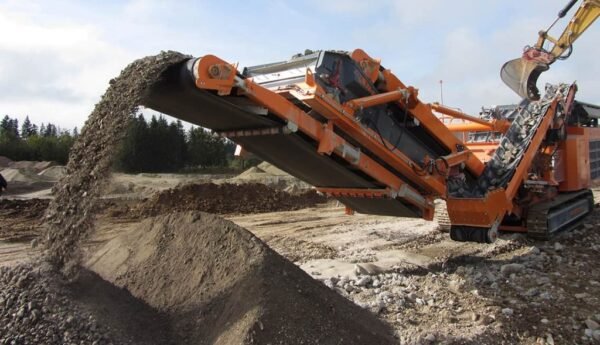
Somewhere in the Pilbara, a mountain is being eaten.
Not slowly, not by wind and rain over a geological age, but in a single shift — hundreds of tonnes of iron-bearing rock disappearing into a steel throat the size of a shipping container, emerging seconds later as a stream of graded aggregate racing along a conveyor. There is no truck in sight. That absence is the point.
For most of the twentieth century, the rhythm of a mine or quarry was set by haul trucks: load, climb, dump, return, load again. Mobile crushing broke that rhythm.
By bringing the crusher to the rock face instead of hauling the rock to a fixed plant, operators cut haul distances from kilometres to metres, and in the biggest in-pit crushing and conveying (IPCC) systems, eliminate truck haulage almost entirely.
Fuel bills fall. Tyre budgets — a genuine line item on a mine’s balance sheet, given a single ultra-class haul truck tyre can cost tens of thousands of dollars — shrink. Diesel particulate and CO2 emissions drop in step.
That shift has turned mobile crushing plants from a contractor’s convenience into mega-mine infrastructure, and pushed manufacturers to build machines whose scale would have seemed implausible a generation ago.
This feature profiles the largest tracked mobile crushers on the market today, and the semi-mobile giants that push the definition of ‘mobile’ further still, into machines that move on transport crawlers rather than their own tracks but still redraw the economics of a mine.
What Is a Mobile Crusher?
A mobile crusher is a self-contained crushing plant mounted on tracks or wheels so it can be repositioned inside a quarry or pit, or moved between sites entirely, without being dismantled.
It replaces what used to be a fixed, concrete-founded installation with a machine that can follow the working face.
Crushing happens in stages. Primary crushing takes run-of-mine rock straight from blasting or excavation and breaks it down to a manageable size — this is the heavy lifting, handling boulders that can exceed a metre across.
Secondary crushing reduces that output further, and tertiary crushing produces the fine, closely sized product needed for concrete aggregate, asphalt, or ore headed to a mill.
Different crusher types suit different stages. Jaw crushers use a fixed and a moving plate to compress rock in a V-shaped chamber — robust, simple, and the standard choice for primary crushing of hard, abrasive rock.
Gyratory crushers, used in the very largest primary applications, crush rock between an eccentrically rotating mantle and a fixed concave shell, offering higher throughput at scale. Cone crushers work on a similar gyrating principle but at a finer setting, making them the workhorse of secondary and tertiary stages.
Impact crushers use high-speed rotors and hammers to shatter rock through impact rather than compression, producing a more cubical product favoured for softer stone and recycled concrete.
Manufacturers also distinguish fully mobile plants — tracked, self-propelled, and able to relocate under their own power within minutes — from semi-mobile plants, which are relocated only occasionally, using transport crawlers or self-propelled modular transporters, and which can be an order of magnitude larger as a result.
In a typical mobile plant, an excavator or wheel loader feeds the hopper; a vibrating feeder meters material onto the crusher; a discharge conveyor carries crushed product to a screen or stockpile; oversize material is recirculated back through the crusher until it passes the desired size.
The Engineering Challenge of Building Bigger
Scaling a crusher up is not simply a matter of enlarging the drawings. Every added tonne of crushing capacity brings a disproportionate increase in structural, power, and logistical demand.
Weight is the first constraint. The largest tracked jaw crushers on the market today operate at well over 100 tonnes, and the jaw box alone — the crusher unit before hopper, conveyors, or chassis are added — can weigh 70-80 tonnes on its own.
That mass has to be carried on track systems wide and long enough to keep ground-bearing pressure low enough for the plant to sit on freshly blasted, uneven rock without sinking or tipping, while still being narrow enough to fit within road transport width limits when the machine is moved between sites.
Power is the second. A large mobile crusher needs several hundred kilowatts simply to turn the crusher, on top of the power draw of feeders, conveyors, screens, magnetic separators, and dust suppression pumps.
Manufacturers increasingly meet that demand with diesel-electric drivetrains, in which a diesel generator powers electric motors at each component rather than driving them mechanically — improving fuel efficiency, cutting emissions, and allowing the plant to plug into grid or genset power where available, switching off the onboard engine entirely.
Structural engineering has to account for the violent, cyclical loading a crusher generates: every bite into hard rock sends a shock load through the frame, day after day, for years.
Track systems need to combine the tractive effort to reposition a 100-tonne-plus machine with the fine control to nudge it centimetres at a time inside a working pit.
Dust suppression, typically water-spray systems at the hopper and crusher discharge, is now close to mandatory both for worker health and for keeping automated optical sorting and camera systems working.
And because these machines operate in remote, often landlocked locations, every design decision eventually runs into transport logistics: a plant that cannot be broken into road-legal loads, or that cannot be relocated between distant deposits without a fleet of low-bed trailers and permits, is not commercially viable no matter how efficient its crushing chamber.
The World’s Largest Mobile Crushers
Metso Lokotrack LT160
Manufacturer: Metso
Country: Finland
Type: Fully mobile tracked jaw crusher (primary)
Year: Current generation
Weight: Approx. 140-150 tonnes (varies by configuration)
Capacity: Continuous high-capacity primary crushing; exact tonnes/hour depends on feed and application
Feed opening: Feed opening able to accept material up to roughly one cubic metre in size
Engine / power: Diesel, matched to the Nordberg C160 jaw crusher unit
Mobility system: Full tracks; can be paired with Metso’s LL-series mobile conveyor system for continuous in-pit operation
Applications: Large-scale in-pit primary crushing for aggregates, cement quarrying, and mining
Notable use: Selected by Boral for its Peppertree quarry in New South Wales, Australia, paired with Metso’s Lokolink mobile conveyor system
Engineering fact: It is built around the Nordberg C160, which Metso describes as the largest jaw crusher ever fitted to a fully mobile chassis, and the LT160 itself is marketed as the biggest and most powerful fully mobile primary crusher built to date.
Metso Lokotrack LT200HP
Manufacturer: Metso
Country: Finland
Type: Fully mobile tracked cone crusher (secondary/tertiary)
Year: Current generation
Weight: Approx. 30 tonnes (66,100 lb standard operating weight)
Dimensions: Approx. 16.7 m long x 3 m wide x 3.4 m tall in transport configuration
Capacity: High-capacity secondary/tertiary output; varies with feed gradation and closed-side setting
Feed opening: Max feed size around 185 mm
Engine / power: Diesel power pack driving the Nordberg HP200 cone crusher via direct V-belt drive
Mobility system: Full tracks, compact transport footprint
Applications: Secondary and tertiary crushing for road aggregates, railroad ballast, concrete and asphalt fractions
Notable use: Widely deployed across quarry and recycling operations worldwide as a companion to Metso’s LT-series primary jaw plants
Engineering fact: Its direct V-belt drive from the gearbox is engineered to cut fuel consumption by a minimum of 15% compared with older drive arrangements — a meaningful saving over the thousands of hours a quarry plant runs each year.
Sandvik UJ640E
Manufacturer: Sandvik
Country: Sweden
Type: Fully mobile tracked jaw crusher (primary)
Year: Current generation
Weight: Approx. 137.5 tonnes in operating configuration
Dimensions: Stands approximately 7.3 m tall in operation; transports in two main sections
Capacity: Site-reported production in the 400-450 tonnes/hour range at a reduced feed size, with substantially higher capacity available when the jaw is opened for coarser product
Feed opening: 1,500 x 1,100 mm feed opening on the CJ615 single-toggle jaw
Engine / power: Onboard diesel generator with electric plug-in grid supply option
Mobility system: Tracked, transported in two sections
Applications: High-volume hard-rock primary crushing for large quarry and aggregate operations
Notable use: Colorado Materials in the United States runs a UJ640E it has nicknamed ‘Goliath,’ calling it the largest tracked jaw crusher in Sandvik’s mobile range
Engineering fact: It carries a 14 cubic metre feeder hopper extension purely to keep the crusher fed continuously — roughly the volume of a small delivery truck sitting above the jaw at all times.
Sandvik UJ440i
Manufacturer: Sandvik
Country: Sweden
Type: Fully mobile tracked jaw crusher (primary)
Year: Current generation
Weight: Mid-range within Sandvik’s mobile jaw line; precise figures vary with under-screen and hopper options
Capacity: High-capacity primary crushing suited to demanding, all-climate operation
Feed opening: Sized for versatile hard-rock feed; jaw plate options let operators tune the setting to the application
Engine / power: Direct drive with low operating rpm, tuned for reduced fuel consumption and emissions
Mobility system: Full tracks; available with or without an under-screen for open or closed-circuit operation
Applications: Versatile hard-rock and quarry primary crushing in extreme climates
Notable use: Deployed as far afield as a Falkland Islands quarry, illustrating the machine’s reputation for reliability in remote, harsh environments
Engineering fact: Sandvik backs the UJ440i with a seven-year remote-monitoring data subscription through its ‘My Fleet’ telematics system, reflecting how central uptime data has become to owning a machine this size.
Kleemann MOBICAT MC 160 PRR
Manufacturer: Kleemann (Wirtgen Group)
Country: Germany
Type: Fully mobile tracked jaw crusher with pre-screening (primary)
Year: Current generation
Weight: Jaw crusher unit alone weighs roughly 73-80 tonnes; total plant weight varies by configuration
Capacity: Feed capacity up to approximately 1,200-1,323 tonnes/hour
Feed opening: 1,500 x 900 mm feed opening on the SStR 1600 jaw
Engine / power: Diesel-electric drive concept; crusher and conveyors driven electrically for lower fuel use, with external power supply option
Mobility system: Two-unit tracked design: a feeding unit with apron conveyor and a main unit carrying the crusher and roll screen
Applications: Precrushing of hard natural stone and recycling at the largest tracked scale Kleemann builds
Notable use: Marketed by Kleemann as the largest track-mounted mobile jaw crusher plant it produces
Engineering fact: Splitting the plant into a separate feeding unit and main crushing unit lets a machine of this scale still be broken down for road transport between sites.
Terex Finlay J-1480
Manufacturer: Terex Finlay
Country: Northern Ireland, UK
Type: Fully mobile tracked jaw crusher (primary)
Year: Current generation
Weight: Heavy-class tracked jaw plant; precise operating weight varies with drive and screen configuration
Capacity: Throughput capacity up to approximately 750 tonnes/hour, depending on application and material
Feed opening: 1,415 x 820 mm single-toggle jaw chamber
Engine / power: Available with hydrostatic drive (reversible, for clearing blockages) or optional direct drive for improved fuel efficiency
Mobility system: Full tracks; 10 cubic metre hopper with hydraulically folding sides for fast set-up
Applications: Primary crushing for quarrying, mining, and demolition/recycling
Notable use: The flagship of Terex Finlay’s jaw crusher range, sitting above the J-1280 and J-1175 in the lineup
Engineering fact: Its hydrostatic drive lets the jaw run in reverse on demand — a genuine safety feature that clears a blocked chamber without anyone entering the crushing zone.
McCloskey J50
Manufacturer: McCloskey International
Country: Canada / Northern Ireland
Type: Fully mobile tracked jaw crusher (primary)
Year: Current generation (J50v2)
Weight: Approx. 47-51 tonnes (roughly 103,000-113,000 lb depending on configuration)
Dimensions: Approx. 14.6-16.4 m long in transport/working configuration
Capacity: Plant capacity of roughly 400 tonnes/hour
Feed opening: 1,270 x 735 mm single-toggle jaw — among the widest in its weight class
Engine / power: CAT C9/C9.3 diesel, 261-280 kW (350-375 hp)
Mobility system: Full tracks with hydraulic folding hopper and stockpiling conveyors
Applications: Aggregate production, quarrying, and demolition recycling
Notable use: A common sight across North American and European aggregate operations for its class-leading stockpile height
Engineering fact: McCloskey builds the J50 in a 410,000 square-foot plant in Ontario, Canada — engineering offices sit an ocean away in County Tyrone, Ireland.
Komatsu BR580JG-1
Manufacturer: Komatsu
Country: Japan
Type: Fully mobile tracked jaw crusher (primary)
Year: Current generation
Weight: Approx. 49-51 tonnes (108,000-112,440 lb)
Dimensions: Approx. 14.5 m long, 3 m wide, 3.4 m tall
Capacity: High capacity for its 50-tonne class, driven by a load-presetting semi-automatic feeder
Feed opening: 44 x 30 inch (approx. 1,120 x 760 mm) KCJ4430 jaw chamber
Engine / power: Komatsu SAA6D125E-5 diesel, 345 flywheel hp, Tier III certified
Mobility system: Full tracks
Applications: Highway construction, quarrying, demolition, and construction-waste recycling
Notable use: A full model change from the earlier BR550JG, widely used in Japan, North America, and Europe
Engineering fact: Its automatic discharge-clearance system can reset the crusher’s outlet gap in under a minute — even after both jaw plates have worn down — using a one-touch control on the monitor panel.
thyssenkrupp Semi-Mobile Crushing Plants (SMCP)
Manufacturer: thyssenkrupp
Country: Germany
Type: Semi-mobile gyratory crushing plant (primary, in-pit)
Year: Ongoing product line
Weight: Some fully pre-assembled modules shipped to site have weighed nearly 800 tonnes in a single piece
Capacity: Installations reaching up to 10,000-15,000 tonnes/hour; the largest gyratory-crusher configurations at Cobre Panama in Panama are rated up to 11,000 tonnes/hour
Feed opening: Built around thyssenkrupp’s largest gyratory crushers, including the KB 63-130 Pro, with what the company describes as the largest feed opening in the gyratory-crusher market
Engine / power: Grid-powered electric drive as standard for this scale of plant
Mobility system: Relocated on transport crawlers or self-propelled modular transporters rather than under its own power — hence ‘semi-mobile’ rather than fully mobile
Applications: In-pit crushing for the largest open-pit copper, iron ore, and coal mines, as the first stage of an in-pit crushing and conveying (IPCC) system that removes truck haulage from the pit almost entirely
Notable use: Multiple direct-feed SMCP units in operation at First Quantum Minerals’ Cobre Panama copper mine, among the largest copper operations built this century
Engineering fact: thyssenkrupp’s SMCP concept can relocate a crushing plant heavy enough to require an entire fleet of transport crawlers, yet still cut haul-truck distances dramatically as a pit deepens and expands.
Astec Mobile Screens & Crushers
Manufacturer: Astec Industries
Country: United States
Type: Fully mobile tracked jaw, cone, and impact crushers (primary/secondary)
Year: Ongoing product range
Weight: Varies significantly by model, from compact recycling units to full quarry-class primary crushers
Capacity: Ranges from modest contractor-scale output to full quarry production rates depending on the model selected
Feed opening: Model-dependent
Engine / power: Diesel, sized to the crushing stage
Mobility system: Full tracks across the range
Applications: Aggregate production, recycling, and contractor crushing across North America
Notable use: Widely specified by US and Canadian aggregate producers as part of Astec’s broader portfolio of crushing, screening, and asphalt equipment
Engineering fact: Astec’s crushing and screening range sits inside a broader US-headquartered equipment group that also builds asphalt plants — giving contractors a single-manufacturer path from raw rock to finished road surface.
Note: specifications above are approximate and drawn from manufacturer literature and dealer specification sheets current as of 2026. Exact weights, capacities, and dimensions vary by hopper, screen, engine, and drive configuration — always confirm against the manufacturer’s current spec sheet before quoting figures commercially.
| Manufacturer | Model | Weight | Type | Feed Size | Capacity | Engine | Best Application |
|---|---|---|---|---|---|---|---|
| Metso | LT160 | 140–150 t | Jaw | ~1 m³ | High | Diesel | In-pit primary |
| Metso | LT200HP | 30 t | Cone | 185 mm | High | Diesel | Secondary/tertiary |
| Sandvik | UJ640E | 137.5 t | Jaw | 1500×1100 mm | 400–450+ t/h | Diesel-electric | Hard rock |
| Sandvik | UJ440i | Mid-range | Jaw | Varies | High | Direct-drive | Quarries |
| Kleemann | MC 160 PRR | 73–80 t | Jaw | 1500×900 mm | 1200–1323 t/h | Diesel-electric | Hard stone |
| Terex Finlay | J-1480 | Heavy class | Jaw | 1415×820 mm | Up to 750 t/h | Hydrostatic | Quarrying, demolition |
| McCloskey | J50 | 47–51 t | Jaw | 1270×735 mm | 400 t/h | CAT C9/C9.3 | Aggregates, recycling |
| Komatsu | BR580JG-1 | 49–51 t | Jaw | 1120×760 mm | High | 345 hp diesel | Highway, demolition |
| thyssenkrupp | Semi-Mobile Plant | Up to 800 t | Gyratory | Largest class | 10,000–15,000 t/h | Grid electric | Mega-mine IPCC |
| Astec | Mobile Crushers | Varies | Jaw/Cone/Impact | Varies | Varies | Diesel | Aggregates, recycling |
Note: Figures are approximate and compiled from manufacturer and dealer specification sheets. Actual weight, feed size, capacity, and engine configuration may vary depending on the selected options and application. Always verify the latest specifications with the manufacturer before making commercial or procurement decisions.
How Mobile Crushers Work, Step by Step
The sequence is consistent across almost every plant on this list, whatever the brand on the side panel.
Loading begins with an excavator or wheel loader depositing blasted or excavated material into the hopper — on the largest machines, a single bucket load barely registers against hopper capacities measured in cubic metres.
Feeding follows: a vibrating grizzly or apron feeder meters that material onto the crusher at a controlled rate, screening out fines before they ever reach the crushing chamber so the crusher isn’t wasting capacity on material that’s already the right size.
Primary crushing does the heavy reduction — a jaw or gyratory crusher breaking oversize rock down to a size conveyors and secondary crushers can handle.
From there, conveyors move material through the plant: main discharge conveyors, side conveyors for waste rock or tramp metal removed by a magnetic separator, and radial stacking conveyors building stockpiles at the far end.
Screening, using vibrating decks, separates the crushed product into size fractions; anything oversize is recirculated back through the crusher rather than sent to stockpile, a loop that repeats until the material passes.
On modern plants, automation increasingly runs this whole sequence. One-button start-up sequences the magnet, conveyors, crusher, and feeder in the correct order for safety.
Remote monitoring systems — Metso’s IC control, Komatsu’s Komtrax, Sandvik’s My Fleet — track hours, location, fault codes, and production data continuously, often streaming that data to a distributor or head office thousands of kilometres away.
And because a crushing chamber degrades the rock as much as the rock degrades the chamber, wear parts — jaw plates, mantle and concave liners, screen media — are consumable by design, engineered for straightforward field replacement rather than a return to a workshop.
Technologies Powering Modern Mobile Crushers
The step-change in mobile crushing over the past decade has been electrical, not mechanical.
Diesel-electric drive, now standard on the largest plants from Metso, Kleemann, and thyssenkrupp, separates the diesel engine’s job — generating electricity — from the job of turning the crusher and conveyors, which electric motors handle directly and far more efficiently than a mechanical drivetrain.
Where grid power or a large enough genset is available, the diesel engine can be switched off entirely and the plant run on external power, cutting fuel costs and emissions to near zero for that period.
Telematics and remote monitoring have moved from a nice-to-have to close to an industry baseline: fleet owners can watch utilisation, fault codes, and production tonnage from a phone or laptop, and distributors can often diagnose a fault before a service truck leaves the yard.
That data feeds predictive maintenance programmes, flagging component wear before it causes an unplanned stop, and increasingly feeds AI-assisted analysis that looks for patterns across an entire fleet rather than one machine at a time.
Automatic closed-side-setting adjustment — seen on machines from Komatsu to Metso — lets the operator reset the crusher’s discharge gap from a control panel in under a minute, compensating for wear without manual intervention.
Camera systems watch the crushing chamber and conveyor lines for blockages or tramp metal. Dust suppression, typically water-spray at the hopper and crusher discharge, has become close to mandatory, both for worker health and for keeping the automated systems around it working cleanly.
Noise reduction and fuel-efficiency gains follow largely from the same diesel-electric and direct-drive engineering.
Digital twins and condition-monitoring platforms, still more common on stationary plants than tracked mobile units, are beginning to appear on the largest semi-mobile in-pit systems, modelling wear and throughput before problems reach the physical machine.
Mega Mining Projects Running on Mobile Crushers
Mobile and semi-mobile crushing has become standard infrastructure at the world’s largest mines.
In Australia, Boral’s Peppertree quarry near Sydney runs a Metso Lokotrack LT160 paired with a mobile conveyor system specifically to cut haul distances at a high-volume aggregate operation.
In Panama, First Quantum Minerals’ Cobre Panama copper mine — one of the largest copper developments built this century — runs multiple thyssenkrupp semi-mobile crushing plants, including units built around the company’s largest gyratory crusher, to move blasted ore straight onto conveyors rather than trucks.
In Western Australia’s Pilbara, Fortescue’s Iron Bridge magnetite project relies on large-scale gyratory crushing supplied by thyssenkrupp to process ore bound for a 22 million tonne-per-annum concentrate operation.
In Sweden, LKAB’s iron ore operations near Kiruna — among the deepest underground mines on Earth — have engaged thyssenkrupp for large secondary and tertiary crushing and screening installations tied to magnetic separation circuits.
In India, semi-mobile crushing plants have been installed at coal operations moving toward 25 million tonnes per year of production, explicitly to support in-pit crushing and conveying as the pit expands.
Chile, South Africa, Botswana, Brazil, and Indonesia all run comparable fleets of tracked and semi-mobile crushers across copper, iron ore, coal, and diamond operations, though public disclosure of exact machine counts and models varies by operator.
The Environmental Case for Mobile Crushing
The environmental argument for mobile and in-pit crushing is, at its core, an argument about trucks.
Every tonne of rock that moves by conveyor instead of haul truck is a tonne that isn’t burning diesel, wearing a multi-tonne tyre, and emitting CO2 and particulate matter along a haul road.
On the largest in-pit crushing and conveying systems, that can mean removing hundreds of truck movements a day from a pit entirely.
The knock-on effects compound: less blasting is sometimes possible where in-pit crushers can handle coarser feed sizes, dust generation drops when material moves by enclosed conveyor rather than open truck bed, and operating costs fall in step with fuel and tyre spend — often the two largest controllable cost lines in open-pit mining.
Diesel-electric and grid-connected drives push energy efficiency further, and every mobile plant able to run on external power rather than its own generator set removes another slice of on-site diesel consumption.
The Future of Mega Mobile Crushers
The next generation of mobile crushing is being shaped by the same forces reshaping the rest of mining and construction equipment.
Battery-electric mobile crushers, already appearing in the compact recycling and demolition segment from several European manufacturers, are the logical extension of the diesel-electric architecture already standard on the largest machines — the diesel generator is, in effect, the one remaining component to replace.
Hydrogen power is being explored more cautiously, given the fuel-storage and refuelling infrastructure a mine site would need to build.
Fully autonomous crushing plants and AI-controlled operation are edging closer, building on the remote-monitoring and closed-side-setting automation already in service: the technical building blocks — sensors, telematics, automatic adjustment — are largely proven, and the remaining work is stitching them into a control loop that needs less operator intervention.
Remote diagnostics will keep deepening, letting a distributor thousands of kilometres from a mine site flag a failing component before it fails.
And as more mines pursue ‘smart mine’ status — integrating haulage, crushing, and processing data into a single operational picture — mobile and semi-mobile crushers are increasingly built to feed that picture rather than operate as isolated machines.
Zero-emission quarrying remains a longer-term goal, but every step outlined here — electrification, automation, remote monitoring — is a step toward it.
Interesting Facts
- The largest semi-mobile crushing plant modules built by thyssenkrupp have shipped to site pre-assembled at close to 800 tonnes in a single piece.
- thyssenkrupp’s largest gyratory-crusher installations, deployed at First Quantum’s Cobre Panama copper mine, are rated up to 11,000 tonnes per hour.
- Some thyssenkrupp semi-mobile crushing systems overall are engineered for throughput rates as high as 15,000 tonnes per hour.
- Kleemann’s MC 160 PRR is built around a jaw crusher unit that alone weighs roughly 73-80 tonnes — before the rest of the plant is added.
- The Sandvik UJ640E’s feed opening measures 1,500 x 1,100 mm, large enough to swallow a boulder the size of a small car.
- Metso’s Lokotrack LT160 is built around the Nordberg C160, which the company markets as the largest jaw crusher ever mounted on a fully mobile chassis.
- The LT160 can accept feed material up to roughly one cubic metre in size — larger than most washing machines.
- The Sandvik UJ640E carries a 14 cubic metre feeder hopper extension purely to keep the crusher continuously fed.
- Komatsu’s BR580JG-1 can reset its crusher’s discharge gap in under a minute using a one-touch control, even after both jaw plates have worn out.
- McCloskey builds its J50 jaw crusher — sold worldwide — from a single 410,000 square-foot plant in Ontario, Canada.
- The McCloskey J50’s 1,270 x 735 mm jaw is marketed as the widest in its weight class.
- Sandvik backs its UJ440i with a seven-year telematics data subscription as standard, reflecting how central remote monitoring has become to operating machines this size.
- A Sandvik UJ640E owned by Colorado Materials in the US has been nicknamed ‘Goliath’ by its own operators.
- The Terex Finlay J-1480’s hydrostatic drive lets its jaw run in reverse on demand, clearing blockages without anyone entering the crushing chamber.
- Diesel-electric drive on the largest tracked jaw plants allows the onboard engine to be switched off entirely when grid or genset power is available on site.
What unites every machine in this feature — from a 30-tonne cone crusher tuned for road aggregate to an 800-tonne semi-mobile module feeding a copper mine — is a simple economic insight: moving crushed rock is far cheaper than moving whole rock, and the closer the crusher sits to where the rock is broken, the more that saving compounds.
That insight has turned mobile and semi-mobile crushing from a contractor’s tool into some of the most consequential infrastructure a modern mine or quarry owns.
The machines keep getting bigger, but the more interesting trend is what’s happening around them: diesel-electric drivetrains, telematics that stream data across continents, automatic wear compensation, and the first real steps toward autonomous operation.
The mega crushers of the next decade will likely be defined less by raw tonnage than by how little a human operator needs to do to keep them running — smarter, cleaner, and increasingly capable of managing themselves.
Also Read
Mega Machines: Inside the World’s Largest Crawler Cranes
Top Autonomous Construction Equipment Trends to Watch in 2026

- SODECA Highlights Industrial Ventilation Technology at Mega Clima Expo Kenya 2026 - October 14, 2026
- How They Were Built: Inside the Engineering of the Lesotho Highlands Water Project - October 11, 2026
- Africa’s Water Reuse Opportunity: Building the Infrastructure for a Water-Secure Future - September 28, 2026