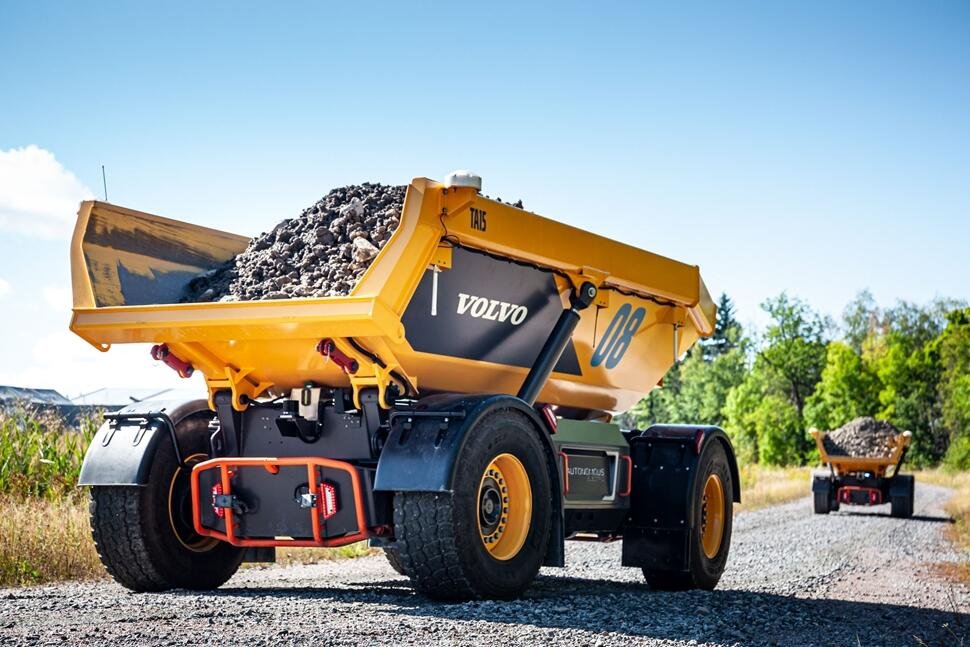
For three decades, autonomous construction machinery lived mostly in mining pits and demonstration yards — a technology perpetually described as “coming soon.”
That changed decisively in 2026. At CES in January and CONEXPO-CON/AGG in March, the world’s largest equipment makers stopped teasing driverless machines and started shipping them. Caterpillar unveiled a five-machine autonomous construction lineup.
John Deere put its first autonomous articulated dump truck to work in a quarry setting. Doosan Bobcat rolled out a modular, cab-optional concept loader.
And a fast-growing category of specialist robotics firms began putting machines that tie rebar and scan job sites overnight to work on live projects.
The numbers back up the shift. Market researchers differ on exact figures, but every major estimate points the same direction: the global autonomous construction equipment market was worth roughly $16.6 billion in 2025 and is on track to reach approximately $18.2 billion in 2026, according to The Business Research Company, with most forecasters projecting compound annual growth in the high single digits to low double digits through the early 2030s.
MARKET SNAPSHOT:
$18.16bn in 2026, rising to $25.86bn by 2030
(9.1–9.2% CAGR)
$17.71bn in 2026, rising to $35.22bn by 2034
(9.0% CAGR)
$15.11bn in 2025, rising to $30.09bn by 2033
(8.99% CAGR)
| Source | 2026 Market Size (est.) | Forecast | CAGR |
| The Business Research Company | $18.16 billion | $25.86 billion by 2030 | 9.1–9.2% |
| Fortune Business Insights | $17.71 billion | $35.22 billion by 2034 | 9.0% |
| SkyQuest | $15.11 billion (2025) | $30.09 billion by 2033 | 8.99% |
| MarketsandMarkets | n/a (2024 base: $4.40bn) | $9.77 billion by 2030 | 14.2% |
| MarketGenics | n/a (2025 base: $13.2bn) | $36.8 billion by 2035 | 10.8% |
For contractors, OEMs and infrastructure planners watching from Nairobi, Johannesburg and Lagos, the equipment arriving on Western and Gulf jobsites this year is a preview of what will eventually reshape African construction economics too. Here are the trends defining autonomous construction equipment in 2026.
1. Caterpillar bets its future on a five-machine autonomous fleet
At CES 2026, Caterpillar Chief Technology Officer Jaime Mineart unveiled what the company calls the next era of autonomy: a lineup spanning excavators, wheel loaders, haul trucks, dozers and compactors, all engineered to operate with no one in the cab.
The announcement builds on more than 30 years of autonomy work that began with a Carnegie Mellon University partnership in the 1980s and has matured into what Caterpillar describes as the industry’s most proven autonomous mining fleet.
Nearly 700 autonomous Cat trucks are now in operation worldwide, and the company says they have safely hauled more than 11 billion tonnes of material without a single reported injury.
“The upside to scaling this technology to construction will be tremendous, adding unprecedented levels of safety, efficiency and productivity. It will, undoubtably, change the way the world is built.”
— Jaime Mineart, Chief Technology Officer, Caterpillar
What’s new in 2026 is the shift from mining pits to general construction and quarry sites. Caterpillar has already automated a live quarry fleet — four 100-ton Cat 777 trucks working a single shift at Luck Stone’s Bull Run plant in Chantilly, Virginia — which have safely hauled more than two million tons of material since launch.
The construction lineup itself has not been given a commercial release date, but it leans on an expanding Cat VisionLink and Cat MineStar software layer, plus a newly announced partnership with Nvidia, to fuse LiDAR, radar, GPS and camera data into what Caterpillar calls a real-time “digital nervous system” for the jobsite.
2. Quarries and aggregates become autonomy’s new proving ground
Mining has run autonomous haul trucks for years, but 2026 is the year the technology jumped the fence into quarries and aggregates — a much closer analogue to mainstream construction work. Caterpillar’s Luck Stone deployment is one example.
John Deere’s is another, and it marks the company’s first-ever autonomous construction machine.
Deere’s 460 P-Tier Articulated Dump Truck, fitted with the company’s second-generation autonomy kit — built on the same technology stack developed with subsidiaries Blue River Technology and Bear Flag Robotics for its farm-autonomy programme — is designed specifically to handle repetitive, high-volume material hauling in quarry settings.
Company leadership frames the move as a response to a structural labour problem rather than a novelty exercise.
“There’s a common thread that connects all of these and it’s labor availability. It impacts all of these industries we serve in a very similar way. It’s difficult for those in these industries to find, attract and retain the talent they need for the work that is required of them.”
— Jahmy Hindman, Chief Technology Officer, John Deere
3. New entrants and concept machines are widening the field
Caterpillar and Deere are the incumbents, but 2026 confirmed autonomy is no longer their exclusive turf.
Doosan Bobcat’s RogueX3, unveiled at CES 2026 and shown again at CONEXPO-CON/AGG, is a fully electric, modular concept loader engineered to run with or without a cab, on wheels or tracks, and with interchangeable lift-arm configurations.
It is the third generation of a concept line the company has iterated on for several years, and while RogueX3 remains a concept rather than a production machine, Doosan Bobcat has already filed multiple patents based on its design — a signal of where the company’s compact-equipment portfolio is heading next.
“Today, as workforce needs change and jobsites become more complex, we’re responding with intelligent systems that empower people to accomplish more, faster and smarter. These innovations aren’t concepts for the distant future; they’re advancements that are shaping how work gets done right now.”
— Scott Park, CEO and Vice Chairman, Doosan Bobcat
Elsewhere, specialist robotics firms are automating tasks the big three haven’t prioritised.
Built Robotics has continued expanding its AI-driven excavation systems, and in March 2026 added machines capable of reading and adapting to complex soil conditions without human intervention.
Bridge-like robots that crawl across rebar mats — using computer vision to locate intersections and tie them automatically — are now deployed on large infrastructure projects, and have reportedly cut injury rates by nearly 40 percent on the sites where they’ve been introduced.
Boston Dynamics’ Spot has meanwhile become a familiar nightly presence on large sites, running autonomous inspection walks that capture 360-degree imagery and LiDAR scans for progress tracking against BIM models.
4. Robotics-as-a-Service is lowering the entry barrier
The biggest historical obstacle to autonomy adoption hasn’t been the technology — it’s been the price tag.
A fully autonomous excavator can cost upward of $500,000, putting it well beyond the reach of most small and mid-sized contractors.
In 2026, a growing number of robotics firms are addressing that with subscription-style pricing: contractors pay a monthly fee, or a rate per cubic yard of work completed, instead of buying equipment outright.
The model mirrors how software shifted from licensed installations to subscription services, and it is one of the clearest signs that autonomy is being engineered for mainstream adoption rather than remaining a showcase technology reserved for the largest fleet operators.
5. Electrification and autonomy are converging
At CONEXPO-CON/AGG 2026 in Las Vegas, electrification was arguably as prominent a theme as autonomy — and increasingly, the two are becoming the same story. Bobcat’s RogueX3 is fully electric by design.
Caterpillar’s new D8 XE dozer, unveiled at the same show, pairs electric drive with the sensor suite that underpins its autonomous programme.
Electric machines are also proving mechanically simpler to automate, since they lack the complexity of a conventional diesel powertrain.
Husco’s GenSteer steer-by-wire system, voted a 2026 Next Level Award winner by CONEXPO attendees, is a further sign that the control layer autonomy depends on — steer-by-wire, brake-by-wire — is becoming standard equipment engineering rather than a bolt-on afterthought.
6. Operator roles are shifting, not disappearing
None of the major OEMs are pitching autonomy as workforce replacement — quite the opposite.
Caterpillar has committed $25 million over five years to a workforce education initiative aimed at helping operators move into digital and autonomous roles.
At the Luck Stone quarry, Mineart says operators who once drove the 777 trucks now manage fleets and optimise site operations from a screen rather than a cab.
Deere and Bobcat make similar arguments, framing automation as filling a structural shortage of skilled operators rather than eliminating jobs outright.
Analysts covering CONEXPO 2026 also noted that automation is becoming a recruitment tool in its own right — appealing to a younger, more digitally fluent workforce more comfortable with tablets and remote consoles than with a traditional cab.
7. Regulation, not engineering, is the real bottleneck
Perhaps the least visible but most consequential trend of 2026 is regulatory.
Technology readiness is now outpacing the legal, insurance and safety-certification frameworks needed for widespread on-road and on-site deployment of autonomous machinery, according to market analysts tracking the sector.
Liability rules for a driverless dozer that damages property, or an autonomous haul truck operating alongside human workers, remain a patchwork that varies by country and even by state or province — a gap that will likely determine which markets adopt the technology fastest over the next several years.
What it means for African construction markets
For Kenya and much of the African construction sector, full autonomous deployment remains some years off.
Construction labour is comparatively affordable across the region, and the capital outlay for autonomous fleets is still steep relative to most contractors’ balance sheets.
But the direction of travel is unmistakable, and the technology being commercialised in Las Vegas, Chantilly and Gilroy this year is what will eventually reach African quarries, rail corridors and mega-projects such as the Lobito Corridor or Kenya’s SGR extension works.
The nearer-term opportunity for African contractors is narrower but real.
Semi-autonomous operator-assist features — collision mitigation, grade control, remote console operation — are increasingly standard on new machines regardless of price point, meaning the technology is arriving incrementally through ordinary equipment upgrades rather than as an all-or-nothing fleet purchase.
Robotics-as-a-Service pricing models could also eventually make targeted automation viable for mid-sized African contractors well before full autonomous fleets become affordable outright.
The bottom line
2026 marks the year autonomous construction equipment stopped being a research project and became a genuine, if still expensive, purchasing decision.
Caterpillar, John Deere and Doosan Bobcat are racing to build out full autonomous lineups; specialist robotics firms are automating the dull, dirty and dangerous tasks incumbents have been slower to tackle; and new financing models are quietly solving the affordability problem that has kept autonomy confined to the largest fleets.
The technology isn’t replacing construction workers so much as redefining what the job looks like — and for an industry that has spent years battling a global shortage of skilled labour, that may be the trend that matters most.
Also Read
While America Builds Less, Africa Builds More
ow High-Reach Excavators and Robotics Are Changing the Industry

- How They Were Built: Inside the Engineering of the Lesotho Highlands Water Project - October 11, 2026
- Africa’s Water Reuse Opportunity: Building the Infrastructure for a Water-Secure Future - September 28, 2026
- Why Water Reuse Is Becoming a Business Imperative for African Industry - September 28, 2026