

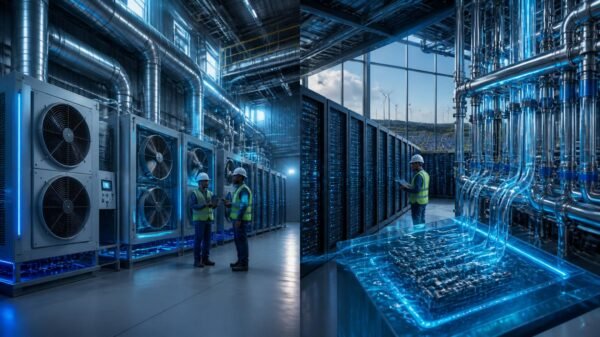
Africa is experiencing a data centre construction boom that could unlock tremendous economic potential.
More operators are recognising the value of the continent’s abundant renewable energy resources, rising bandwidth and declining Internet costs, which are all vital to support the increasingly demanding operational needs of large-scale cloud and AI-ready data centres.
The projected rapid growth of the African hyperscale data centre market will drive demand for specialised cooling infrastructure in the coming years.
The future’s most successful data centre construction firms and mission-critical contractors will be deeply familiar with various air- and liquid-based data centre cooling systems.
These options enable flexible decision-making, keep acquisition and operational costs low and overcome prevailing water scarcity and power unreliability challenges.
Air-Side Economisation
This approach relies on an HVAC component called an air-side economiser, which modulates the airflow between outdoor and indoor spaces to lower server temperatures. It complements mechanical cooling, promising massive energy savings and decreased carbon emissions.
The compressors can power off when the air-side economiser works to reduce equipment wear and tear.
When the compressors are off, the economiser can deliver emergency cooling if needed due to mechanical or compressor failure, preventing downtime and emergency repairs.
Air-side economisation is viable in areas with less airborne contamination risk and drier air. A good example is Limuru, Kenya, home to the high-altitude Tilisi development.
It is at an elevation of 2,200 metres and can be colder than 10 degrees Celsius at night. This free data centre cooling method is feasible once the temperature drops below 14 degrees.
Precision Cooling
Precision cooling systems regulate the indoor climate of IT environments. Computer room air handlers (CRAH) are the type suitable for hyperscale data centres.
Functioning like oversized, specialised radiators, CRAHs use a central chiller plant that pumps cold water through the coils inside them.
The water absorbs the heat coming from the servers, transferring thermal energy to the chiller.
CRAHs are ideal for significant electrical loads. These advanced machines use variable-speed fans, a feature they share with modern HVAC systems, making them highly efficient at scale.
The setup of these data centre cooling systems can be complex, as they require extensive central infrastructure involving chilled water pipework, chillers and cooling towers.
Evaporative Cooling
This method leverages endothermic reactions to absorb substantial heat generated by servers and lower the air temperature.
Its mechanism relies on large fans drawing outside air and blowing it over wetted pads and into the server rooms.
This liquid-dependent air-based cooling technology is highly efficient and works best in arid or mild climates.
However, it requires large volumes of water, making it controversial in areas facing water scarcity, such as Cape Town, South Africa.
Sustainability concerns are amongst the reasons newer facilities are adopting more advanced liquid-cooling methods.
For instance, Teraco’s expanded 50MW CT2 hyperscale data centre in Cape Town features a zero-water, closed-loop cooling system with AI-driven temperature optimisation and free-air cooling capabilities.
Cold Plate Liquid Cooling
An advanced form of direct-to-chip cooling, this technology involves attaching metal plates to CPUs and GPUs.
These plates increase the heat sink surface area and efficiently remove heat emanating from the hardware using a closed-loop liquid system.
Cold plate liquid cooling is arguably the most popular today because its thermal dissipation is superior to air-based cooling methods.
This innovation is sustainable due to its high thermal stability and efficient water use.
Immersion Cooling
This cutting-edge cooling technology involves submerging server components in thermally conductive dielectric fluids to achieve exceptionally high heat transfer rates.
This capability is key to complying with the regulatory requirements of countries that are increasingly embracing sustainability practices, such as Egypt and Nigeria, demonstrating a stronger commitment to lowering carbon emissions.
Immersion cooling is one of the experimental methods now considered commercially viable for hyperscale data centres, but not for other uses.
Researchers consider reliability, complexity and cost-effectiveness concerns primary limitations for harsh-environment mobility-related applications, such as automotive, aerospace and military.
That is why more industrial construction professionals are considering immersion cooling as an alternative to popular near-junction solutions.
Various Data Centre Cooling Solutions Are Fuelling Africa’s Hyperscale Boom
High industrial construction activity across the continent is sustainable if developer-operators, data centre building firms and mission-critical contractors choose the most practical cooling technology for the project.
As mechanical engineers innovate and develop better solutions, hyperscalers should be able to mitigate unique compliance risk and address pressing operational challenges in Africa.
Also Read
Africa Data Centres starts work on second data centre in Cape Town
Africa Data Centres Confirms Build of 10MW Data Centre in Lagos

She specialises in covering innovative construction equipment, green building solutions, and the integration of automation and efficiency in modern construction projects across residential and commercial sectors.
- Why African Equipment Buyers Need Reliable OEM Parts Networks - September 14, 2026
- Nature-Based Soil Stabilisation: How Bamboo Could Transform Erosion Control in Southeast Nigeria - August 10, 2026
- Data Centre Cooling Systems in Africa: HVAC and Liquid Cooling Guide for Hyperscale Projects - July 8, 2026