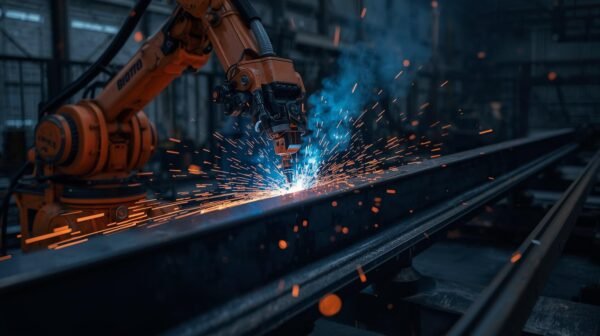
For decades, robotic welding was the exclusive playground of automotive assembly lines and aerospace cleanrooms.
In those highly controlled environments, success relies on absolute predictability: identical parts arrive at identical intervals, and robotic arms execute rigid, pre-programmed paths to the millimeter.
The typical construction site is the exact opposite. It is a chaotic mix of shifting foundations, uneven terrain, airborne dust, volatile outdoor lighting, and unpredictable “fit-up gaps” caused by steel parts expanding and contracting under the sun.
For years, the consensus among engineering procurement and construction (EPC) contractors was clear: Keep the robots in the factory; the dirt belongs to manual labor.
However, recent technological breakthroughs are completely turning that logic on its head. Driven by an unprecedented global labor crisis and massive leaps in artificial intelligence, robotic welding is breaking out of its fixed cages and stepping onto active job sites.
The Driver: A Workforce and Margin Crisis
The sudden push toward field automation is not just about adopting shiny new tech—it is a matter of business survival.
The structural steel and construction industries are facing a severe labor deficit. Data from the American Welding Society indicates that the industry is facing a shortage of roughly 400,000 welding professionals, with more than 150,000 veteran tradespeople rapidly heading toward retirement.
Recruiting next-generation talent to replace them has proven incredibly difficult, driving up the labor premium for certified structural site welds to historic highs.
THE 2026 STEEL CRISIS BY THE NUMBERS
400,000
Global Welder Shortage
Estimated active worker deficit worldwide.
$180.3 Billion
Prefabricated Construction Market
Global market value in 2026.
±3%
Quality Accuracy Standard
Precision increasingly demanded by major projects.
Beyond labor shortages, modern megaprojects demand razor-thin tolerances. Structural nodes for high-rises, heavy infrastructure, and marine environments leave absolutely zero room for human error.
When a manual welder makes a mistake on a critical joint, the resulting rework kills the project timeline and burns through material budgets.
Automated systems, by contrast, optimize arc time and deposition rates (the weight of material welded into a joint per hour), maximizing material efficiency and slashing a project’s carbon footprint.
The Core Technical Bottlenecks
So, why has it taken so long for automated welding to leave the factory floor? The primary barrier is the distinction between structured and unstructured environments.
On an open-air site, a robot cannot simply repeat a pre-programmed path. If a crane sets a heavy structural beam just three millimeters out of alignment, a traditional blind robotic arm will strike its arc in the empty air, ruining the component.
Furthermore, early attempts to bring optical sensors to the field failed due to environmental interference:
-
Visual Blinding: Thick welding smoke, sparks, and shifting outdoor sunlight easily blind standard laser sensors.
-
The Programming Hurdle: Traditional “teach pendants”—where a human operator manually maps out the robot’s paths using a controller—make no financial sense for small-batch, custom structural connections. If programming takes longer than the actual weld, the investment is a failure.
The Breakthroughs: Tech Overcoming the Dirt
To conquer the field, automation had to evolve from rigid machines into adaptive, learning systems. This transition is being led by three core innovations:
1. AI-Driven Weld Seam Tracking
Instead of blindly following a line, modern systems use structured laser light sensors fused with deep-learning vision algorithms.
These systems map out the unique geometry of the joint milliseconds ahead of the welding arc.
If a fit-up gap changes midway through a pass, the robot instantly calculates an online path generation, dynamically altering its torch posture, current, voltage, and travel speed in real time.
2. Physical AI and Mobility
One of the most notable shifts is the introduction of mobile robotic platforms powered by “Physical AI”—such as Path Robotics’ newly unveiled Rove system, which pairs an adaptive welding brain with a quadruped, legged chassis.
Rather than forcing a massive, immovable structural asset into a robotic cell, the robot walks directly to the work piece, stabilizes itself on uneven terrain, and executes precision welds in situ.
3. Digital Twins and Automated Programming
Engineers are now directly bridging the gap between design and fabrication. By utilizing Automated Offline Programming (AOLP), software extracts welding trajectories directly from raw 3D CAD or BIM (Building Information Modeling) files with zero human intervention.
This data feeds into a digital twin—a virtual, real-time replica of the physical environment. Before the torch even ignites, the system simulates the weld, running predictive thermal analysis to eliminate distortion and prevent structural defects.
Deployment Strategies: Where Robots Fit Today
For forward-thinking contractors looking to deploy this tech, automation shouldn’t be treated as an all-or-nothing gamble. Progressive firms are deploying a tiered strategy:
| Deployment Level | Ideal Application | Core Advantage |
|---|---|---|
| Near-Site Micro-Factories | Modular assembly yards located just outside the main job site. | Controlled environment that maximizes robot uptime while minimizing shipping costs of heavy modules. |
| Heavy Infrastructure Fieldwork | Bridge girders, storage tanks, and massive pipeline tie-ins. | High-volume, highly repetitive multi-pass welds that exhaust human operators. |
| On-Site Collaborative Robots (Cobots) | High-mix structural steel adjustments on the live deck. | Lightweight, easily programmable arms that work alongside human welders to handle standard joins. |
B2B Takeaway for Project Managers
Workforce Transformation, Not Workforce Replacement
Transitioning to automated welding is not about replacing skilled welders—it is about unlocking their full potential. Experienced welders become highly valued robot operators, programmers, and quality-control specialists who oversee advanced welding systems. By assigning repetitive, physically demanding multi-pass welds to automation, manufacturers reduce worker fatigue, improve safety, and preserve critical welding expertise. The result is a stronger workforce, higher-quality output, and the ability to scale production around the clock—up to 24/7—without increasing headcount.
The Verdict: Is it Ready?
Is robotic welding fully ready for every corner of a dynamic construction site? Not entirely. A plug-and-play, completely autonomous site robot that can handle a chaotic environment without oversight is still a work in progress.
However, for structural fabrication, near-site modular construction, and predictable heavy infrastructure tasks, the technology is absolutely ready—and it is actively redefining project margins.
The market for robotic steel beam welding is projected to surpass $1.7 billion, proving that the transition is well underway.
In a construction landscape defined by razor-thin margins and severe talent shortages, the competitive edge no longer belongs to the firms with the largest manual workforce.
It belongs to the firms that know how to effectively manage the robots.
Also Read
Top Welding Certifications Required for Construction Projects in 2026
Laser Cutting vs Plasma Cutting in Steel Fabrication: A Complete Guide

- Accurate and Reliable Measurement and Monitoring of Industrial Plant Water Treatment - October 21, 2026
- SODECA Highlights Industrial Ventilation Technology at Mega Clima Expo Kenya 2026 - October 14, 2026
- How They Were Built: Inside the Engineering of the Lesotho Highlands Water Project - October 11, 2026