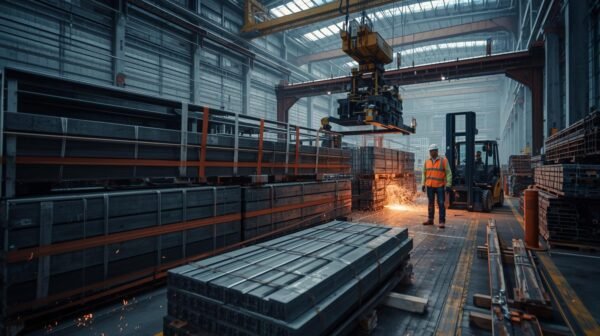
Walk through any busy fabrication plant, construction staging yard, or distribution warehouse and you will notice one thing every operation has in common — bundles, pallets, beams, and pipes held firmly in place by strapping.
Industrial strapping systems are so deeply embedded in construction logistics and manufacturing supply chains that they often go unnoticed until something goes wrong: a load shifts in transit, structural steel arrives damaged, or a warehouse accident results from an improperly secured pallet.
The global market for industrial packaging and load securing continues to expand at pace with the construction and manufacturing sectors.
As infrastructure investments accelerate across Africa, Asia, the Middle East, and North America, and as steel fabrication output climbs to meet demand from modular construction, energy infrastructure, and large-scale civil projects, the pressure on supply chains to deliver materials safely and efficiently has never been greater.
Industrial strapping systems sit at the intersection of transport safety, warehouse efficiency, and operational productivity.
A well-specified strapping solution does not simply bundle products together — it protects significant capital investment, ensures regulatory compliance in cargo transport, reduces insurance exposure, and keeps workers safe on site and in the warehouse.
This guide covers every dimension of industrial strapping systems relevant to construction professionals, fabrication companies, logistics managers, and warehouse operators — from materials science and equipment selection to automation trends, sustainability, and the future of smart strapping technology.
What Are Industrial Strapping Systems?
Industrial strapping systems are integrated solutions comprising strapping material, tensioning equipment, sealing or jointing mechanisms, and in automated configurations, conveyor integration and control systems.
Their primary function is to unitize, secure, or reinforce loads — preventing movement, damage, or collapse during handling, storage, or transport.
At the most basic level, a strapping system consists of three components: the strap itself (the band of material wrapped around a load), a method of tensioning the strap to a specified tightness, and a means of joining or sealing the strap so it holds under load.
In manual operations, all three steps are performed by a worker using hand tools. In fully automated packaging lines, purpose-built machines execute the entire cycle in seconds with precision that no manual process can match.
Strapping systems are used across a remarkable breadth of industries. In construction and civil engineering, they secure structural steel sections, concrete reinforcement bundles, timber, pipe and tube assemblies, and prefabricated elements. I
n steel fabrication, they unitize finished components for storage and distribution. In logistics and warehousing, they stabilize palletized goods for racking and transport.
In heavy manufacturing and equipment supply, they anchor oversized loads to flatbed trailers and shipping containers.
Industrial strapping is not a commodity consumable. It is an engineered component of the logistics chain — and selecting the wrong material or system for an application can result in load failure, product damage, regulatory non-compliance, or serious injury.
Why Strapping Matters in Construction and Fabrication
Safety Benefits
Load failure during transport or material handling is one of the most preventable causes of workplace injury and road accidents in the construction supply chain.
When steel sections, pipe bundles, or pallet loads are inadequately strapped, they can shift under braking, cornering, or rough road conditions.
The consequences range from damaged goods to catastrophic vehicle accidents and fatalities.
Robust industrial load securing systems prevent this. Properly tensioned strapping immobilizes loads within the designed deflection range, distributes forces across the load surface, and maintains integrity through the vibration and shock of highway transport and crane lifts.
For steel fabrication logistics in particular, where individual bundles can weigh several tonnes, the safety stakes are absolute.
Damage Prevention and Product Integrity
Construction materials and fabricated components represent significant value. A single delivery of structural steel sections, precision-cut pipe assemblies, or finished architectural metalwork can be worth tens or hundreds of thousands of dollars.
Movement during transport causes metal-on-metal abrasion, surface coating damage, dimensional deformation, and in extreme cases structural compromise.
Correctly specified strapping — with appropriate edge protection, tensioning, and material choice — preserves that value from factory to site.
Logistics Efficiency and Supply Chain Performance
Strapping contributes directly to warehouse and logistics efficiency.
Properly unitized loads stack reliably in racking systems, can be lifted and placed with standard fork equipment, and move through automated sortation and conveyor systems without intervention.
When loads are poorly strapped or strapping fails in storage, the resulting manual rework, product inspection, and repackaging consumes labor hours and delays outbound deliveries.
Regulatory Compliance and Transport Safety
Road freight regulators in most jurisdictions specify load securing requirements for commercial vehicles.
In Europe, the EN 12195 standard governs cargo securing for road transport.
In North America, the Federal Motor Carrier Safety Administration (FMCSA) sets binding cargo securement rules.
Construction supply chains moving heavy structural materials must demonstrate that loads meet tensile and dunnage requirements — and the strapping system is a key element of that demonstration.
Non-compliance exposes transport operators to fines, vehicle prohibition orders, and unlimited civil liability in the event of an accident.
For construction logistics contractors, load securing compliance is therefore not an operational nicety but a fundamental legal obligation.
Productivity Advantages
Well-designed strapping operations save time and reduce handling steps throughout the supply chain.
Unitized bundles move more efficiently through staging yards, can be picked and placed by crane or forklift without individual item handling, and unload faster at the construction site.
In fabrication shops, automated strapping machines dramatically increase throughput on packaging lines, freeing skilled operators for higher-value work.
Main Types of Industrial Strapping Materials
Selecting the correct strapping material is the foundation of any effective load securing strategy.
The three principal materials used in industrial strapping — steel, polyester (PET), and polypropylene (PP) — each have distinct mechanical properties, cost profiles, and application suitability.
Understanding these differences is essential for construction and fabrication professionals specifying strapping systems.
| Property | Steel Strapping | PET Polyester | Polypropylene (PP) |
| Tensile Strength | Highest | High | Moderate |
| Elongation / Flex | Very Low | High | Very High |
| Corrosion Risk | Yes (unless coated) | None | None |
| Weight | Heavy | Light | Very Light |
| Cost | Higher | Moderate | Lowest |
| Recyclability | High (steel) | High (PET) | Moderate |
| Best For | Structural steel, heavy loads | Palletized goods, medium loads | Lightweight packaging, indoor use |
Table 1: Comparative properties of the three principal industrial strapping materials.
Steel Strapping
Steel strapping — also called steel banding — has been the workhorse of heavy industrial packaging for over a century.
Made from high-tensile steel strip in thicknesses from 0.4mm to over 1.5mm and widths typically ranging from 13mm to 32mm, steel strapping delivers the highest tensile strength of any strapping material, making it the default choice for the heaviest construction and fabrication applications.
Structural steel fabricators rely on steel banding to bundle H-beams, I-sections, channel sections, and flat plate assemblies that can weigh several tonnes per bundle.
Pipe mills use steel strapping to secure large-diameter line pipe bundles for offshore and onshore pipeline projects. Steel banding is also widely used in securing heavy cast and forged components for machine manufacturing and heavy equipment supply chains.
The primary disadvantages of steel strapping are its susceptibility to corrosion when used outdoors or in marine environments (unless galvanized or coated), its inflexibility compared to polymer alternatives, and the edge hazard its sharp cut ends present to workers.
Appropriate PPE — including cut-resistant gloves — is mandatory when working with steel banding.
Polyester (PET) Strapping
Polyester strapping has become the dominant choice for medium-to-heavy duty industrial applications across construction logistics, fabrication, and general warehousing over the past three decades.
PET strapping offers tensile strength approaching that of steel for equivalent strap widths, combined with a critical advantage that steel cannot match: high elastic elongation recovery.
When a PET strap is tensioned and a load settles or shifts slightly — as commonly occurs with timber, concrete products, and corrugated packaging — the polyester strap recovers its tension elastically rather than going slack.
This maintained tension is what keeps palletized goods stable through the entire distribution journey, from warehouse rack to delivery point.
For construction logistics, PET strapping has largely replaced steel on palletized brick, block, and tile products; bundled timber and engineered wood products; roofing materials; and boxed hardware and fitments.
It is safer to handle than steel (no sharp metal edges), performs well in outdoor environments, and is fully recyclable at end of use — a growing consideration as construction supply chains face sustainability pressure.
Polypropylene (PP) Strapping
Polypropylene strapping occupies the lighter-duty end of the industrial strapping spectrum.
With lower tensile strength than either steel or PET, PP strapping is most appropriate for lighter palletized goods, secondary packaging, and applications where the primary function is unitizing rather than heavy load securing.
In construction supply chains, PP strapping appears on boxed hardware, insulation products, small tile and fixing packs, and interior fit-out materials.
Its very low cost makes it economically attractive for high-volume light packaging operations, and it is compatible with a wide range of manual and semi-automatic strapping machines.
The main limitations of PP strapping are its relatively low strength-to-width ratio, susceptibility to creep under sustained tension (it will elongate and lose tension over time under load), and poor UV resistance in prolonged outdoor exposure.
It is not appropriate for structural steel bundles, pipe assemblies, or any load requiring sustained high tension.
Manual, Semi-Automatic, and Fully Automated Strapping Systems
Industrial strapping systems span a wide range of mechanization, from simple hand tools through to robotic packaging lines operating at hundreds of cycles per hour.
Choosing the right level of automation for a construction or fabrication operation depends on throughput volume, product variability, available capital, and workforce capability.
| Factor | Semi-Automatic | Fully Automated |
| Throughput | Moderate | Very High |
| Labor Required | 1 operator | Minimal / supervisory |
| Capital Cost | Medium | High |
| Consistency | Good | Excellent |
| Flexibility | High | Moderate-High |
| ROI Timeframe | 6–18 months | 12–36 months |
Table 2: Operational comparison of semi-automatic vs. fully automated strapping systems.
Manual Strapping
Manual strapping tools — comprising hand-held tensioners, sealers, and cutters — remain appropriate for low-volume operations, site applications, and situations where load geometry changes frequently.
On construction sites, where the range of materials being bundled or secured varies widely and strapping requirements are intermittent, manual tools offer the flexibility that fixed machines cannot.
Steel strapping on structural lifts, temporary securing of pipe assemblies before final installation, and bundling of demolition waste for removal are common manual applications.
The limitations of manual strapping are consistency and speed.
Tension applied manually varies between operators and over the course of a shift as fatigue sets in.
Throughput is inherently limited to what a single worker can process.
For any operation handling more than a few dozen strapping cycles per shift, manual tools create a productivity bottleneck.
Semi-Automatic Strapping Machines
Semi-automatic strapping machines form the backbone of packaging operations in most medium-scale fabrication plants, building materials distributors, and regional logistics warehouses.
The operator positions the load, feeds the strap through a chute or around the load, and activates the machine — which tensions, seals, and cuts the strap automatically in a single cycle lasting two to five seconds.
Semi-automatic machines are available in bench-top configurations for lighter products and floor-standing configurations for palletized loads and heavy bundles.
They accommodate a wide range of strap widths and materials, and modern machines offer adjustable tension settings to match the fragility or density of different load types — critical in construction logistics operations handling everything from glass wool insulation to dense concrete block.
The ROI case for semi-automatic machines is generally compelling even at moderate volumes.
A single machine eliminates the inconsistency of manual strapping, typically doubles or triples throughput per labor hour, and reduces strap consumption through precise tension control and consistent strap placement.
Fully Automated Strapping Systems and Robotics
Fully automated strapping systems integrate strapping machines with conveyors, product detection sensors, and programmable logic controllers (PLCs) to process loads continuously without manual intervention.
In high-volume building materials distribution centers and steel service center operations, automated lines strap hundreds of pallet loads per hour across multiple strap positions — top, bottom, and cross-strapping — without an operator touching the load.
The leading edge of strapping automation now encompasses robotic strapping systems, in which articulated robotic arms apply strapping to complex or irregular load geometries that fixed-path automated machines cannot accommodate.
These systems are gaining traction in structural steel fabrication and heavy equipment manufacturing, where finished products vary significantly in shape and size.
Robotic strapping integrates with broader warehouse automation platforms, sharing data with warehouse management systems (WMS) and enterprise resource planning (ERP) systems to enable full digital traceability of packaging operations.
Automated strapping machines also increasingly feature smart monitoring capabilities — sensors that track strap consumption, tension consistency, and machine cycle counts, feeding data to maintenance management systems to predict and prevent failures before they cause downtime.
Key Applications of Industrial Strapping in Construction and Fabrication
Structural Steel Transportation
The transport of structural steel from rolling mill to fabrication shop, and from fabrication shop to construction site, represents one of the most demanding applications for industrial strapping systems.
Universal beams, columns, hollow sections, angle iron, and flat plate are typically bundled in weights from 500kg to 5 tonnes or more, loaded onto flatbed trailers or skeletal container platforms, and transported over long distances on roads where vibration and shock loading are constant.
Steel banding or high-tensile PET strapping — selected based on surface finish requirements — secures these bundles in multiples of four to eight straps per bundle, with edge protectors at contact points to prevent strap cutting into the steel surface or damaging protective coatings.
In hot-rolled structural steel, surface appearance is less critical and steel banding predominates. In precision fabrication and architectural steelwork, PET strapping with corner guards preserves finished surfaces.
Pipe and Tube Securing Systems
Pipe mills and tube manufacturers are among the highest-volume users of industrial strapping worldwide.
Line pipe for oil, gas, and water infrastructure is bundled in hexagonal packs — a configuration that maximizes bundle density and load stability — and secured with multiple steel straps at regular intervals along the bundle length.
For pipes with external coatings (fusion-bonded epoxy, polyethylene, or concrete weight coating), PET strapping with padded edge protection is specified to avoid coating damage.
At the construction end of the pipe supply chain, securing systems must also accommodate the staged delivery of pipe to trench-side or above-ground pipe racks, where bundles may sit on temporary timber bearers or steel supports for weeks before installation.
Strapping in these applications must maintain tension through thermal cycling and potential ground settlement — characteristics where PET outperforms steel banding.
Pallet Stabilization in Building Materials Logistics
Pallet strapping is the single largest application of industrial strapping by volume in the construction supply chain.
Brick, block, tile, stone, roofing materials, insulation boards, plasterboard, and structural timber are all palletized for transport and warehousing, and all require strapping to maintain pallet stability through repeated handling cycles.
Building materials pallets present particular challenges: the loads are often heavy (brick pallets routinely exceed 1 tonne), the products are fragile to abrasion or moisture, and the pallets may be handled multiple times — at the distribution center, at the merchant’s yard, and again at the construction site.
PET strapping dominates this sector, providing the maintained tension and elastic recovery needed to keep pallets stable through repeated lift cycles without over-tensioning and cracking brittle products.
Fabricated Metal Products Packaging
Fabrication shops producing structural steel connections, plate girders, staircase stringers, handrail assemblies, and bespoke architectural metalwork face diverse strapping requirements driven by the variability of their product mix.
Where production volumes of specific components are high enough to justify it, semi-automatic strapping machines handle repetitive packaging efficiently.
For one-off heavy fabrications destined for project-specific delivery, manual strapping tools combined with purpose-built timber and steel packaging frames provide the flexibility required.
Protecting surface finishes is paramount in this sector.
Hot-dip galvanized, paint-finished, and powder-coated fabrications require PET strapping with foam edge protection to prevent contact damage.
Stainless steel and aluminum fabrications demand non-reactive strapping materials and padding to avoid galvanic contamination at contact points.
Warehouse Operations and Pallet Racking
In construction product distribution centers and steel service centers, warehouse automation increasingly drives strapping system selection.
Automated storage and retrieval systems (AS/RS) demand precisely and consistently strapped pallet loads to operate without jam events.
Conveyor-integrated strapping machines apply consistent tension to every load at a fixed point in the inbound or outbound flow, eliminating the variability that leads to jams, dropped loads, and rack damage.
Warehouse safety is directly linked to strapping quality. Improperly secured pallet loads in high-bay racking systems present a life-threatening hazard if strap failure allows load collapse.
Industrial safety standards — including SEMA racking guidance in the UK and RMI specifications in North America — address load integrity requirements that strapping systems must meet.
Modular Construction and Off-Site Fabrication Logistics
The rapid growth of modular construction and design-for-manufacture (DfMA) approaches to building delivery is creating new strapping challenges.
Volumetric modules, panelized wall systems, and pre-assembled mechanical and electrical service modules must be packaged to survive factory-to-site transport in road and sea containers, often across international supply chains.
These loads combine structural steel frames with finished internal surfaces, mechanical systems, and glazing — requiring carefully engineered load securing systems that immobilize the module within the container without transmitting forces to fragile interior components.
Industrial Safety and Load Securing Best Practices
Industrial strapping operations carry real safety risks that must be managed through proper training, equipment maintenance, and work procedure design.
The following practices reflect industry best standards across construction logistics, fabrication packaging, and warehouse operations.
Proper Tensioning
Over-tensioning is as dangerous as under-tensioning.
Excessive tension crushes lightweight products, generates dangerous stored energy in the strap that can cause injury if the seal fails, and promotes fatigue failure of the strap itself. Under-tensioning allows load movement, strap slippage, and pallet instability.
Correctly calibrated machines with tension settings matched to the load and strap specification are the foundation of consistent, safe strapping. Manual tensioning should always use calibrated tool settings — never improvised over-pulls.
Worker Safety and PPE
Steel strapping presents the most acute worker safety hazard of any strapping material. Cut ends are razor-sharp and recoil with significant force when tension releases.
Operators must wear cut-resistant gloves rated to EN 388 Level D or equivalent at minimum, and eye protection is required when cutting steel banding.
Training on correct tool handling, strap management, and emergency procedures is mandatory for all strapping operators.
Even with polymer strapping, snap-back injury from sudden seal failure or improper tool use can cause serious lacerations.
Safe working procedures should prohibit straddling tensioned loads, reaching over taut straps, or applying tension with improvised leverage beyond tool design intent.
Equipment Inspection and Maintenance
Strapping machines, tensioners, sealers, and cutters must be inspected before use and maintained on manufacturer-recommended schedules. Worn sealer jaws produce substandard joints that fail under load — often undetected until the load is in transit or in racking.
Worn cutter blades require excessive force to operate, increasing ergonomic injury risk.
Maintaining calibration of tension settings on automated machines prevents the gradual drift that can lead to systematic under-tensioning across an entire production shift.
Common Load Securing Mistakes
- Strapping over packaging materials that will compress in transit, causing strap loosening
- Insufficient strap count for load weight and transport distance
- Omitting edge protectors at strap corners, leading to strap cutting and failure
- Using PP strapping on loads that require PET or steel specification
- Sealing joints over load corners or edges where bending stress concentrates
- Failing to account for load settling after strapping — particularly in timber and aggregate products
Sustainability Trends in Industrial Packaging and Strapping
Construction and fabrication supply chains face mounting pressure to reduce packaging waste, lower carbon footprint, and transition toward circular economy principles.
Industrial strapping systems are part of this conversation, and the materials and practices of the sector are evolving in response.
Recyclable and Sustainable Strapping Materials
PET strapping is manufactured from the same polymer as PET beverage bottles, and high-quality PET strap is now produced using significant recycled content — some manufacturers offering strapping with over 80% post-consumer recycled PET.
At end of use, PET strapping from construction and fabrication operations can be collected and returned to PET recycling streams. Steel banding, similarly, carries a high residual value as scrap metal and is recycled at rates exceeding 90% in most developed markets.
Polypropylene strapping presents greater recycling challenges due to contamination and collection economics, though the sector is developing dedicated PP recovery programs for high-volume users.
The lightest-weight PP strapping, while generating the most volume by strap count, produces the lowest mass of packaging material per strapped load — a consideration in carbon accounting for packaging waste.
Lightweight Packaging and Strap Optimization
Advanced tensioning systems and higher-specification strap materials allow the use of narrower, lighter strapping without compromising load security — reducing material consumption per load and lowering packaging cost per unit shipped.
Digital tension control in automated systems eliminates the conservative over-engineering that manual strapping operations often default to, applying precisely the tension the load requires rather than a safety margin driven by inconsistency.
Reducing Waste Through Automation
Automated strapping systems reduce strap waste in two ways. First, machine-controlled strap feed eliminates the excess strap lengths that manual operations generate when operators pull more strap than the load perimeter requires.
Second, consistent seal quality on automated machines reduces the frequency of failed joints that must be cut free and remade — a significant source of strap waste on poorly maintained manual or semi-automatic operations.
Eco-Friendly Logistics in Construction Supply Chains
Packaging automation enables load consolidation strategies that reduce total transport movements — a primary driver of carbon emissions in construction logistics.
Consistently, precisely strapped pallet loads can be stacked to the maximum safe height in vehicles and containers, improving load density and reducing the number of trips required to deliver a given volume of material.
This optimization, enabled by reliable strapping, contributes directly to construction supply chain decarbonization.
Smart Strapping Technologies and Automation Trends
The digitization of industrial packaging operations is accelerating across construction, fabrication, and logistics.
Strapping systems are no longer standalone mechanical tools — they are connected components of integrated smart manufacturing and warehouse management ecosystems.
IoT-Enabled Strapping Systems
Leading strapping machine manufacturers now offer IoT connectivity as standard on mid-range and premium automated machines.
Sensors embedded in the machine monitor strap tension, feed rate, sealing temperature (in heat-sealed systems), cycle count, and fault codes — transmitting data continuously to plant management systems or cloud-based monitoring platforms.
Maintenance teams receive alerts when parameters drift outside specification, enabling pre-emptive intervention before production disruption occurs.
IoT connectivity also enables remote diagnostics and firmware updates — machine manufacturers can connect to customer equipment via secure cloud links to diagnose faults, optimize settings, and push performance improvements without requiring an engineer visit.
For remote construction logistics operations in challenging geographies, this capability is increasingly valuable.
Predictive Maintenance and Digital Twins
Predictive maintenance algorithms analyze the sensor data streams from IoT-connected strapping machines to identify patterns that precede specific failure modes — worn sealer jaws, degraded cutter blades, or bearing wear in strap feed mechanisms.
By predicting failures before they occur, operations avoid the unplanned downtime that disrupts packaging throughput and backs up production lines in fabrication plants and distribution centers.
Digital twin technology — creating virtual models of physical strapping machines and packaging lines — allows engineers to simulate the impact of production changes (new strap specifications, different load configurations, throughput increases) before implementing them physically.
This reduces the risk and cost of process changes in live production environments.
Robotic Packaging Systems
Industrial robots are entering strapping operations at the premium end of the market, particularly for applications involving large, heavy, or geometrically complex loads that exceed the capability of conventional automated strapping machines.
Collaborative robots (cobots) working alongside human operators handle strap positioning and guiding tasks that previously required manual intervention in semi-automated lines, improving ergonomics and consistency.
Fully robotic strapping cells, integrating articulated robot arms with vision systems that identify load geometry and direct strap placement, are operating in advanced structural steel fabrication facilities.
These systems handle the variability in product dimensions that makes fixed-path automation impractical for bespoke fabrication outputs, while delivering the consistency and throughput that manual operations cannot sustain.
Warehouse Automation Integration
In modern automated distribution centers serving construction merchants and building material retailers, strapping machines operate as nodes in conveyor-based packaging lines, receiving data from warehouse management systems about which loads require strapping at which tension specifications, and feeding completion data back to the WMS to update inventory and shipment records.
This integration eliminates manual data capture at the packaging station and ensures that load securing records are captured automatically as part of the digital shipment dossier — increasingly important for transport compliance documentation.
Challenges Facing Construction Strapping Operations
Rising Material Costs and Supply Chain Volatility
The cost of strapping materials — particularly steel and PET — has experienced significant volatility over the past several years, driven by steel price cycles, polymer feedstock inflation, and global supply chain disruption.
Construction logistics operators working on fixed-price contracts have found packaging costs rising mid-project, eroding margins on material supply contracts.
Strategies to manage this exposure include volume purchase agreements with strap suppliers, material grade optimization to reduce consumption, and process automation to eliminate strap waste.
Operator Training and Skills Retention
Manual and semi-automatic strapping operations depend critically on trained operators who understand correct tensioning, seal quality inspection, load configuration, and safe tool use.
In construction logistics and fabrication, where labour markets are competitive and staff turnover is often high, maintaining consistent operator competence is a persistent challenge.
Standardized training programs, visual work instructions at packaging stations, and regular quality audits of sealed joints are the practical tools available to operations managers.
Harsh Site and Environmental Conditions
Construction site logistics operates in conditions far removed from the controlled environment of a manufacturing plant.
Strapping operations at staging yards, on site loading bays, and in temporary fabrication facilities contend with dust, moisture, temperature extremes, and the physical demands of outdoor working.
Manual tools must be robust enough to function reliably in these conditions, and strap materials must perform adequately in wet or UV-exposed environments — a particular consideration for polymer strapping.
Equipment Maintenance Requirements
Semi-automatic and automated strapping machines are precision equipment that requires regular maintenance to perform consistently.
In high-throughput operations running multiple shifts, maintenance schedules compete with production pressure.
The consequence of deferred maintenance is typically a gradual deterioration in seal quality — producing apparently sealed loads that fail under transport stress — before an outright machine breakdown forces the issue.
Building maintenance compliance into shift management protocols, supported by IoT monitoring data, is the most effective mitigation.
Future Outlook for Industrial Strapping Systems
The industrial strapping sector is entering a period of significant technological evolution, driven by the convergence of automation, digitization, and sustainability imperatives in construction and fabrication supply chains.
AI and Machine Learning in Packaging Operations
Artificial intelligence applications are beginning to influence strapping operations through adaptive tension control algorithms that adjust strap tension in real-time based on load weight, product type, and environmental conditions — going beyond the fixed preset approach of conventional machines.
Machine learning models trained on sensor data from large populations of connected machines will progressively improve predictive maintenance accuracy, reducing unplanned downtime across fleets of strapping equipment.
Growth of Automation in Construction Logistics
The construction sector’s push toward industrialized building — greater off-site prefabrication, standardized component supply, and just-in-time delivery to site — will drive increased investment in automated packaging for construction product manufacturers and distributors.
As product formats standardize and volumes through individual distribution centers grow, the economic case for automated strapping lines becomes more compelling across a wider range of construction supply chain businesses.
Smart Construction Logistics and Traceability
The integration of strapping operations with digital logistics platforms will create end-to-end traceability of load securing from packaging to delivery.
Strapping records — strap type, tension applied, operator or machine ID, timestamp — will become part of digital product passports that accompany structural materials through the construction supply chain, supporting quality management, audit requirements, and eventual circular economy tracking.
Sustainable Strapping Innovation
Materials innovation in strapping continues to advance sustainability credentials.
Bio-based polymer strapping made from renewable feedstocks is in commercial development, while advanced PET strapping incorporating increasing percentages of recycled content is already in widespread use.
Strap-free unitizing technologies — stretch wrapping, adhesive bonding, and reusable mechanical banding systems — are competing with conventional strapping in some applications, pushing the strapping industry to demonstrate its value more precisely and reduce material intensity per load.
Emerging Markets and Infrastructure Growth
Infrastructure investment programs across Sub-Saharan Africa, Southeast Asia, and the Gulf region are expanding the markets for industrial strapping systems significantly.
As local fabrication capacity grows and regional construction supply chains develop, demand for strapping equipment and materials in these markets will increase.
The shift toward higher automation levels in these growing markets — leapfrogging the incremental mechanization path taken by mature markets — creates opportunities for advanced strapping system vendors to deploy IoT-connected, high-efficiency equipment from the outset.
Strapping Systems as a Strategic Asset in Modern Construction
Industrial strapping systems are far more than a commodity consumable in the construction and fabrication supply chain.
They are engineered solutions that protect significant capital investments in materials and manufactured products, enable safe and efficient logistics operations across complex supply chains, and support compliance with transport safety regulations that carry serious legal and commercial consequences when breached.
The correct selection of strapping material — steel for the most demanding heavy industrial applications, PET for medium-to-heavy duty palletized logistics, and PP for lighter packaging operations — combined with the appropriate level of automation for the throughput and variability of the operation, creates a foundation for consistent, safe, and cost-effective packaging.
The digitization of strapping operations through IoT connectivity, predictive maintenance, robotic integration, and warehouse management system integration is transforming what was once a purely mechanical function into a data-generating, performance-optimized component of smart industrial operations.
Construction and fabrication businesses that recognize and invest in this transformation will achieve measurable advantages in supply chain efficiency, transport safety compliance, and operational resilience.
As the construction sector continues its transition toward industrialized building methods — with greater prefabrication, tighter delivery schedules, and higher expectations for supply chain visibility — the demands placed on industrial strapping systems will only increase.
The operations, technologies, and standards described in this guide represent the current state of the art; the innovations already in development will take this essential but underappreciated discipline further than many in the sector have yet imagined.
Also Read
Building the Future: Automation in Modern Fabrication Shops
What Defines the Next Generation of Strapping Safety for the Construction Industry?

- Accurate and Reliable Measurement and Monitoring of Industrial Plant Water Treatment - October 21, 2026
- SODECA Highlights Industrial Ventilation Technology at Mega Clima Expo Kenya 2026 - October 14, 2026
- How They Were Built: Inside the Engineering of the Lesotho Highlands Water Project - October 11, 2026