

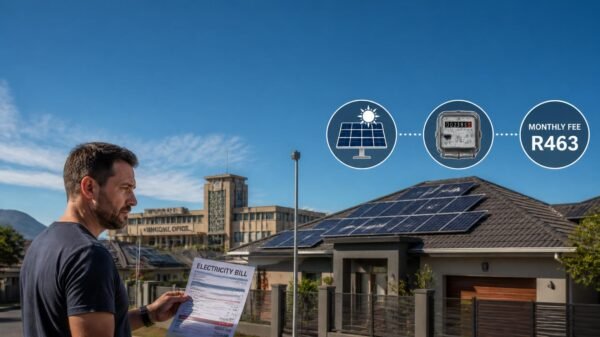
The Emfuleni Local Municipality council approved, in principle, a proposal allowing an application fee of approximately R2,400 to be charged when a resident applies to install solar panels and connect them to the power grid.
On top of that once-off registration cost, residents would have to pay a monthly levy of R463 to generate their own reliable electricity.
The municipality covers Vanderbijlpark, Vereeniging, Evaton, Sebokeng and Vaal Oewer, an industrial belt south of Johannesburg with roughly 825,000 residents.
The proposal is not yet final — it must still pass through a public participation process before being formally adopted, giving ratepayers a window to formally object before implementation.
Why Emfuleni Says the Charges Are Necessary
Emfuleni’s official justification, as reported by opposition councillors, frames the levy as compensation for a service the municipality is structurally unable to deliver.
FF Plus councillor Gerda Senekal described the charge as covering “a service that the Municipality can no longer deliver,” referring to reliable grid electricity.
The backdrop is a municipality in acute financial distress. Emfuleni owes Eskom R7.74 billion in bulk electricity debt, and it forfeited its revenue-collection privileges due to poor financial management, forcing Eskom to enter into a distribution agreement with Emfuleni in 2023 to protect its own interests.
In effect, Eskom now handles electricity billing in parts of the municipality because Emfuleni could not be trusted to manage it.
Councillors opposed to the levy argue this context exposes the real motive: it is a way for the struggling municipality to raise money rather than a genuine cost-reflective tariff.
This isn’t happening in isolation. Other utilities, like City Power in Johannesburg, are effectively penalising solar users by forcing them off cheaper prepaid tariffs onto postpaid plans with higher fixed charges — postpaid customers on an 80-amp connection face fees rising to R1,483 from 1 July 2026, compared with R241.50 for prepaid users.
Senekal argues the Emfuleni levy fits a wider trend where utilities raise fixed capacity charges to offset falling energy sales caused by self-generation, illegal connections and poor revenue collection — a genuine industry-wide problem, even if Emfuleni’s proposed solution is contested.
Resident and Civil Society Objections
Opposition has come from two directions: political parties and civil rights organisations.
The Freedom Front Plus has been the most vocal, with Senekal stating plainly that “The Freedom Front Plus sees this levy and application fee as nothing but a desperate attempt by Emfuleni to generate revenue, seeing as it is failing to provide sustainable electricity to paying residents.”
The party has urged residents to raise objections during the public participation window and has linked the issue to the upcoming municipal elections on 4 November 2026, following the recall of Emfuleni’s previous mayor.
AfriForum, the civil rights lobby group with a track record of litigating against municipal electricity tariffs, has taken a more procedural line.
Local government affairs manager Morné Mostert has demanded the municipality justify the fees before implementation, stating that “Before residents are expected to pay new fees, the Municipality must demonstrate that the charges are authorised by law.”
The organisation has formally requested documentation from Emfuleni explaining how the fees were calculated and what legal process was followed.
These objections land against a backdrop of broader service-delivery collapse in Emfuleni, including persistent sewage discharges into the Vaal River and long-standing infrastructure failures, which critics say undermines the municipality’s moral and administrative standing to introduce new charges on residents who have invested in self-generation precisely because the municipal grid is unreliable.
Compliance Questions Under South African Regulation
The legal terrain here is genuinely murky, and Emfuleni’s proposal touches several overlapping regulatory frameworks.
First, municipal tariffs generally require a municipality-specific by-law.
AfriForum’s own guidance to solar users notes that each municipality must have its own bylaw in place setting out rules for the registration of solar panels — meaning the legal basis for any charge depends on whether Emfuleni has actually adopted such a by-law, not merely a council resolution “in principle.”
Second, there is a live and highly relevant precedent involving NERSA, the National Energy Regulator of South Africa.
In a separate but instructive case, the Pretoria High Court ruled that NERSA’s approval of municipal electricity tariffs without proper cost studies and public participation processes was unconstitutional, and ordered that municipalities whose cost studies are absent must continue charging tariffs based on previously approved rates.
That ruling establishes a clear principle: municipal electricity-related charges cannot simply be conjured by council resolution — they require a documented cost-of-supply study and a genuine public consultation process.
AfriForum’s core objection to Emfuleni’s solar levy mirrors this exact argument, alleging that key rules and studies needed to support the charges are reportedly missing, and that the municipality has not clearly shown how it calculated the fees or confirmed the proper legal steps.
There is also a safety and compliance dimension feeding into the political urgency.
A house fire in Pretoria is suspected to have been caused by a solar installation using cheaper equipment, and South Africans with rooftop systems have separately been warned that failing to comply with registration and municipal rules could lead to fines, penalties, and even disconnection of electricity supply.
Municipalities can point to legitimate safety and grid-stability reasons for registering embedded generation; the dispute in Emfuleni’s case is less about whether registration itself is reasonable and more about whether the specific fee amounts were properly costed and legally gazetted before being imposed.
Implications for Rooftop Solar Adoption
If Emfuleni’s charges survive legal and public scrutiny, they could become a template — deliberately or not — for other financially distressed municipalities looking to claw back revenue lost to self-generation.
South Africa’s rolling blackouts over the past several years drove a boom in rooftop solar precisely because households and businesses stopped trusting municipal and Eskom supply.
A monthly penalty for opting out of that unreliable supply risks discouraging exactly the kind of decentralised generation that has eased pressure on the national grid.
The tension is structural, not unique to Emfuleni: municipalities earn a significant share of their revenue from electricity sales, and every household that goes off-grid or partially self-generates erodes that income base — even as it reduces strain on ageing infrastructure.
Without a nationally standardised, cost-reflective framework for feed-in tariffs and grid-connection fees, municipalities are left to experiment individually, often with legally questionable results, as the NERSA litigation history shows.
For other African municipalities watching South Africa’s experience — many of which face similar combinations of unreliable grid supply, growing distributed solar uptake, and strained municipal finances — Emfuleni’s case is instructive either way.
Handled transparently, cost-reflective connection fees can fund necessary grid upgrades to accommodate two-way power flows.
Handled as Emfuleni’s critics allege — without proper studies, by-laws, or public consultation — such charges risk protracted legal challenges, reputational damage, and a chilling effect on the very self-sufficiency that residents adopted to escape municipal service failures in the first place.
Also Read
The $40 Billion Problem: Why Africa’s Solar Financing Is Built for the Wrong Market
South Africa’s Private Energy Market Heats Up as Lyra Energy Locks In Solar Deals

- SODECA Highlights Industrial Ventilation Technology at Mega Clima Expo Kenya 2026 - October 14, 2026
- How They Were Built: Inside the Engineering of the Lesotho Highlands Water Project - October 11, 2026
- Africa’s Water Reuse Opportunity: Building the Infrastructure for a Water-Secure Future - September 28, 2026