Ask most people to name a great building and they will describe a façade, a skyline silhouette, or a lobby.
Ask a structural engineer the same question, and the conversation almost always turns upward. The roof is where the hardest problems in construction get solved: how do you cover 68,000 seated fans without a single supporting column blocking a single sightline?
How do you span 320 metres of open space using fabric thinner than a raincoat?
How do you keep snow, hail and hurricane-force wind off a stadium bowl while letting daylight pour through?
Across the world, a small circle of engineers, architects and fabricators has spent the last six decades answering those questions, and in doing so, has quietly rewritten what a roof is allowed to be.
These are not decorative canopies. They are load paths, tension networks and material science experiments performing a structural role most people never think to look up and notice.
This is CCE News‘s tour through some of the most remarkable roof structures ever built, and what they teach the construction industry, including projects rising across Africa right now, about the future of long-span design.
When the Roof Becomes the Architecture
For most of building history, roofs followed a simple rule: compression holds things up. Stone arches, timber trusses and steel beams all work by pushing loads down into walls and foundations. Tensile architecture flips that logic.
Instead of pushing, cables and membranes pull, distributing enormous forces across a lightweight net of steel and coated fabric.
The result is structures that can cover vast open spans using a fraction of the material a conventional roof would need, while creating the free-flowing, organic forms that have become the signature of contemporary stadiums, airports and public buildings.
The pioneer of this approach was the German architect and engineer Frei Otto, whose experiments with soap-film models in the 1960s proved that a minimal, naturally tensioned surface could support real structural loads.
His breakthrough transformed roof design from a matter of guesswork into a discipline any engineering faculty now teaches, and it set the template for every tensile roof that followed.
Munich’s Olympic Web: Where Tensile Engineering Was Born
Frei Otto’s defining achievement remains the roof of the Munich Olympic Stadium, built for the 1972 Summer Games.
Working with engineers who adopted principles borrowed from bicycle wheel design, the team created an outer steel compression ring supporting the seating bowl, connected inward to a tension ring formed from steel cables.
Over this cable net, 112 sections of lightweight acrylic and fabric membrane were stretched to create a canopy that appears to float above the stands.
“The Olympic Stadium proved that a fabric-and-cable roof could do everything a steel roof could do, at a fraction of the weight.”
The Munich roof was not just an aesthetic statement. Wind speeds inside the bowl had to stay below 2 metres per second to protect the validity of Olympic records, and the tensile canopy delivered that shelter without a single interior column.
More than fifty years later, engineers still study Munich as the textbook case for cable-net roof design.
Denver’s Snow-Capped Peaks: Engineering for Extreme Weather
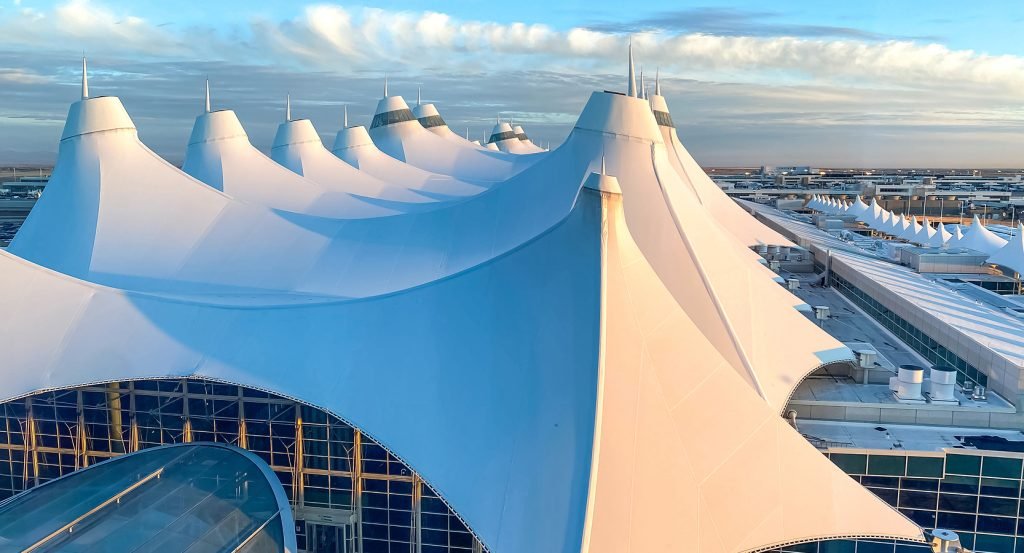
Denver International Airport’s Great Hall took Frei Otto’s thinking and applied it to one of the harshest climates any tensile structure has faced.
Engineer Horst Berger, who had translated Otto’s soap-film theory into mathematical models that could be calculated rather than sculpted by hand, designed a canopy of PTFE-coated fibreglass membrane stretched across steel cables in a series of peaks deliberately shaped to echo the Rocky Mountains behind the terminal.
Denver sits in a region prone to significant snowfall, extreme wind and occasional severe hailstorms, conditions that would test any roof system.
The Great Hall’s membrane roof has performed as the proving ground for large-span tensile fabric structures in demanding climates, and its success helped convince airport and stadium clients worldwide that fabric roofs were not a fair-weather compromise but a durable, long-term solution.
Beijing’s Bird’s Nest: Steel as Sculpture
Not every landmark roof relies on fabric. Beijing’s National Stadium, built for the 2008 Olympics and universally known as the Bird’s Nest, is built around an enormous saddle-shaped elliptical steel lattice weighing roughly 42,000 tonnes.
The stadium stretches 333 metres north to south and 294 metres east to west, rising to a height of just over 69 metres, with an ETFE cushion membrane completing the roof over the seating bowl.
What looks like a chaotic tangle of woven steel branches is, in fact, a carefully engineered structural lattice in which every member is doing real work, carrying loads, resisting wind uplift and bracing the stadium against seismic movement.
The Bird’s Nest demonstrates that tensile-inspired design thinking, lightweight, load-efficient, sculptural, can also be expressed in exposed steel rather than stretched fabric.
The O2: London’s Giant Umbrella
Originally built as the Millennium Dome and now operating as The O2 Arena in Greenwich, this is still one of the largest domed tensile structures on Earth.
A ring of twelve masts, each around 100 metres tall, supports a tensioned canopy of PTFE-coated glass-fibre fabric spanning roughly 320 metres in diameter.
From the air it resembles a vast circus tent scaled up to the size of a small stadium district, and structurally, that comparison is not far off: the same tensioning principles that hold up a canvas big top are simply engineered here at industrial scale, with steel masts and cable networks doing the heavy lifting.
Cape Town Stadium: Africa’s Own Engineering Landmark
For African readers, the most relevant entry on this list sits on the doorstep of Table Mountain.
Built for the 2010 FIFA World Cup, Cape Town Stadium’s roof is regarded as the largest cable-supported glass structure in the world, weighing close to 4,700 tonnes.
Nearly 9,000 individual glass panels are suspended from 72 steel cables, each 98 millimetres in diameter, with a compression ring fabricated in Kuwait and shipped to site in 11-metre sections weighing an average of 27 tonnes apiece.
The underside of the roof is clad in a translucent ETFE membrane, the first architectural use of that material in South African construction, engineered with enough flexibility to allow the entire roof to move up and down by as much as 2 metres in high winds.
The design team shaped the roof’s undulating silhouette to echo the traditional hats worn by Venda women, grounding an extraordinarily technical structure in local cultural reference.
Cape Town Stadium swept the South African Institute of Steel Construction Awards and went on to win Germany’s Deutscher Stahlbaupreis, proof that African contractors and engineering firms, working alongside international specialists, can deliver roof engineering at the very top tier of world sport infrastructure.
Khan Shatyr: The World’s Tallest Tensile Structure
In Astana, Kazakhstan, Foster + Partners and engineering firm Buro Happold pushed tensile design in a different direction altogether: height.
The Khan Shatyr Entertainment Center rises 150 metres above a 200-metre elliptical base, an ETFE-cushioned membrane roof suspended from a network of cables and supported by a central mast, enclosing an area larger than ten football pitches.
Inside, the transparent membrane works with heating and cooling systems to maintain comfortable temperatures year-round despite Kazakhstan’s brutal winters, turning what is essentially a giant fabric tent into a functioning indoor city district.
SoFi Stadium: The Next Generation of Roof Engineering
The newest generation of tensile roofs is trading fibreglass for ETFE film, prized for being lighter, more translucent and easier to maintain than older PTFE membranes.
SoFi Stadium in Los Angeles, home to the Rams and Chargers, uses a translucent ETFE canopy suspended from a massive steel superstructure, allowing daylight to flood the bowl while still sheltering fans from sun and rain.
It is a reminder that tensile roof design has not stood still since Munich; each generation of stadiums pushes the material and the mathematics a little further.
The Materials Behind the Magic
Every structure on this list depends on a small family of specialised materials and systems that have matured enormously since Frei Otto’s first experiments:
- PTFE-coated fibreglass fabric: the original architectural membrane, prized for durability, self-cleaning surfaces and a service life measured in decades.
- ETFE film and cushions: lighter and more transparent than PTFE, now the material of choice for stadiums such as Beijing’s National Stadium, SoFi Stadium and Khan Shatyr.
- PVC-coated polyester: a cost-efficient option widely used for shading canopies, market roofs and mid-scale tensile structures.
- High-strength steel cable networks: spiral strand and locked coil cables that carry the enormous tension loads generated across a stretched membrane.
- Compression rings and masts: the steel backbone, whether an outer ring at Munich, twelve masts at The O2, or a central mast at Khan Shatyr, that holds the entire tensioned system in equilibrium.
What unites all of it is a basic engineering truth: materials in pure tension are far more efficient than materials in bending or compression.
A cable or membrane under tension uses every fibre of its cross-section to carry load, which is why these roofs can span such enormous distances using so little material by comparison with a conventional steel-truss roof.
What This Means for Africa’s Construction Sector
Cape Town Stadium already proved that African contractors, engineering consultancies and steel fabricators can execute world-class tensile and cable-supported roof projects when the right international partnerships and skills transfer are in place.
As African cities compete for major sporting events, transport hub upgrades and mixed-use developments, long-span, lightweight roof systems offer real practical advantages: faster erection times, lower substructure loads, reduced steel tonnage and striking architectural identity for cities looking to build a global profile.
For contractors and consulting engineers across the continent, the message from these landmark projects is straightforward. Long-span tensile and cable-net roofs are no longer a niche specialism reserved for Munich, Beijing or London.
They are an increasingly accessible toolkit, backed by mature materials, proven mathematics and a track record stretching from the 1972 Munich Games to the last FIFA World Cup on African soil.
The next great roof on this list may well be under construction somewhere on the continent right now.
Also Read
Inside the Blueprint: Why Airports Have Curved Roofs
The future of roofing: Trends and Technologies to Watch

- SODECA Highlights Industrial Ventilation Technology at Mega Clima Expo Kenya 2026 - October 14, 2026
- How They Were Built: Inside the Engineering of the Lesotho Highlands Water Project - October 11, 2026
- Africa’s Water Reuse Opportunity: Building the Infrastructure for a Water-Secure Future - September 28, 2026