
WASHINGTON D.C. | June 17, 2026: The Federal Open Market Committee concludes its two-day June meeting today, and for the first time in eight years, the chair sitting at the head of the table is not Jerome Powell.
Kevin Warsh, confirmed by the Senate in a 54-45 vote on May 13, 2026 — the most divisive confirmation in Fed history — faces his first policy decision against one of the most complicated inflation backdrops the central bank has navigated in years.
The rate decision itself is almost entirely priced in. CME FedWatch data shows a 97.4% probability the Fed holds its benchmark rate steady in the 3.50–3.75% range. The Fed has not moved rates since December 2025, when it delivered its last cut.
Markets are not watching for a change today. What they are watching for is every word Warsh utters at his 2:30 PM ET press conference — and what the updated dot plot signals about where rates are headed for the remainder of 2026.
Who is Kevin Warsh?
Warsh is no stranger to the Fed. In 2006, at age 35, he became the youngest person ever appointed to the Federal Reserve Board of Governors, serving alongside then-Chair Ben Bernanke through the 2008 financial crisis and the emergency interventions that followed.
He left the Board in 2011 and subsequently became a partner at Duquesne Family Office and a visiting fellow in economics at Stanford University’s Hoover Institution, where he developed views on monetary policy that diverged significantly from the post-crisis consensus.
His public positions going into this chairmanship reflected a tighter approach to inflation discipline and streamlined Fed communication.
He has expressed a desire to emulate Alan Greenspan’s style and has indicated he may not hold press conferences after every meeting — a practice Powell instituted.
However, the Fed confirmed there will be a press conference today, making Warsh’s public debut closely scrutinised by investors across asset classes.
Critically for crypto markets, Warsh has historically taken a more open stance toward digital assets than his predecessors.
In 2025, he stated publicly that Bitcoin does not pose a systemic threat to the Fed’s capacity to control monetary conditions and may in fact serve as a useful signal for the Fed’s policy calibration — a notably different posture from Powell’s more guarded language on cryptocurrencies.
The Inflation Complication
Warsh inherits a central bank that has kept rates above inflation-target levels for over five years, and the backdrop has worsened in recent months.
The Iran war, which began in late February 2026, triggered a surge in oil prices that is now feeding through to consumer prices broadly.
The Consumer Price Index hit 4.2% annually in May 2026 — its highest reading since April 2023. Wholesale prices soared 6% in April, driven largely by energy costs.
As Krishna Guha, Head of Economics and Central Banking Strategy at Evercore ISI, noted after the April CPI print: the inflation data needs to travel a significant distance back toward disinflation before the FOMC could consider reducing rates further.
Some economists now openly discuss the possibility that Warsh’s first rate move could be a hike — an ironic outcome for a chair who, before his nomination, argued that AI-driven productivity gains would ease inflation and allow for lower borrowing costs.
Core CPI, however, came in at just 0.2% month-over-month in May — below consensus — leaving Warsh navigating a split picture: headline inflation driven by energy shocks versus a core that suggests underlying price pressures may be more contained.
How he frames this tension today will be the most consequential signal of the session.
Two Scenarios for Crypto Markets
For Bitcoin and the broader cryptocurrency market, today’s outcome pivots on Warsh’s language rather than the rate decision itself.
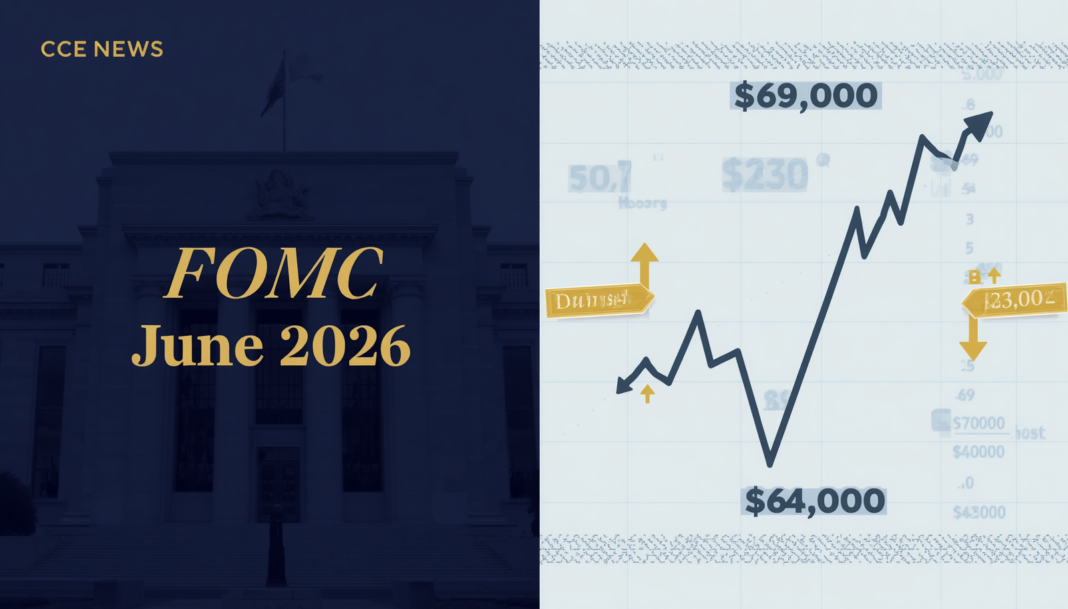
In the dovish scenario — where Warsh signals the rate path is stable and frames energy-driven inflation as transitory — markets expect Bitcoin to push through the $67,000 resistance level and target $68,500 to $70,000.
This scenario would reinstate the risk-on appetite that drove Bitcoin from below $60,000 to current levels near $66,000, and is likely to pull institutional capital back into spot Bitcoin ETFs, which recorded $85.8 million in inflows on June 16 — the first meaningful reversal after a 13-day, $4.4 billion outflow streak.
In the hawkish scenario — where Warsh’s dot plot shows at least three FOMC members projecting 2026 rate hikes, or where Warsh’s language suggests the easing bias is being formally dropped — Bitcoin faces a pullback toward $63,000 to $64,000.
Elevated real rates increase the opportunity cost of holding non-yielding assets and typically prompt institutional de-risking across risk assets, a pattern that played out sharply between mid-May and early June 2026.
Bank of America economist Aditya Bhave has flagged that the June dot plot may show the Fed on hold for the rest of 2026, with the median dot potentially dropping the last projected rate cut.
That outcome would land somewhere between the two extremes — confirming a hold path without triggering hike fears — and could produce a muted, range-bound crypto market reaction near current levels.
The Bigger Picture
What today represents for cryptocurrency markets is larger than a single rate decision. It is the first real test of how a new Fed chair — with different communication instincts, a less established policy track record, and a more open posture toward digital assets — manages market expectations under genuine inflationary pressure.
The uncertainty premium around Warsh is higher than it would be for a veteran chair whose views are well-mapped.
That uncertainty itself is a market variable. Traders have been positioning cautiously since June 16, and the FOMC press conference at 2:30 PM ET today will likely produce the clearest directional signal for Bitcoin and altcoins that markets have had in several weeks.
Also Read
Cryptocurrency Trading: Coinbase Unveils AI Tools That Can Advise Investors and Execute Trades
What to Check When Evaluating a South African Broker for Online Trading

- Inside the Blueprint: The World’s Most Incredible Roof Structures - July 7, 2026
- Inside the Blueprint: Why Airports Have Curved Roofs - July 7, 2026
- Mega Machines: World’s Largest Mobile Crushers 2026 - July 7, 2026
