

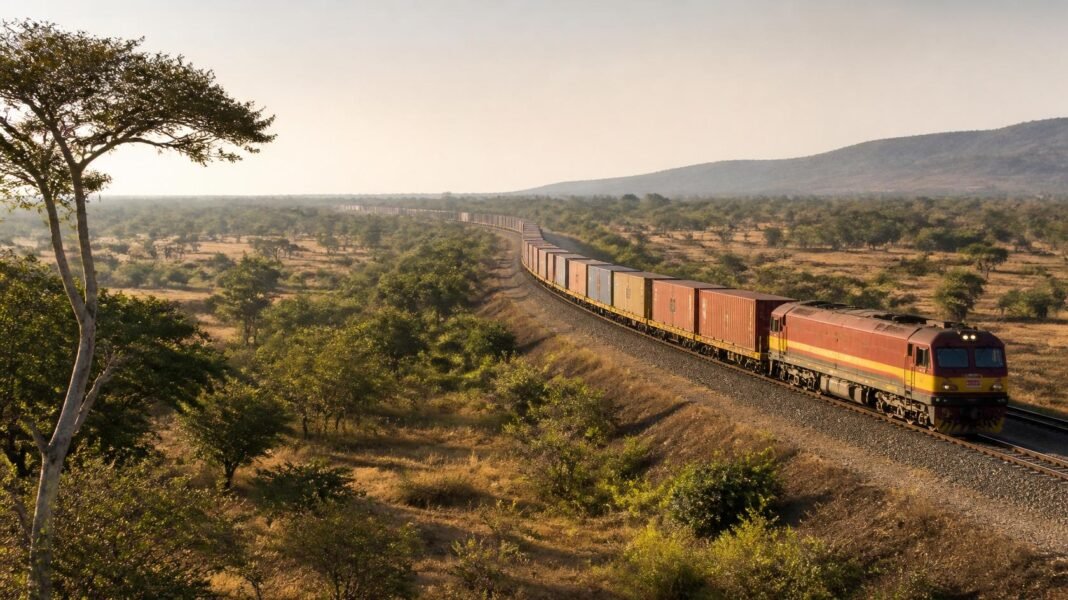
The Lobito Corridor’s transformation from concept to construction site has cleared its final financing hurdle.
The Africa Finance Corporation (AFC) has announced financial close on a $753 million package for the Lobito Corridor Railway Project in Angola, unlocking rehabilitation works on one of the continent’s most closely watched cross-border transport links.
The transaction, structured jointly by AFC and advisory firm Eaglestone, closes out a financing process that began with agreements signed late last year.
It clears the way for full-scale rehabilitation, upgrade and long-term operation of the 1,300-kilometre brownfield rail corridor connecting the Port of Lobito on Angola’s Atlantic coast to the border with the Democratic Republic of Congo.
The financing structure
The $753 million package is anchored by two development finance institutions:
- $553 million from the U.S. International Development Finance Corporation (DFC)
- $200 million from the Development Bank of Southern Africa (DBSA)
AFC and Eaglestone acted as co-financial advisers on the transaction, structuring and mobilising financing on behalf of Lobito Atlantic Railway S.A. (LAR), the project’s borrower and concessionaire.
LAR is a joint venture between construction and infrastructure group Mota-Engil and commodities trader Trafigura, with rail operator Vecturis — a specialist in freight concessions — also part of the sponsor consortium responsible for long-term corridor operations.
Why the corridor matters
The Lobito line runs through Angola’s interior toward the copper- and cobalt-rich border region shared with the DRC, one of the world’s most important sources of battery minerals.
By offering a shorter, more direct route to Atlantic shipping lanes than existing southern and eastern export corridors, the rehabilitated railway is positioned to reshape how Central African mineral output reaches global markets — cutting transit distances for cargo that currently moves through more congested or circuitous routes.
Beyond minerals, AFC and the project sponsors expect the corridor to support wider agricultural and general cargo trade between Angola and the DRC, while strengthening regional logistics capacity and export competitiveness across Southern and Central Africa.
What the sponsors are saying
“The financial close of the Lobito Corridor Railway Project underscores AFC’s leadership in delivering complex transformational infrastructure that advances Africa’s industrialisation and regional integration.
As one of the continent’s most strategic transport corridors, the project will strengthen regional connectivity, facilitate trade, and unlock new opportunities for economic growth across Angola and the wider region.”
— Samaila Zubairu, President & CEO, Africa Finance Corporation
“Reaching financial close on the Lobito Corridor Railway Project is the culmination of years of work and a defining moment for infrastructure finance in Sub-Saharan Africa.
This transaction demonstrates that complex, multi-lender, cross-border project financings can be structured and successfully closed on the continent.”
— Nuno Gil, Founding Partner, Eaglestone
Context: AFC’s growing Angola footprint
Angola joined AFC as a member state in 2022 and advanced to shareholder status in 2025, a progression that has coincided with deepening collaboration across infrastructure, energy, mobility and industrial sectors.
The Lobito financing sits alongside AFC’s other rail commitments in the country, including complementary greenfield projects, underscoring the corporation’s expanding role as a financing partner for Angola’s transport build-out.
What happens next
With financial close achieved, attention shifts to execution: rehabilitation and upgrade works along the 1,300km line, followed by LAR’s long-term operation of the concession.
For shippers and mining companies in the DRC’s Copperbelt and Lualaba region, the practical test will be whether the upgraded corridor delivers on its promise of faster, more reliable access to the Atlantic — a question Africa Logistics will continue tracking as construction progresses.
Also Read
Africa Construction in Rail and Ports: Boosting Regional Trade
10 Mega Construction Projects Set to Transform Africa by 2026

With years of experience covering infrastructure projects, equipment, and engineering solutions, Yvonne brings in-depth analysis and practical insights to contractors, engineers, and industry stakeholders.
She is passionate about highlighting sustainable construction practices and the latest advancements that drive efficiency and safety on worksites.
- Why America’s Grid Expansion Is Creating a New Construction Boom - July 31, 2026
- U.S. Housing Starts Surge 19% in June, Signalling Strong Construction Activity Despite Decline in Building Permits - July 23, 2026
- 10 Benefits of Smart Buildings: How Intelligent Buildings Are Transforming Commercial Real Estate - July 21, 2026
