

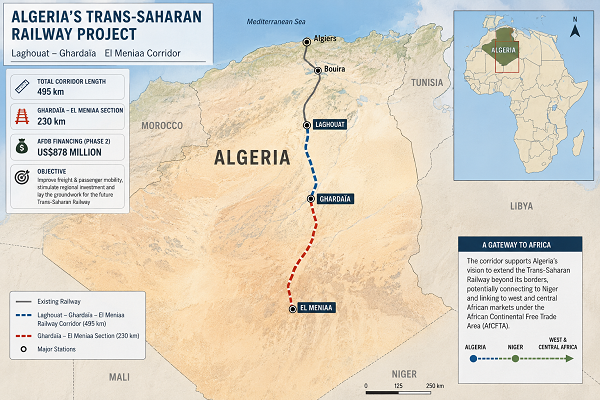
The African Development Bank (AfDB) has approved US$878 million to finance the second phase of Algeria’s 495-kilometre Laghouat–Ghardaïa–El Meniaa railway corridor, one of North Africa’s most ambitious rail infrastructure projects.
At the heart of the investment is the 230-kilometre Ghardaïa–El Meniaa section, which will extend Algeria’s railway network further into the Sahara Desert.
Beyond improving freight and passenger mobility, the line is expected to stimulate regional investment, support economic development in southern Algeria and serve as a critical building block for the proposed Trans-Saharan Railway.
If realised in full, the Trans-Saharan Railway could eventually connect Algeria with Niger and, in the longer term, integrate with wider African transport networks, supporting cross-border trade under the African Continental Free Trade Area (AfCFTA).
While the financing announcement is significant, the engineering challenge behind the project is equally remarkable.
Constructing more than 200 kilometres of railway across one of the world’s harshest environments requires advanced planning, specialised construction techniques and infrastructure designed to withstand extreme desert conditions for decades.
Building Through the Sahara
Unlike railways built across fertile plains or densely populated regions, constructing a railway through the Sahara presents unique engineering challenges.
Temperatures can exceed 45°C during summer months, causing steel rails to expand significantly.
Designers must account for thermal movement through carefully engineered rail fastening systems and expansion management techniques that maintain track stability under extreme heat.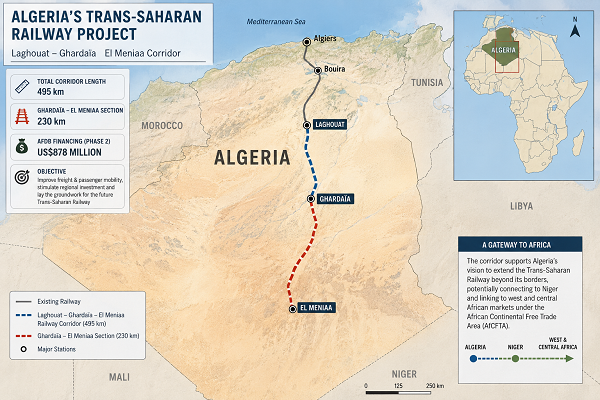
Wind-blown sand presents another obstacle. Shifting dunes can quickly cover tracks, requiring route planners to study prevailing wind patterns, install protective barriers where necessary and establish long-term maintenance strategies to keep the railway operational.
Engineers must also contend with remote construction locations where virtually every piece of equipment, construction material, fuel supply and workforce facility must be transported over long distances.
Building a railway is far more complex than laying steel rails.
The project will involve extensive earthworks to create a stable formation capable of supporting heavy freight and passenger trains for decades.
This includes excavation, embankment construction, ground compaction and ballast installation to ensure the track remains level despite changing desert conditions.
Modern signalling and telecommunications systems will be integrated throughout the corridor, enabling safer train operations while improving traffic management and operational efficiency.
Bridges, drainage structures and culverts will also form an essential part of the project. Although deserts receive little rainfall, intense storms can produce sudden flash floods capable of damaging railway infrastructure if adequate drainage systems are not incorporated into the design.
Delivering a project of this scale requires an extensive fleet of specialised construction equipment.
Bulldozers, excavators and motor graders will prepare the railway alignment, while compaction equipment will stabilise embankments before ballast is laid.
Dedicated track-laying machinery will install rails with millimetre precision, followed by ballast tamping machines that ensure the track geometry meets stringent safety standards.
Large mobile cranes will handle bridge components, signalling equipment and heavy precast concrete elements, while batching plants located near construction zones will supply concrete for foundations, drainage structures and station facilities.
Managing these operations across hundreds of kilometres of remote desert terrain demands careful logistics planning and coordination throughout every phase of construction.
Building Climate-Resilient Infrastructure
Climate resilience has become an increasingly important consideration for railway projects worldwide, and Algeria’s desert railway is no exception.
Engineers must design infrastructure capable of withstanding prolonged heat exposure, abrasive sandstorms and occasional flash flooding while minimising maintenance requirements over the railway’s operational life.
Materials are selected not only for structural strength but also for long-term durability under extreme environmental conditions.
Protective coatings, corrosion-resistant components and carefully engineered drainage systems all contribute to extending the railway’s service life while reducing lifecycle costs.
Once operational, the expanded railway is expected to improve connectivity between northern and southern Algeria, facilitating the movement of passengers, construction materials, agricultural products and mineral resources.
Improved rail infrastructure can reduce transportation costs, ease pressure on highways and create new opportunities for industrial investment along the corridor.
During construction, the project is also expected to generate employment for engineers, contractors, equipment suppliers and skilled trades.
In the longer term, enhanced rail connectivity could strengthen Algeria’s position as a strategic transport hub linking North Africa with the Sahara region.
The Laghouat–Ghardaïa–El Menia railway demonstrates that Africa’s next generation of infrastructure projects will require more than financing—they will demand advanced engineering solutions capable of operating in some of the world’s most challenging environments.
As countries across the continent expand rail networks to support economic growth and regional integration, projects like this provide valuable lessons in climate-resilient design, large-scale construction management and long-term infrastructure planning.
While the African Development Bank’s financing provides the catalyst, the real success of Algeria’s railway will ultimately be measured by the engineers, contractors and construction teams transforming ambitious plans into a durable transport corridor that serves future generations.
Also Read
- What the $25 Billion Morocco Pipeline Means for Africa’s Construction Industry
- EACOP at 80%+ and Nearing First Oil — But a London Lawsuit Could Still Reshape Its Timeline

She brings insightful analysis and in-depth reporting to the sector, highlighting innovations and developments that shape Africa’s built environment.
- How They Were Built: Inside the Construction of the Grand Ethiopian Renaissance Dam - September 4, 2026
- CNH Construction Sales Rise 12% as North American Demand Offsets Tariff Headwinds - August 3, 2026
- Wacker Neuson Expands South African Dealer Network to Strengthen Compact Construction Equipment Support - July 29, 2026
