

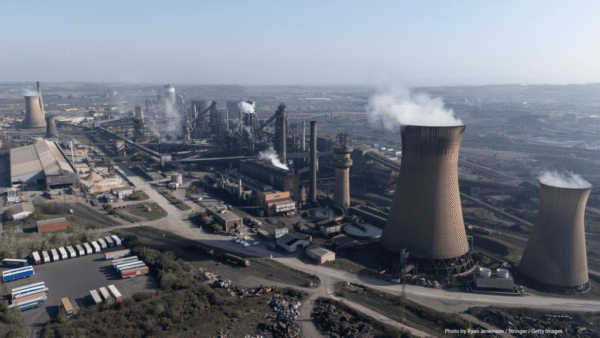
The UK government’s decision to nationalise British Steel has sparked a diplomatic row with China, but its significance extends far beyond Britain’s steel industry.
For the UK, bringing the company into public ownership was necessary to protect the UK’s national interest.
“British Steel is part of the fabric of our nation and a cornerstone of Britain’s industrial strength,” said prime minister Keir Starmer.
“Today’s decision secures the future of steelmaking in the UK, protects skilled jobs and safeguards a vital national capability,” he added.
But for African countries increasingly relying on foreign investment to build railways, ports, power plants, industrial parks and mining projects, the episode offers an important case study in how governments respond when strategic industries are deemed too important to fail.
The British government formally took ownership of British Steel after Parliament approved legislation bringing the company into public hands.
The move followed months of uncertainty over the future of the Scunthorpe steelworks, Britain’s last remaining producer of virgin steel using blast furnaces.
British officials argued that preserving domestic steelmaking was essential for national resilience, manufacturing capability and long-term economic security. Thousands of jobs were also at stake, along with supply chains that support the UK’s construction, defence and engineering sectors.
China’s sharp response
The decision drew a swift response from Beijing. Chinese officials criticised the nationalisation, arguing that it undermined the confidence of Chinese companies investing in the United Kingdom and calling for fair treatment of foreign investors.
Jingye Steel said last week that it expects the British government to compensate the company for financial losses arising from its investment in British Steel following the nationalisation.
“How Britain handles the matter will directly affect Chinese investors’ confidence in the UK’s investment climate and shape public perceptions in China of the British government’s credibility,” said the Chinese Foreign Ministry.
The reaction reflects more than the fate of a single steel company. It highlights the growing tension between governments seeking to protect strategic industries and foreign investors expecting predictable investment environments.
Around the world, governments are increasingly treating industries such as steel, energy, telecommunications and critical minerals as assets linked to national security rather than purely commercial enterprises.
Why Africa should pay attention
At first glance, British Steel appears to have little connection with Africa. The continent imports much of its steel from global suppliers while developing its own production capacity in countries including South Africa, Egypt and Algeria.
The bigger story, however, concerns infrastructure investment.
Over the past two decades, Chinese companies and financial institutions have become major partners in Africa’s infrastructure development, financing and constructing highways, standard gauge railways, ports, hydropower projects, industrial parks and mining operations across the continent.
As African economies industrialise, many of these projects are becoming increasingly strategic to national development.
The British Steel case demonstrates that governments may choose to intervene when they believe critical industries or infrastructure are at risk—even when those assets are owned by foreign investors.
Balancing investment with national interests
African governments face a delicate balancing act.
On one hand, foreign investment remains essential to closing the continent’s infrastructure financing gap. International partners provide capital, technology and engineering expertise that many countries need to accelerate development.
On the other hand, governments also have a responsibility to protect assets that are critical to economic security, industrial growth and public welfare.
The challenge is finding the right balance between maintaining investor confidence and preserving the ability to act when strategic national interests are at stake.
Lessons for policymakers
The British Steel nationalisation raises several questions that African policymakers may increasingly confront.
How should governments respond if a foreign-owned operator decides to scale back or close infrastructure considered strategically important?
What legal protections should exist for both investors and host governments?
How can countries attract long-term foreign investment while retaining sufficient policy flexibility to safeguard essential industries?
These are questions that extend beyond steel. They apply equally to ports, electricity generation, rail networks, critical mineral processing facilities and other infrastructure that underpins economic development.
Financial analysts also caution that the UK taxpayer is assuming massive liabilities. Prior to the takeover, the plant was reportedly losing £700,000 every day.
Looking ahead, the dispute between Britain and China is unlikely to reshape Africa’s infrastructure landscape overnight. However, it illustrates the growing complexity of managing foreign investment in sectors considered vital to national development.
For African governments pursuing ambitious industrialisation agendas, the lesson is not that foreign investment should be avoided. Rather, it is that partnerships must be structured to balance commercial objectives with long-term national interests.
As competition for strategic resources and industrial capacity intensifies globally, the British Steel case may become an important reference point in future debates over ownership, investment security and the governance of critical infrastructure across Africa.
Also Read
- UK Construction Sector Contracts Again as Housing Weakness Weighs on Industry
- US Mortgage Rates Climb Toward 6.8% as Housing Affordability Squeeze Deepens Into Summer

She brings insightful analysis and in-depth reporting to the sector, highlighting innovations and developments that shape Africa’s built environment.
- Moldtech: Engineering Africa’s Next Generation of Precast Concrete Production - September 23, 2026
- How They Were Built: Inside the Construction of the Grand Ethiopian Renaissance Dam - September 4, 2026
- CNH Construction Sales Rise 12% as North American Demand Offsets Tariff Headwinds - August 3, 2026