
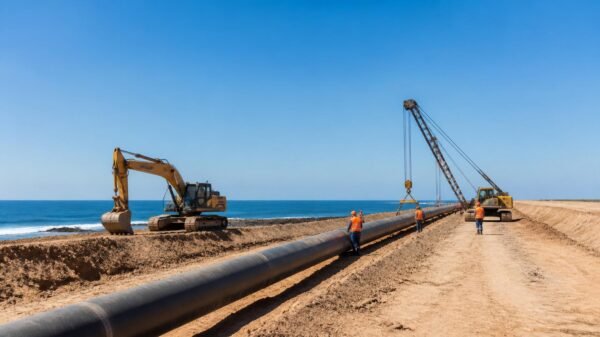
A newly disclosed environmental and social impact study has pulled back the curtain on the Moroccan segment of the African Atlantic Gas Pipeline, the $25 billion project linking Nigerian gas reserves to Morocco and, eventually, Europe.
Most of the coverage so far has focused on the geopolitics.
For Africa’s construction sector, the more useful story is what the document reveals about scope, sequencing and the machinery and labour this project will actually require once shovels go into the ground.
1. Why the Project Matters
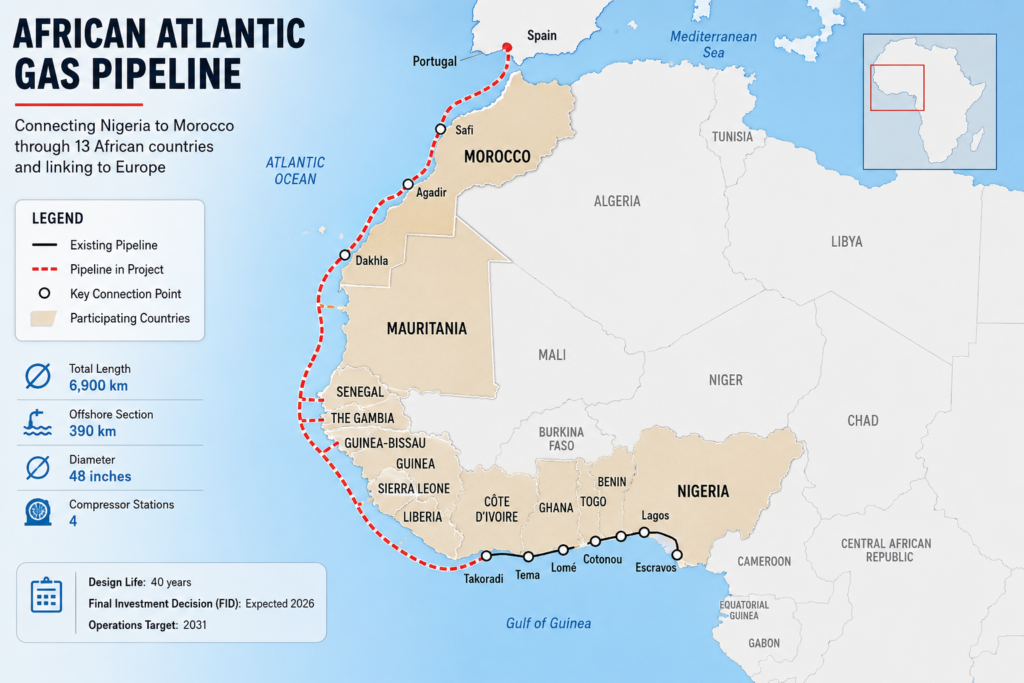
The African Atlantic Gas Pipeline is designed to move up to 30 billion cubic metres of gas a year along roughly 6,900 kilometres of coastline, tying together 13 West and North African countries before connecting into Morocco’s existing Maghreb-Europe Gas Pipeline.
For Nigeria, it is a long-awaited route to monetise gas reserves that have historically been flared or stranded.
For the ECOWAS states along the route — Benin, Togo, Ghana, Côte d’Ivoire, Liberia, Sierra Leone, Guinea, Guinea-Bissau, The Gambia, Senegal and Mauritania — it offers a shared trunk line that could underpin new gas-fired power plants, fertiliser production and industrial zones without each country having to develop its own upstream gas.
For Morocco, the pipeline consolidates a strategy that has been building for years: positioning the kingdom as the continent’s gas gateway into Europe.
Roughly half of the pipeline’s planned capacity is earmarked for Moroccan domestic use, with the balance destined for export through the Maghreb-Europe link at a moment when European buyers are actively diversifying away from Russian supply.
None of that changes unless the pipeline gets built — and building it is where the construction industry comes in.
An intergovernmental agreement between Nigeria and Morocco is expected before the end of 2026, and it is that agreement, more than any pipeline route map, that will determine when contracts start moving.
Scale matters here too. At $25 billion and 6,900 kilometres, this ranks among the largest single infrastructure projects ever attempted on the continent, comparable in ambition to the trans-Saharan gas pipeline proposal it has effectively displaced as the preferred route.
A build of this size does not move in one motion — it moves as a series of overlapping national contracts, each with its own procurement timeline, and Morocco’s segment is simply the first to reach the level of detail construction firms can actually plan against.
2. Engineering Overview
The impact study covers only the Moroccan section, but it is detailed enough to sketch the shape of what is coming.
Length and route. The Moroccan segment runs 2,220 kilometres, of which 1,830 kilometres are onshore and 390 kilometres offshore. It falls under what planners call Phase 1B, stretching from Kayar in Senegal to the tie-in point with the existing Maghreb-Europe Gas Pipeline on Moroccan soil.
Onshore vs offshore. Engineers initially studied a fully offshore route down the Atlantic coast and rejected it — the study cites higher construction and maintenance costs, greater technical complexity, and the risk of damage to marine ecosystems.
The hybrid alignment that was chosen instead lets the line serve coastal cities and industrial zones directly, while keeping at least a kilometre of buffer from populated areas and ecologically sensitive habitats.
Compression stations. Four compression stations are planned along the Moroccan overland stretch, sited near Boujdour, Tan-Tan, Agadir and Safi, spaced roughly 300 to 320 kilometres apart.
Their job is to maintain pressure and keep gas flowing steadily through a 48-inch-diameter line — a scale that puts this firmly in the category of major long-distance transmission infrastructure rather than a regional distribution network.
Terminals and camps. The Moroccan section will also include two receiving terminals and six temporary construction camps, each expected to serve roughly 300 kilometres of pipeline and house up to 1,200 workers, complete with pipe storage yards and equipment maintenance workshops.
Timeline. A final investment decision is expected in the fourth quarter of 2026.
Construction of the Moroccan section is planned to begin once that decision is taken, with commercial operations targeted for the second quarter of 2031 — a roughly four-and-a-half-year build window for this segment alone, even before accounting for the rest of the 6,900-kilometre system.
3. Construction Challenges
Few pipeline projects on the continent combine this particular mix of terrain and geography, and each element carries its own construction burden.
Offshore installation. With 390 kilometres of offshore pipe in Morocco alone — and considerably more across the project’s other coastal segments — contractors will need deepwater pipe-lay capability, seabed surveying, and trenching or rock-dumping for pipeline stability in Atlantic swell conditions that are considerably rougher than the calmer waters typical of Gulf of Guinea projects.
Desert conditions. The stretch running through Boujdour and Tan-Tan crosses arid, sparsely populated terrain on the edge of the Sahara.
That means extreme heat, sand encroachment, water scarcity for construction crews and concrete curing, and long haul distances for materials — all factors that slow productivity and drive up logistics costs relative to a temperate-climate build.
Corrosion protection. A pipeline that alternates between saline offshore water, humid coastal air and dry desert soil needs a coating and cathodic protection strategy robust enough to handle all three environments over a multi-decade design life, rather than a single specification applied uniformly along the route.
Cross-border logistics. Because the wider pipeline threads through 13 countries with different customs regimes, port capacities and regulatory approval processes, moving pipe, plant and skilled labour across borders is likely to be one of the more underestimated cost and schedule risks on the project — a pattern that has slowed other multi-country African infrastructure schemes before this one.
4. Machinery and Equipment
The fleet requirements for a project of this scale span marine, desert and industrial construction equipment simultaneously.
- Pipe-laying vessels for the offshore sections, capable of welding, coating and lowering large-diameter pipe to the seabed in Atlantic conditions.
- Sideboom pipelayers for the onshore right-of-way, used to lift, align and lower sections of 48-inch pipe into the trench without damaging the coating.
- Excavators and trenching equipment, sized for both firm desert ground and the softer coastal soils near the receiving terminals.
- Automated and semi-automated welding systems, essential for large-diameter girth welding at the pace needed to keep a multi-year linear project on schedule, backed by radiographic and ultrasonic inspection crews.
- Horizontal directional drilling (HDD) equipment, for crossing rivers, wadis and any protected habitats the route needs to pass beneath rather than through.
- Heavy lift cranes and specialised erection equipment for the four compression stations, where turbines, compressors and associated piping require a different equipment mix from the linear pipe-laying work.
For Africa’s equipment dealers and rental fleets, a project of this duration is less about a single large order and more about a multi-year, phased demand curve as work moves from camp mobilisation through pipe-laying to station commissioning.
5. Business Opportunities
No EPC contractor has been appointed yet — that step follows the final investment decision, not precedes it — but the shape of the opportunity is already visible.
EPC contractors. ONHYM and NNPC are forming a joint project company to oversee execution, financing and construction, which will in turn run the contractor selection process.
Given the project’s scale, international pipeline EPC majors are widely expected to compete for the work, likely in joint ventures with regional partners who bring local content and permitting knowledge.
Steel suppliers. A 48-inch-diameter, multi-thousand-kilometre line represents one of the largest linepipe orders the region has seen in years, with real potential for African steel producers to compete for portions of supply if they can meet the required specifications.
Concrete producers. Compression station foundations, terminal infrastructure and pipe-coating weight-coating (for offshore stability) all require reliable concrete supply, much of it in remote locations that will favour producers able to set up mobile or temporary batching plants.
Surveying and environmental firms. The impact study itself is a preview of the ongoing survey, geotechnical and environmental monitoring work the project will require at every stage, from route refinement to construction supervision.
Logistics firms. Six construction camps housing up to 1,200 workers each need sustained supply chains for food, fuel, water and materials — a significant, multi-year contract opportunity for regional logistics operators along a route that crosses some of the more remote parts of the Moroccan coast.
The realistic pattern for a project of this size is that international pipeline majors will lead the largest EPC packages, while African firms compete hardest — and win most consistently — on the second tier: civil works, camp construction and operation, local haulage, aggregate and concrete supply, and specialised subcontracts within the bigger packages.
Companies that can demonstrate a track record on comparable linear infrastructure, even at smaller scale, will be better placed when prequalification rounds open.
6. What’s Next
The near-term milestones are clear even if the contract awards are not:
- Final investment decision — expected in the fourth quarter of 2026, the trigger point for Moroccan construction to begin.
- Intergovernmental agreement — Nigeria and Morocco are working toward signing before the end of 2026, establishing the governing authority that brings the 13 participating countries into a coordinated regulatory framework.
- Procurement and tendering — EPC, equipment and materials tenders are expected to follow the FID and IGA, not precede them, so contractors positioning for this project have a realistic window to prepare qualifications now.
- Phased construction — work is expected to proceed in stages rather than as a single continuous build, starting with the segments closest to completion, including the Morocco–Mauritania–Senegal connections, with first gas from these early sections targeted for 2031.
7. The Bottom Line for African Contractors
Strip away the diplomacy, and this is a pipeline project — one that will need trenching, welding, coating, concrete, cranes and camps on a scale few projects on the continent can match.
The environmental and social impact study for the Moroccan segment is the clearest signal yet that this is moving from feasibility studies toward an actual construction programme, even if the contract awards that matter most to equipment dealers, EPC firms and materials suppliers are still to come.
For a project with a four-and-a-half-year build window on just one of its segments, the companies that start positioning now — prequalifying, scouting camp and logistics partnerships, and tracking the FID timeline — will be the ones ready to move when the tenders finally open.
CCE NEWS will continue tracking the project’s procurement, EPC appointments, equipment tenders and construction milestones as the pipeline advances toward final investment decision
Also Read
- Non-Destructive Digging Is Replacing Traditional Excavation
- Wastewater Infrastructure in Africa: The Equipment Driving Next-Gen Utilities
- Belle Rive Solar Farm: South Africa’s Largest Off-Grid Agricultural Solar Project
- India’s Navitas Solar Enters Africa: What the Expansion Means
- British Steel Nationalisation: Why It Matters for Infrastructure Projects

- Hyundai’s New HX210L: Why Earthmoving Contractors Should Pay Attention - August 7, 2026
- Top Construction Machinery Dealers in South Africa: The Companies Powering Africa’s Largest Construction Market - July 27, 2026
- Global Construction Industry on Track to Hit $22 Trillion by 2030 as AI, Energy and Infrastructure Drive New Growth - July 24, 2026