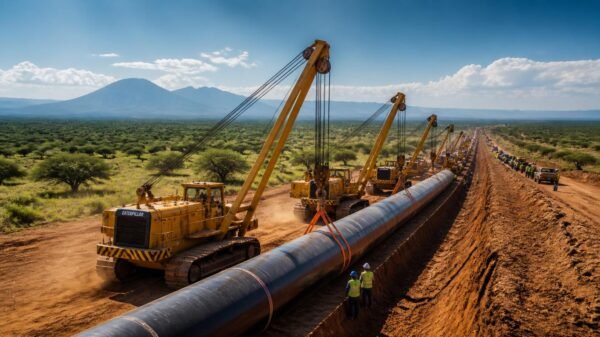
Nairobi | July 14, 2026__The East African Crude Oil Pipeline (EACOP), the 1,443-kilometre heated crude oil pipeline linking Uganda’s Lake Albert oilfields to the Tanzanian port of Tanga, has entered the final and most consequential stretch of its decade-long construction programme.
Overall construction stood at roughly 80 to 84 percent complete as of mid-2026, with the project’s marine terminal and jetty at Chongoleani, near Tanga, reported to have moved past 88 percent completion.
Commissioning is targeted for July 2026, with first oil exports projected for October.
That progress is now shadowed by litigation. On July 7, 2026, four Ugandan farmers filed a claim at London’s High Court seeking to stop EACOP Ltd, the project’s UK-registered operating company, from bringing the pipeline into service.
The case, brought by London law firm Leigh Day, asks an English court to apply Ugandan constitutional, environmental and climate law against a company incorporated in England and Wales — a jurisdictional strategy that, if successful, could set a precedent for how UK-domiciled companies are held to account for infrastructure built elsewhere on the continent.
Project Background
EACOP traces its origins to 2006, when commercially viable oil reserves were confirmed in Uganda’s Albertine Graben, along the Lake Albert basin bordering the Democratic Republic of Congo.
Estimated reserves run to roughly 6.5 billion barrels, with between 1.4 and 1.7 billion barrels considered recoverable.
Uganda’s landlocked geography meant that monetising those reserves required a dedicated export route, and after years of planning, the pipeline concept — running from Uganda’s Tilenga and Kingfisher fields, across Tanzania, to the Indian Ocean coast — took shape as the preferred solution over a rival route through Kenya.
A final investment decision was reached in February 2022, formally launching large-scale construction on what is designed to become the world’s longest electrically heated crude oil pipeline.
The project is valued at approximately US$5 billion and is majority owned by French energy major TotalEnergies (62 percent), with Uganda’s National Oil Company (UNOC) and Tanzania Petroleum Development Corporation (TPDC) each holding 15 percent, and China National Offshore Oil Corporation (CNOOC) holding the remaining 8 percent.
The 24-inch diameter line runs roughly 296 km through Uganda before extending approximately 1,147 km across Tanzania, split into three construction zones — Buliisa to Mutukula in Uganda; Mutukula to Singida; and Singida to the Tanga coast.
Six pump stations and an electric heating system are required to keep Uganda’s naturally waxy crude flowing.
At start-up, the pipeline is expected to carry approximately 216,000 to 230,000 barrels of oil per day, with capacity to scale toward 246,000 bpd. The project has employed more than 8,000 Ugandan and Tanzanian workers over the construction period.
EACOP has been contested from the outset. International campaigns — most prominently Stop EACOP — have pressed banks, insurers and investors to withdraw support, citing risks to wetlands, protected wildlife areas and communities along the route, as well as the pipeline’s lifetime carbon footprint.
Dozens of international banks and insurers have declined to finance or underwrite the project, pushing its shareholders toward greater reliance on equity and Chinese-linked financing.
Uganda and Tanzania have consistently defended the project as central to national development, job creation and, for Uganda specifically, its entry into the global oil export market.
Where Construction Stands
Progress reporting on EACOP has been uneven across sources, reflecting the different metrics used by officials and independent trackers. Tanzania’s Prime Minister’s office and TPDC leadership have offered figures ranging from roughly 70 percent in October 2025 to 79 percent by January 2026.
By April 2026, project figures cited 82 percent overall completion, with the Chongoleani marine jetty specifically reported at 88.1 percent.
In June, East African Community ministers briefing the East African Legislative Assembly in Arusha put overall construction at just over 80 percent, while independent environmental assessments published the same month placed the figure at approximately 80 percent as well.
A minority of more recent reports place completion above 90 percent, though this figure has not been corroborated by TotalEnergies, UNOC or TPDC in on-record statements available at time of writing and should be treated cautiously pending confirmation from the operator.
What is consistent across sources is the trajectory: all line pipe sections have been delivered, pump station construction is well advanced, and the Chongoleani marine terminal and jetty — the export point on Tanzania’s coast — is ahead of the rest of the project.
EACOP Managing Director Guillaume Delout said in February 2026 that the project’s focus remained on “safe, timely, and efficient project completion as we advance toward First Oil.”
The construction phase now underway is also the most environmentally sensitive: final river and wetland crossings, including the Victoria Nile crossing within Murchison Falls National Park and the Kibale/Bukoora river crossing feeding into the SAMUKA Ramsar site and ultimately Lake Victoria.
Independent reviews, including one commissioned by the Netherlands Commission for Environmental Assessment, have flagged these crossings as the pipeline’s most ecologically critical construction activity, given the use of horizontal directional drilling beneath sensitive wetland systems.
On the compensation front, Tanzanian authorities reported in late 2025 that 99.4 percent of affected households on the Tanzania side — 9,869 of 9,927 — had received compensation totalling approximately TZS 35.06 billion (roughly US$13.1 million), alongside 43 replacement homes built for displaced families.
Independent assessments, however, including those cited in the current UK litigation, dispute whether compensation levels across the full route have been adequate.
The London Lawsuit
The claim filed on July 7 targets EACOP Ltd specifically because of its UK incorporation — a fact that Leigh Day’s legal team describes as the single jurisdictional hook making the case viable in an English court.
The four claimants are Ugandan farmers whose land was acquired for the pipeline corridor. Among them is Samuel Abedilembe, a farmer from Kijumba in Hoima District, who told reporters he lost 42 percent of his landholding to the project and that compensation received was insufficient to restore his family’s livelihood.
The claim rests on three grounds drawn from Ugandan domestic law: an alleged breach of Article 39 of Uganda’s Constitution, which establishes the right to a clean and healthy environment; alleged non-compliance with Uganda’s National Environment Act, 2019; and an alleged conflict between the pipeline’s projected lifetime emissions and obligations under Uganda’s National Climate Change Act, 2021.
Leigh Day partner Matthew Renshaw said the case would be “brought under Ugandan law” despite being heard in London, because EACOP Ltd’s UK incorporation brings it within the jurisdiction of English courts.
“The primary focus of our case is to stop the operation of the pipeline in its tracks.”
— Marc Willers KC, barrister advising the claimants
Renshaw described the injunction sought — an order preventing EACOP from becoming operational — as “at the heart of this claim,” adding that even should first oil shipments begin before the case is resolved, the litigation would continue to seek an order halting operations thereafter.
The claimants are also seeking remedies for harm they say communities have already experienced during construction, including flooding, water and noise pollution, and loss of subsistence land.
Procedurally, the High Court will first need to determine whether it has jurisdiction to hear the substance of the claim at all — a threshold question that is expected to be contested.
Leigh Day has indicated the case could take approximately 12 months to reach a first hearing and around 18 months to reach trial, meaning a final resolution is unlikely before EACOP’s targeted commissioning and first-oil dates later this year.
The case adds to a broader pattern of transnational climate and human-rights litigation targeting EACOP.
The project has also faced legal challenges in France, where TotalEnergies has previously been ordered to strengthen its climate disclosures, and at the East African Court of Justice, where a coalition of civil society organisations from Uganda, Kenya and Tanzania has pursued a long-running appeal seeking to halt the project on environmental grounds.
Reactions
The lawsuit has drawn a sharp response from industry advocates. NJ Ayuk, Executive Chairman of the African Energy Chamber, characterised the litigation as “colonialism 2.0,” arguing that decisions about Uganda’s energy development should rest with Ugandan institutions rather than a British court.
The Chamber has framed the case as part of a wider trend of foreign-funded legal campaigns aimed at delaying African energy infrastructure, and has called on UK courts to decline jurisdiction over what it characterises as a sovereign development matter.
Campaign groups backing the farmers, including Avaaz, have taken the opposite view, describing the case as one of the last available avenues to halt what they term a project with lifecycle climate impacts equivalent to hundreds of millions of tonnes of carbon dioxide, and warning of irreversible damage to wetlands and biodiversity areas that intersect the pipeline route across both countries.
Outlook
EACOP’s shareholders continue to target commissioning around July 2026 and first oil exports by October, positioning Uganda to become East Africa’s first crude oil-exporting nation.
Uganda’s separate Hoima refinery project, designed to process a portion of Lake Albert crude domestically, has in parallel seen its own timeline slip, with commissioning now expected in 2029 or 2030 rather than the previously targeted 2027 — underscoring that EACOP’s export route, rather than domestic refining capacity, will carry the near-term weight of monetising Uganda’s oil discovery.
For now, construction and litigation are proceeding on separate but converging tracks. Should the pipeline reach commissioning and first oil before the London case advances to a substantive hearing, the practical significance of any eventual court ruling — and whether an operational pipeline could still be ordered to halt — is likely to become a central question in the dispute itself.
Also Read
- Why Saudi Investors Are Betting Billions on Kenya’s Mega Construction Projects
- Canada’s Biggest Infrastructure Projects to Watch in 2026

With years of experience covering infrastructure projects, equipment, and engineering solutions, Yvonne brings in-depth analysis and practical insights to contractors, engineers, and industry stakeholders.
She is passionate about highlighting sustainable construction practices and the latest advancements that drive efficiency and safety on worksites.
- Why America’s Grid Expansion Is Creating a New Construction Boom - July 31, 2026
- U.S. Housing Starts Surge 19% in June, Signalling Strong Construction Activity Despite Decline in Building Permits - July 23, 2026
- 10 Benefits of Smart Buildings: How Intelligent Buildings Are Transforming Commercial Real Estate - July 21, 2026