

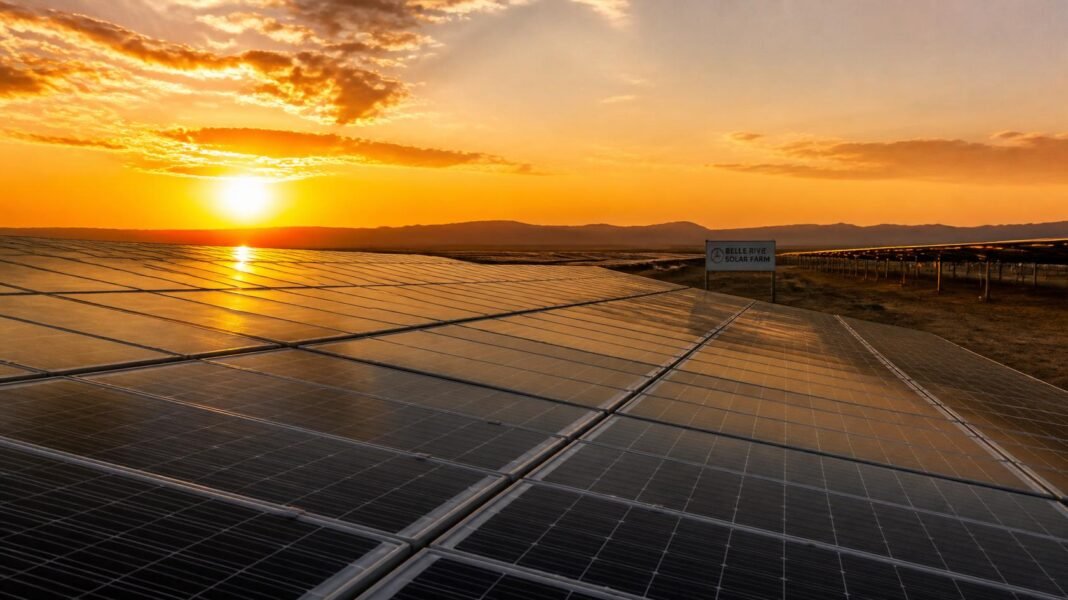
Belle Rive Farm in South Africa’s Free State is setting a new benchmark for renewable energy in commercial agriculture with a utility-scale solar and battery project designed to operate independently of the national electricity grid.
The development highlights a growing trend of large farming businesses investing in energy resilience while creating new opportunities for solar engineering, procurement and construction (EPC) contractors.
Situated on the banks of the Vaal River near Hertzogville, Belle Rive Farm has announced plans to develop what is expected to become South Africa’s largest off-grid agricultural solar energy project.
The installation combines a 4.89 MWp ground-mounted solar photovoltaic (PV) plant, a 20 MWh battery energy storage system (BESS) and an extensive medium-voltage electrical network capable of powering critical farming operations around the clock.
The project reflects a broader shift across South Africa’s agricultural sector, where reliable electricity has become as essential as water, machinery and fertile land.
Belle Rive Solar Farm at a Glance
The renewable energy development includes several major infrastructure components that place it among the country’s most ambitious agricultural energy projects.
Project highlights include:
- Location: Belle Rive Farm, Free State, South Africa
- Solar capacity: 4.89 MWp ground-mounted solar PV
- Battery storage: 20 MWh battery energy storage system
- Electrical infrastructure: Approximately 17 kilometres of medium-voltage distribution lines
- Farm size served: More than 2,000 hectares
- Purpose: Complete off-grid operation for commercial farming activities
The system is being delivered by renewable energy specialist RenEnergy Africa, which is serving as the engineering, procurement and construction (EPC) contractor for the project.
Why Belle Rive Farm Is Going Off-Grid
For many South African businesses, rising electricity costs and concerns over long-term power reliability have accelerated investment in private renewable energy infrastructure.
Belle Rive Farm operates large-scale agricultural activities including seed potatoes, ware potatoes, onions, maize and pecan nuts. These operations rely heavily on continuous electricity for irrigation systems, cold storage facilities, packhouses and processing equipment.
Farm owner Stanley de Beer said the decision was driven by the need for greater energy certainty.
“We had reached a point where the question wasn’t whether to invest in energy independence, but how quickly we could make it happen.”
He added that uninterrupted electricity is essential for maintaining large-scale farming operations where delays can disrupt irrigation schedules, storage conditions and production planning.
More Than a Solar Installation
Although described as a solar farm, the Belle Rive project is significantly more complex than a conventional photovoltaic installation.
The development requires extensive civil, electrical and mechanical engineering works, including:
- Ground-mounted solar array construction
- Battery energy storage facilities
- Medium-voltage reticulation infrastructure
- Transformers and inverter stations
- Power management and monitoring systems
- Microgrid integration
- Electrical protection and control systems
Together, these components enable the farm to function as its own independent power network rather than relying on Eskom’s electricity supply.
A Growing Market for Solar EPC Contractors
Projects such as Belle Rive illustrate how commercial agriculture is becoming an important growth market for renewable energy contractors.
Unlike rooftop commercial solar systems, utility-scale agricultural developments require multidisciplinary engineering teams capable of delivering complete energy infrastructure.
This creates opportunities for:
- Civil engineering contractors
- Electrical contractors
- Structural steel fabricators
- Battery storage specialists
- Cable and switchgear suppliers
- Automation and SCADA providers
- Operations and maintenance service companies
As larger farming businesses pursue energy independence, demand for integrated EPC services is expected to grow.
Renewable Energy Becomes Critical Farm Infrastructure
Historically, renewable energy projects on farms focused primarily on reducing electricity bills.
Today, the priorities have shifted.
Reliable power supports precision irrigation, refrigerated storage, automated grading systems, water pumping and food processing facilities that operate throughout the year.
For export-oriented farms, uninterrupted electricity can protect product quality, minimise operational disruptions and improve supply chain reliability.
This is driving investment in renewable energy infrastructure that functions as a core business asset rather than an optional sustainability initiative.
Could More South African Farms Follow?
Industry analysts believe Belle Rive Farm represents a broader transformation taking place across South Africa’s commercial agricultural sector.
As solar technology becomes more cost-effective and battery storage systems continue to improve, many large farming operations are expected to evaluate similar off-grid or hybrid energy solutions.
The trend could extend beyond agriculture to include food processing facilities, mining operations and other energy-intensive industries seeking greater control over their electricity supply.
If replicated at scale, projects like Belle Rive could reshape how rural infrastructure is designed, constructed and powered across Southern Africa.
The Bigger Picture
The Belle Rive Solar Farm South Africa project demonstrates how renewable energy is becoming a strategic investment in agricultural productivity and business continuity.
Rather than simply generating clean electricity, the project showcases how modern commercial farms are evolving into self-powered enterprises supported by sophisticated energy infrastructure.
For South Africa’s construction sector, renewable energy developers and EPC contractors, it also signals the emergence of a fast-growing market where engineering expertise, battery storage integration and utility-scale solar construction are becoming essential to the future of commercial agriculture.
Also Read
- South Africa Clears Four REIPPPP Solar Projects for Construction, Adding Over 1GW to National Grid
- South Africa’s Emfuleni Municipality Faces Backlash Over Proposed R463 Monthly Solar Panel Charge

- Hyundai’s New HX210L: Why Earthmoving Contractors Should Pay Attention - August 7, 2026
- Top Construction Machinery Dealers in South Africa: The Companies Powering Africa’s Largest Construction Market - July 27, 2026
- Global Construction Industry on Track to Hit $22 Trillion by 2030 as AI, Energy and Infrastructure Drive New Growth - July 24, 2026
