

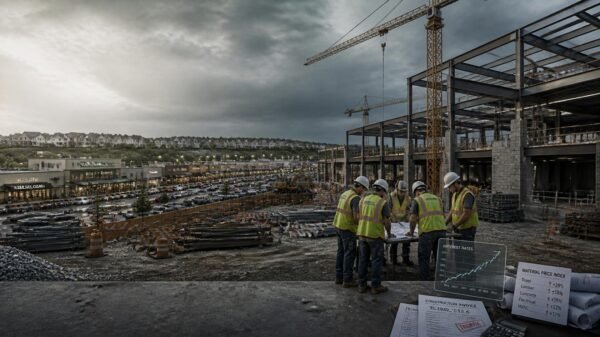
Retail construction in the United States is stuck in a rut it cannot seem to climb out of, and new data confirms the slump has become one of the defining features of the country’s built environment.
According to CoStar Group’s second-quarter 2026 report, roughly 72.1 million square feet of retail space was under construction across the U.S. between April and June — a figure that ticked up just 0.9% year over year and still sits well below the 10-year average of about 78.9 million square feet.
That modest uptick offers little comfort. Retail construction volumes remain near levels last recorded during the early stages of the post-pandemic recovery, a sharp contrast to the last full expansion cycle, when construction activity consistently topped 90 million square feet.
The first quarter of 2026 was even weaker: CoStar recorded just 64.2 million square feet under construction, down from roughly 70 million square feet a year earlier.
For contractors, developers, and equipment suppliers who have built businesses around retail construction, the numbers raise an uncomfortable question — not whether the slowdown is real, but how long it will last, and where the work has gone instead.
The Math That Won’t Pencil Out
The core problem, according to CoStar’s national director of retail analytics, Brandon Svec, is that retail development in most U.S. markets simply does not make financial sense anymore.
In the CoStar release accompanying the Q2 2026 data, Svec described a development landscape where the underlying economics of new retail projects are difficult to make work in most markets — a theme he returns to in more detail below.
Land prices, construction costs, and interest rates have all climbed sharply over the past several years, pushing the rents developers need to charge well above what most retail tenants are willing or able to pay.
Even in fast-growing markets with strong population gains and healthy leasing demand, the return on a ground-up retail project frequently fails to clear the bar investors require before breaking ground.
That dynamic explains why retail construction starts have fallen to multi-decade lows even as store closures have moderated and vacancy has stayed historically tight.
Supply simply is not being replaced at anywhere near the pace it once was, and developers have shown no appetite to change that in the near term.
Retail Ranks Among the Weakest Segments Industry-Wide
Independent survey data backs up what CoStar’s construction figures show.
The Associated General Contractors of America’s 2026 Construction Hiring and Business Outlook, released with technology partner Sage, found retail construction to be one of the three most negative segments contractors were tracking this year, alongside private office and lodging.
Contractors’ net expectations for retail construction activity fell 13 percentage points compared with the prior year, landing at negative 18% — meaning far more firms expect retail work to shrink in 2026 than expect it to grow.

AGC chief executive officer Jeffrey Shoaf summed up the broader mood among contractors bluntly:
“While there are pockets of optimism in select private-sector markets, contractors’ overall sentiment has dampened notably compared to last year.” Retail, alongside office and lodging, sits firmly outside those pockets of optimism.
Even warehouse and industrial construction, long considered a reliable growth category fueled by e-commerce and reshoring, has cooled.
AGC’s survey found contractor optimism toward warehouse construction sliding from a net reading of 14% in 2025 to just 5% this year — still positive, but at its lowest level since 2021.
Where the Work Has Gone Instead
While retail and several other private-sector categories have stalled, one segment has absorbed an outsized share of contractor capacity: data centers.
The scale of that shift has been extraordinary. U.S. data center construction spending reached $58.1 billion through May 2026 alone, according to ConstructConnect’s July 2026 Data Center Report — more than four times the record pace set over the same period in 2025.
U.S. Census Bureau figures confirmed the trend from a different angle, showing that monthly data center construction spending topped $50 billion for the first time in April 2026.
The AGC/Sage outlook data illustrates just how dominant the category has become in contractors’ own expectations.
Data centers posted the highest net reading of any segment tracked in the 2026 survey, at 57% — with 65% of contractor respondents expecting the dollar value of data center work to grow this year, compared with just 8% expecting it to shrink.
Power infrastructure construction, needed to feed the electricity demands of those facilities, is riding the same wave: starts are forecast to finish 2026 more than 30% above 2025 levels, following gains of over 20% earlier in the year.
Healthcare construction, particularly hospitals and outpatient facilities, is another category AGC expects to help drive private-sector activity in 2026, alongside water and sewer infrastructure and select manufacturing projects.
None of these segments are a like-for-like replacement for retail work — data centers and power projects, in particular, demand specialized electrical, structural, and cooling expertise that differs meaningfully from typical retail build-outs.
But for contractors and equipment operators willing to retool their crews and fleets, they represent where the growth in the U.S. construction market currently sits.
Backlogs Remain High, But Selectivity Is the New Normal
The picture is not entirely bleak for contractors exposed to retail. Industry-wide construction backlogs remain historically elevated, with many general contractors and specialty trades reporting eight to nine months of work already on their books, according to figures compiled from Commerce Bank and AGC survey data.
That suggests the underlying issue for most firms in 2026 is not a shortage of work overall, but a need to be more selective about which categories they chase and how they price the risk that comes with rising material and financing costs.
Tariff exposure has added another layer of complexity. Roughly 70% of contractors surveyed by AGC reported being affected by tariffs on construction materials in 2025, with 40% responding by raising bid prices and a further 20% adding price-adjustment clauses to new contracts.
Combined with persistent labour shortages — more than four in five firms report difficulty filling hourly craft positions — the cost and staffing environment is pushing contractors toward projects with clearer margins and more predictable timelines, a category retail increasingly struggles to offer.
What It Means Going Forward
For now, CoStar’s data suggests retail construction has found a floor rather than a bottom to build from.
The 0.9% year-over-year uptick in Q2 2026 halts a period of sharper declines, but volumes remain roughly 9% below the 10-year average and nowhere near the levels seen during the last full expansion cycle.
Barring a meaningful drop in interest rates or construction costs, that gap between achievable rents and required rents is unlikely to close quickly enough to pull significant new retail supply back into the pipeline.
In the meantime, the contractors, structural steel suppliers, electrical subcontractors, and heavy equipment operators best positioned to keep growing in the current U.S. market are those following the capital — toward data centers, power infrastructure, and healthcare facilities — rather than waiting for retail development to return to its pre-2020 pace.
A Signal Worth Watching Beyond the U.S.
The shift also carries lessons for equipment manufacturers, dealers, and construction firms operating outside the United States, including across Africa’s own fast-growing construction and logistics markets.
U.S. data has long served as an early indicator of where global capital expenditure is headed, and the current divergence — retail development stalling while data centers, power infrastructure, and healthcare facilities absorb record levels of investment — mirrors a broader repositioning of construction capacity toward digital infrastructure and energy resilience that is increasingly visible in emerging markets as well.
Heavy equipment suppliers with exposure to both markets are likely to see demand patterns shift accordingly: less appetite for machinery tied to conventional retail build-outs, and growing interest in equipment suited to earthworks, power infrastructure, and large-scale industrial and data-centre projects.
For firms tracking global construction cycles as a guide to their own regional strategy, the U.S. retail slowdown is less a standalone story than one data point in a much larger realignment of where construction capital is flowing worldwide.
Also Read
- U.S. Construction Spending Beats Expectations in April with 0.4% Rise as Housing
- Wall Street’s AI Infrastructure Boom Faces New Test

She brings insightful analysis and in-depth reporting to the sector, highlighting innovations and developments that shape Africa’s built environment.
- Moldtech: Engineering Africa’s Next Generation of Precast Concrete Production - September 23, 2026
- How They Were Built: Inside the Construction of the Grand Ethiopian Renaissance Dam - September 4, 2026
- CNH Construction Sales Rise 12% as North American Demand Offsets Tariff Headwinds - August 3, 2026