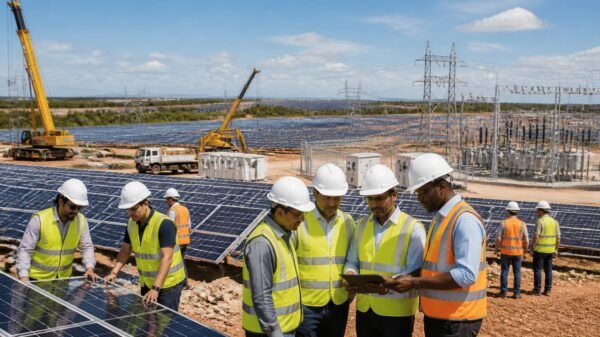
LUSAKA/SURAT, July 2026 — India’s renewable energy sector is beginning to move beyond equipment exports and into full-scale project delivery in Africa, with Navitas Solar’s first utility-scale engineering, procurement and construction (EPC) project on the continent highlighting a broader shift in how Indian companies are approaching overseas growth.
Through its EPC arm, Navitas Planet, the Surat-based solar manufacturer is developing a 54 MW captive solar power project in Zambia’s Serenje Province that will supply electricity to a mining operation.
Valued at approximately ₹200 crore (around US$23 million), the project represents a significant milestone for Navitas Solar as it transitions from being primarily a solar module manufacturer into an international renewable energy infrastructure developer.
The plant is expected to be commissioned during India’s FY27 and will become the company’s first major utility-scale EPC assignment in Africa, following an earlier 0.5 MW project in Latin America.
From Solar Manufacturer to Global Project Developer
Navitas Solar’s expansion reflects a growing ambition among Indian renewable energy companies: moving higher up the value chain.
For years, Indian firms have supplied solar modules to international markets, but utility-scale project execution has remained a more competitive space dominated by large global EPC contractors.
The Zambia project changes that equation.
Navitas will deploy its own N-type TOPCon bifacial solar modules at the site, while inverters and other balance-of-system equipment will be sourced from an established manufacturer with regional service capability.
The company has indicated that a significant portion of project equipment will be sourced from India, strengthening the role of Indian manufacturing in Africa’s renewable energy supply chain.
Founded in 2013, Navitas Solar has expanded its module manufacturing capacity to approximately 3 GW annually and has increasingly focused on international markets including Africa, Europe and the United States.
Why Zambia Matters
The choice of Zambia as Navitas Solar’s first major African EPC market is closely linked to the country’s industrial economy.
Mining is one of Zambia’s largest electricity consumers, particularly in the copper sector, where reliable and affordable power is essential for operations.
Captive solar projects allow mining companies to generate electricity directly for their facilities, reducing exposure to grid instability, diesel costs and rising energy prices.
The model is gaining momentum across resource-rich African economies, including:
- Zambia
- Democratic Republic of Congo
- Namibia
- South Africa
- Botswana
For solar developers, mining-linked projects offer an attractive opportunity because they are typically supported by industrial customers with clear electricity demand rather than depending entirely on public utility financing.
India Looks to Expand Africa Solar Presence
Navitas Solar’s move is part of a wider push by Indian renewable energy companies seeking opportunities beyond a highly competitive domestic market.
Other Indian firms have already begun establishing a presence in Africa.
Sterling and Wilson Renewable Energy has secured large-scale solar EPC projects in South Africa, while Jakson Green has expanded into solar-plus-storage developments in West Africa.
The trend reflects Africa’s growing importance in global renewable energy investment.
The continent has some of the world’s strongest solar resources, yet electricity access remains a major challenge. Rapid urbanisation, industrial growth and mining expansion are creating demand for new generation capacity.
For Indian companies, Africa offers an opportunity to combine manufacturing capability, engineering expertise and experience gained from one of the world’s most competitive solar markets.
Competing in a Market Dominated by China
Africa’s renewable energy sector has historically attracted significant Chinese involvement, with Chinese companies benefiting from large manufacturing capacity, integrated supply chains and competitive financing models.
For Indian companies, competing purely on price will be difficult.
The opportunity lies in differentiation through:
- Engineering expertise.
- Reliable project execution.
- Long-term operations and maintenance.
- Regional partnerships.
- Energy storage integration.
- Understanding local market conditions.
Successful market entry will require companies to recognise that Africa is not a single renewable energy market.
Each country has different:
- Regulatory systems.
- Power market structures.
- Financing conditions.
- Grid capabilities.
- Currency risks.
A strategy that works in South Africa may not necessarily translate directly to Zambia, Kenya or Ghana.
The Equipment Challenge Behind Africa’s Solar Growth
Behind every solar project is a wider construction and infrastructure ecosystem.
Utility-scale solar developments require:
- Earthmoving and site preparation equipment.
- Piling systems for mounting structures.
- Cranes and lifting equipment.
- Electrical infrastructure.
- Transformers and switchgear.
- Battery storage systems.
- Digital monitoring platforms.
As African solar deployment accelerates, demand will increasingly extend beyond photovoltaic modules into the broader construction supply chain supporting renewable infrastructure.
For equipment manufacturers, EPC contractors and engineering companies, Africa’s energy transition represents a growing infrastructure opportunity.
Financing and Execution Will Determine Success
Despite Africa’s enormous solar potential, project development remains challenging.
Developers must consider:
- Currency volatility.
- Payment security.
- Grid limitations.
- Regulatory uncertainty.
- Availability of skilled local partners.
Projects backed by industrial customers, such as mining companies, may offer stronger commercial foundations because they provide a defined electricity buyer.
This is one reason captive renewable energy projects are attracting increasing attention across Africa.
What Navitas Solar’s Move Could Mean
The Zambia project will serve as an important test of whether Indian renewable energy manufacturers can successfully expand from supplying components into delivering complete energy infrastructure solutions.
Success could encourage more Indian companies to pursue African opportunities in:
- Utility-scale solar.
- Mining renewable power.
- Battery storage.
- Industrial energy systems.
- Hybrid power projects.
For Africa, increased participation from Indian companies could bring additional sources of technology, financing and engineering expertise into a market where demand for clean energy continues to rise.
Navitas Solar’s Zambia project is therefore more than a single solar installation. It represents a wider transformation taking place in global renewable energy — where manufacturers are increasingly becoming infrastructure developers, and where Africa is emerging as a strategic destination for companies seeking long-term growth.
The companies that succeed will not simply export equipment. They will build local partnerships, understand market realities and deliver energy solutions designed for Africa’s unique operating environment.
CCE News will continue tracking Navitas Solar’s African order book, along with the wider build-out of mining-linked captive solar capacity across Zambia, South Africa and the broader SADC region.
Also Read
- The Future of Solar Energy in Africa:Trends, Challenges, and Opportunities Through 2035
- South Africa Clears Four REIPPPP Solar Projects for Construction

She brings insightful analysis and in-depth reporting to the sector, highlighting innovations and developments that shape Africa’s built environment.
- Moldtech: Engineering Africa’s Next Generation of Precast Concrete Production - September 23, 2026
- How They Were Built: Inside the Construction of the Grand Ethiopian Renaissance Dam - September 4, 2026
- CNH Construction Sales Rise 12% as North American Demand Offsets Tariff Headwinds - August 3, 2026