

South Africa’s Cabinet has approved the Integrated Social Facilitation Framework (ISFF) as a binding national policy instrument, marking the country’s most structured attempt yet to dismantle the extortion networks known as the “construction mafia.”
Announced by Public Works and Infrastructure Minister Dean Macpherson on 7 July 2026, the framework moves government from reacting to site invasions after they happen to preventing them before ground is broken.
For an industry that has watched more than 180 infrastructure projects worth roughly R63 billion disrupted, halted, or delayed since 2019, the ISFF is not another statement of intent. It is a compliance obligation.
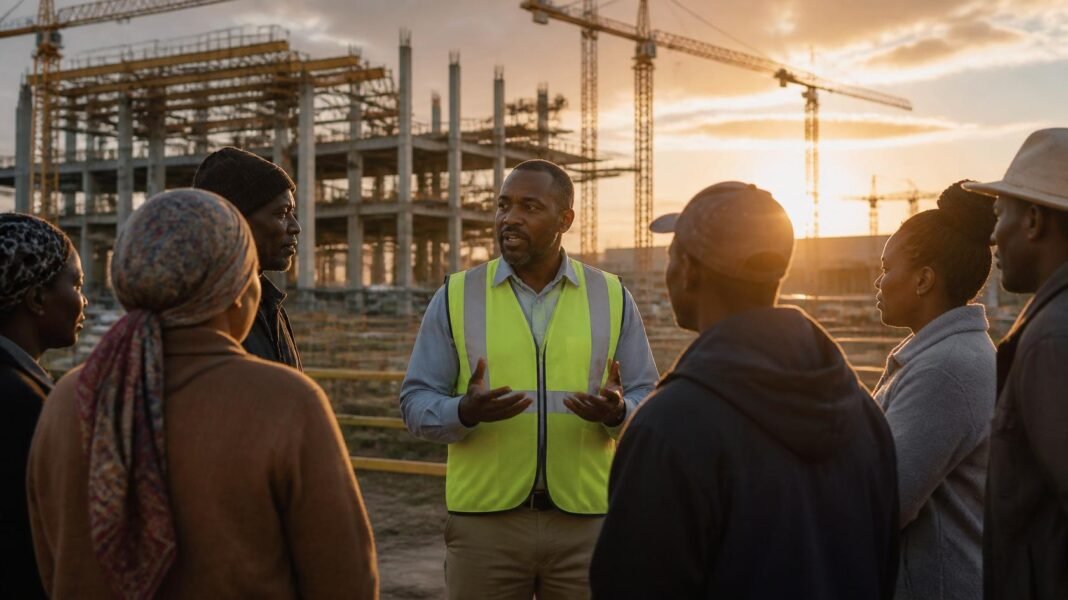
Government departments, municipalities, state-owned entities, and every stakeholder in the infrastructure development chain are now required to engage communities before construction begins, using a standardised national process rather than the ad hoc arrangements that have varied from province to province.
Why the Framework Exists
Construction mafia activity has followed a familiar pattern since it first surfaced in KwaZulu-Natal: groups presenting themselves as “business forums” or community representatives approach a project and demand a share of its value, typically citing a misreading of the Preferential Procurement Policy Framework Act’s 30% subcontracting provisions.
When contractors refuse, the response has ranged from work stoppages and vandalism to intimidation, assault, and in some cases killings on site.
National Treasury has been explicit that no such 30% entitlement exists in law for private contracts, and demands of this kind constitute extortion under both common law and the Prevention of Organised Crime Act.
Macpherson framed the scale of the problem as structural rather than isolated. “This is important because the construction mafia does not operate in one sphere of government, and infrastructure delivery does not sit in one department alone.
A national problem requires a national framework,” he told reporters at the 7 July briefing. The comment captures the core design logic of the ISFF: rather than leaving individual departments, provinces, or state entities to manage community risk on their own, the framework creates one standardised, mandatory process that applies across all of them.
The urgency is tied directly to South Africa’s infrastructure ambitions. Government has committed more than R1 trillion in public investment over three years to build and maintain infrastructure, and Macpherson has been candid that this spending is meaningless if project sites remain under criminal control.
“South Africa cannot turn itself into a construction site if construction sites are controlled by criminals,” he said, referencing his own “turn South Africa into a construction site” slogan from when he took office in July 2024.
What the Framework Actually Requires
At its core, the ISFF standardises community engagement across the entire infrastructure project lifecycle, not just at the point where conflict typically erupts.
It is designed to address community protests, project disruptions, vandalism, delays, and security risks by building structured community participation into planning from the outset, rather than treating social facilitation as a reactive, late-stage fix. Four structural requirements sit underneath that goal.
Social facilitation built into planning and procurement from day one. Historically, community engagement specialists have entered projects only once construction was imminent.
Sharon Shunmugam, president of the South African Council for the Project and Construction Management Professions (SACPCMP), explained that facilitators have “normally become involved in the project around Stage Five, which is known as implementation, when it’s shovel about to hit the ground.”
Under the ISFF, that engagement moves to the earliest planning and budgeting stages, with the explicit intention of de-risking projects before contractors and equipment ever arrive.
Professionalised, accredited social facilitators. The framework introduces a new registration category for social facilitators, developed jointly by the SACPCMP and the Council for the Built Environment (CBE).
This formalises what has until now been an unregulated function, with the aim of ensuring facilitators are qualified, accountable, and consistent in how they engage communities.
Acting Deputy Director General for Real Estate Management Services Molatelo Mohwasa clarified that the Department of Public Works and Infrastructure (DPWI) itself will not appoint these facilitators; instead, the department is setting the national standard, framework, and guidelines that the profession will operate under.
Clearer governance and a risk-based approach. Implementation will be coordinated through a DPWI-led Integrated Social Facilitation Collaboration Committee, bringing together the DPWI, the Infrastructure Technical Assistance Facility, the CBE, the Construction Industry Development Board (CIDB), the Independent Development Trust, the Association of Social Engagement Facilitators of South Africa, the South African Local Government Association (SALGA), the Municipal Infrastructure Support Agent (MISA), the Association of Construction Project Managers, the SACPCMP, and National Treasury.
High-risk projects, where community conflict, extortion, vandalism, or disruption is judged most likely, are to be prioritised first.
Stronger monitoring, evaluation, and consequence management. The framework commits government to measuring whether professional social facilitation is actually reducing disruptions and improving community relationships on the ground, rather than assuming the policy is working by default.
Enforcement remains tied to existing law enforcement structures: Macpherson was explicit that the ISFF “does not replace law enforcement.
It strengthens it,” and that government will continue working with the South African Police Service, National Treasury, the CIDB, provinces, and municipalities “to ensure that those who commit extortion, intimidation, violence and procurement abuse face consequences.”
The Five-Point Implementation Plan
Macpherson laid out five practical areas of focus for rollout. First, prioritise implementation on high-risk projects.
Second, work with public entities, provinces, municipalities, and implementing agents to ensure social facilitation is embedded in project planning and procurement from the start.
Third, advance the professionalisation, accreditation, and registration of social facilitators with SACPCMP and the CBE.
Fourth, strengthen monitoring and reporting to measure whether the approach is reducing disruptions.
Fifth, continue working with SAPS, National Treasury, the CIDB, provinces, and municipalities to ensure consequences for extortion, intimidation, violence, and procurement abuse.
Implementation guidelines are currently being developed, awareness webinars are being run across the built environment sector, and SACPCMP is advancing the professional registration category for facilitators.
The Track Record Behind the Policy
The ISFF does not emerge in isolation. It builds on the Durban Declaration, signed in November 2024 following a national summit that brought together the DPWI, SAPS, National Treasury, the CIDB, public entities, and industry stakeholders.
Since that declaration, more than 770 cases of construction-related extortion and intimidation have been reported nationally, resulting in 241 arrests and 176 convictions.
KwaZulu-Natal, where the construction mafia phenomenon first took hold, has been used as the proof of concept.
Monthly site disruptions in the province have fallen from more than 60 incidents to fewer than 10, a decline government is now citing as evidence that structured social facilitation, combined with law enforcement pressure, actually works at scale.
The ISFF is effectively an attempt to replicate that provincial result nationally through binding policy rather than voluntary cooperation.
What It Means for Contractors and Investors
For contractors, developers, and public entities, the practical shift is that social facilitation budgets and community engagement plans will need to be factored into procurement and planning documentation from the earliest project stages, rather than added reactively once tensions surface on site.
Projects flagged as high-risk are likely to face closer scrutiny and earlier facilitator involvement.
For investors watching South Africa’s infrastructure pipeline, the framework is a signal that government is treating the extortion economy as a structural risk to the R1 trillion infrastructure programme, not a peripheral law-and-order issue.
Analysts have also cautioned against overstating the direct financial toll of the crisis. While the R63 billion figure is frequently cited, it represents the total capital value of infrastructure projects that were delayed, halted, or affected, not cash or assets stolen directly by criminal groups.
Broader estimates, incorporating think-tank and government data, put the direct annual drain on the economy at closer to R17 billion a year.
What Comes Next
The ISFF does not, by itself, end construction site extortion. Macpherson has been clear that it operates alongside, not instead of, law enforcement and prosecution.
Its real test will be whether the accreditation of social facilitators, the risk-based prioritisation of projects, and the new monitoring architecture can reproduce KwaZulu-Natal’s disruption decline in provinces where the construction mafia has more recently taken hold, including Gauteng and the Eastern Cape.
With implementation guidelines still being finalised and the professional registration category still being built out, the coming months will determine whether the ISFF becomes the operational backbone of South Africa’s fight against construction extortion, or another well-intentioned framework awaiting enforcement capacity to catch up with its ambitions.
Also Read
Lobito Corridor Rail Project Moves to Construction as AFC Secures $753m Financial Close
South Africa Clears Four REIPPPP Solar Projects for Construction, Adding Over 1GW to National Grid

She brings insightful analysis and in-depth reporting to the sector, highlighting innovations and developments that shape Africa’s built environment.
- How They Were Built: Inside the Construction of the Grand Ethiopian Renaissance Dam - September 4, 2026
- CNH Construction Sales Rise 12% as North American Demand Offsets Tariff Headwinds - August 3, 2026
- Wacker Neuson Expands South African Dealer Network to Strengthen Compact Construction Equipment Support - July 29, 2026
