

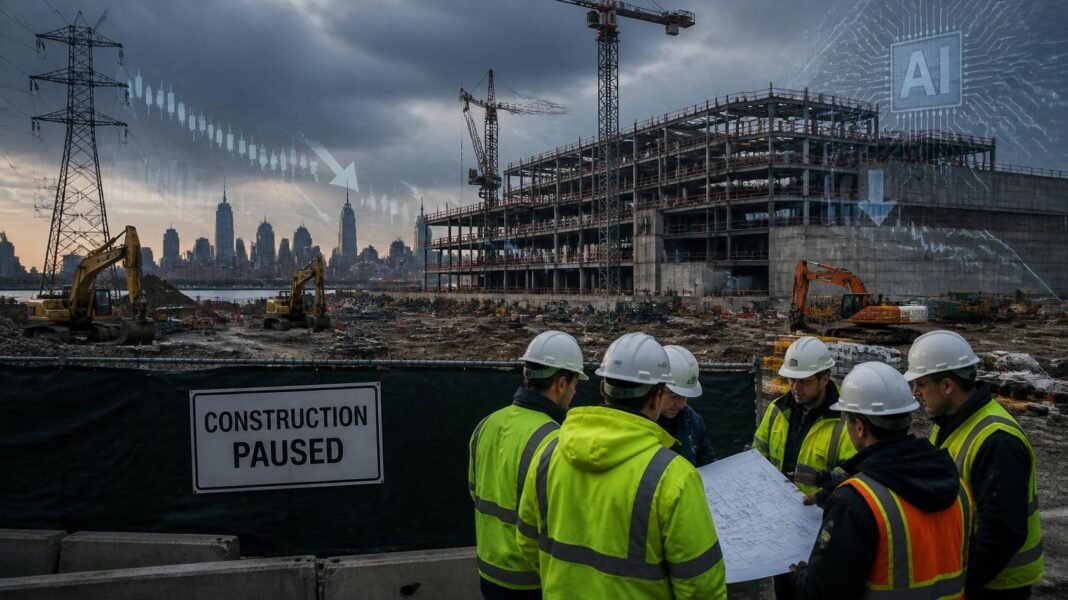
NEW YORK, July 14, 2026 —New York has become the first U.S. state to halt construction of large-scale data centres statewide, a move that lands squarely in the path of one of the biggest capital-spending booms the global construction industry has ever seen.
Governor Kathy Hochul signed an executive order on Tuesday freezing state environmental permitting for hyperscale facilities for up to a year, a decision that reverberates well beyond Albany and into the boardrooms of hyperscalers, EPC contractors and heavy equipment suppliers who have built their forward order books around the AI data centre gold rush.
For an industry that has treated data centre construction as one of the few unambiguous growth verticals of the decade, the order is a signal that the political and infrastructural limits of that growth are starting to bite.
What the Order Actually Does
The moratorium applies to “hyperscale” facilities capable of drawing 50 megawatts or more of power, according to Hochul’s office.
It pauses state-level permitting for new large data centres while the Department of Public Service develops a regulatory framework addressing energy demand, water consumption, land disruption, noise pollution and grid reliability.
The freeze does not affect projects that already hold permits, but it stops new hyperscale developments from entering the pipeline for up to twelve months.
“As data center development threatens to hike up utility bills, deplete our natural resources, and create uncertainty for New Yorkers, it’s my responsibility to take action and lead.”
— Gov. Kathy Hochul
Hochul framed the pause as a way to get ahead of a buildout that state regulators had not yet caught up with, rather than a rejection of the technology itself.
“New York will lead the way in creating the strongest standards in the nation for data center development, ensuring that when companies succeed because of New York, New Yorkers succeed too.”
— Gov. Kathy Hochul
Why Contractors and Equipment Suppliers Should Care
Data centres have quietly become one of the largest single categories of non-residential construction spend in North America, pulling in concrete, structural steel, precision HVAC, backup generation and high-voltage electrical work at a scale that rivals traditional infrastructure megaprojects.
According to New York’s independent grid operator, more than 12 gigawatts of large energy-using loads, including data centres, were already queued to connect to the state’s grid as of May — a pipeline now frozen at the permitting stage.
The New York order is not an isolated event. Communities across the United States have blocked or delayed more than $130 billion worth of AI data centre projects since the start of 2026, as local opposition to power and water demands hardens into policy.
Maine’s legislature passed its own moratorium earlier this year, though it was vetoed by Governor Janet Mills after objections over a single stalled project.
Dozens of other state legislatures have introduced bills aimed at reining in data centre expansion, even as demand from hyperscalers shows no sign of slowing.
The Wall Street Angle
The timing matters. Major cloud and AI players have been raising capital-expenditure guidance through 2026 on the back of surging demand for AI infrastructure, with systems integrators reporting record order backlogs for rack-scale AI server deployments.
That capex has flowed directly into construction pipelines: transformer lead times have stretched, gas turbine and grid-equipment backlogs have lengthened, and general contractors specialising in mission-critical facilities have been among the busiest in the sector.
A regulatory pause of this scale introduces a new variable into that growth story.
Investors have treated data centre capex as one of the more durable pillars of the AI trade; a first-in-the-nation moratorium, even a temporary one, tests whether that durability holds up against local political resistance over electricity prices and water use.
National polling adds context to the politics: a Gallup survey published in May found 71 percent of Americans are somewhat or strongly opposed to data centres in their communities, a higher opposition rate than for nuclear power plants.
Political Stakes in Albany
The order also carries weight in New York’s own political calendar. It arrives ahead of a competitive gubernatorial race in which Hochul’s Republican challenger, Nassau County Executive Bruce Blakeman, has argued against a statewide freeze, favouring local deal-making between municipalities and tech companies instead.
The state legislature had already passed its own year-long moratorium bill earlier this year, but Hochul’s office opted for an executive order rather than signing that legislation, saying it needed further work.
Hochul has also indicated she will pursue legislation to repeal sales tax exemptions currently available to large data centre developers.
What to Watch Next
For the construction and engineering sector, the immediate question is whether other states follow New York’s lead or whether the moratorium proves to be an outlier driven by New York’s unusually high residential electricity costs — among the highest in the country, according to U.S. Department of Energy data.
Either way, EPC firms, mechanical and electrical contractors, and OEM suppliers with data centre-heavy order books now have a live case study in how quickly regulatory sentiment can shift against a sector that, until recently, state and local governments were actively courting.
CCE News will continue tracking data centre construction policy across North America, alongside its ongoing coverage of U.S. and Canadian infrastructure spending, as part of its broader reporting on global construction markets relevant to African contractors, suppliers and investors watching international capital flows.
Also Read
- Wall Street Is Pouring Billions Into AI Data Center Construction. Here’s Why
- Top Data Centre Projects Under Construction in the U.S

She brings insightful analysis and in-depth reporting to the sector, highlighting innovations and developments that shape Africa’s built environment.
- How They Were Built: Inside the Construction of the Grand Ethiopian Renaissance Dam - September 4, 2026
- CNH Construction Sales Rise 12% as North American Demand Offsets Tariff Headwinds - August 3, 2026
- Wacker Neuson Expands South African Dealer Network to Strengthen Compact Construction Equipment Support - July 29, 2026
