

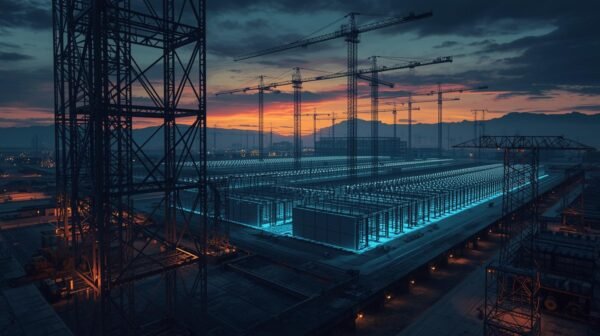
The global construction industry has witnessed many cycles — commodity booms, urban expansion, post-war rebuilding — but few compare in speed and scale to what artificial intelligence is now driving.
In 2025 alone, total spending on US data center construction starts reached an estimated $77.7 billion, a staggering 190 percent year-over-year increase, according to a February 2026 report from ConstructConnect.
Monthly spending on data center construction starts jumped from around $500 million in mid-2021 to $6.5 billion by December 2025 — a thirteenfold increase in under five years.
And the pipeline shows no sign of cooling. Construction intelligence platform ConstructConnect was already tracking 76 projects valued at more than $88 billion slated to begin within the first six months of 2026 — a figure already 13 percent higher than total 2025 starts.
In the Associated General Contractors’ 2026 Construction Outlook survey, a net 57 percent of respondents foresaw higher data center spending this year, making it the single most bullish sector across the entire survey — far ahead of power construction at 34 percent.
Globally, the numbers are even more arresting. This once-in-a-generation investment supercycle is projected to require $3 trillion in capital by 2030, according to Built In research.
For the first time in recorded history, US spending on data center construction has officially surpassed spending on traditional office buildings.
The sector’s compound annual growth rate ran at 98 percent between 2021 and 2025 — a figure almost without precedent in the construction economy.
📊 Key Figures at a Glance
US data center construction starts (2025)
▲190% YoY
Global investment projected by 2030
Global capacity expected to double by 2030
Big Tech capex (2025–2026)
Projected data center power demand
The Hyperscale Catalyst
The proximate cause of this extraordinary buildout is clear: the explosive commercial deployment of large language models and generative AI applications, which require vastly more compute infrastructure than any prior wave of internet technology.
A single AI training cluster can consume as much power as a small city. Running inference — generating responses in real time — demands that this capacity be distributed across dozens of facilities worldwide.
The scale of individual project commitments reflects this reality. The Stargate Project, formed in January 2025 by OpenAI, SoftBank, Oracle and MGX, announced a $500 billion four-year commitment to AI infrastructure across multiple US states.
Amazon Web Services committed $100 billion to expand its Generative AI Innovation Center.
Meta brought a $1 billion Kansas City facility online, opened a new plant in El Paso, Texas, and began construction on its 30th data center in Beaver Dam, Wisconsin.
Microsoft committed approximately $80 billion to AI infrastructure in 2026. Alphabet, Amazon, Microsoft and Meta collectively planned to invest over $350 billion in data centers in 2025 and around $400 billion in 2026.
Bank of America estimated that global hyperscale spending rose 67 percent in 2025 and a further 31 percent in 2026, totalling $611 billion in just two years. These figures do not merely represent technology spending — they represent construction demand at an industrial scale.
What This Means for Contractors and Builders
For the construction industry, AI data centers have become a defining revenue line — and in many markets, a lifeline.
Where residential construction has softened, office construction remains subdued, and infrastructure spending moves at the pace of government procurement, data center projects are moving fast and paying well.
Construction Dive described data centers as ‘the beating heart of the building industry’ in 2025.
A December 2025 study from the American Edge Project counted 4,149 active US data centers, with thousands more in planning and permitting phases across 2026.
The scope of individual campuses has grown to match: a large AI campus now routinely requires 4,000 construction workers — compared with 750 for a conventional data center just a few years ago.
The compensation premium is visible. Fortune reported in late 2025 that construction workers on data center projects are earning six-figure salaries — wages being inflated across the trades to satisfy what experts describe as seemingly insatiable AI-driven demand.
JLL’s 2026 Global Data Center Outlook estimates that global data center construction costs rose from $7.7 million per megawatt in 2020 to $10.7 million per megawatt in 2025, a seven percent compound annual growth rate, with a further six percent increase forecast for 2026.
For civil and structural contractors, MEP subcontractors, and specialist fit-out firms willing to develop capability in this sector, the opportunity is substantial. The challenge is getting qualified and getting in fast.
New Technical Demands: Cooling, Power and Design Innovation
AI data centers are not conventional data centers built bigger — they represent a fundamentally different building typology, driven by the extreme thermal output of modern GPU clusters.
A standard 42U rack of Nvidia H100 processors can generate 60 to 80 kilowatts of heat load. At that density, conventional air cooling is no longer viable.
Cooling has moved from a mechanical afterthought to the primary design constraint of every new AI facility.
Speaking at Data Center World 2026 in Washington DC, senior technology executives from Aligned Data Centers and Trane Technologies described how the entire building must now be conceived as a cohesive thermal management system — not a collection of independent layers.
The shift to liquid cooling in its various forms — direct-to-chip, immersion, and hybrid systems — is now the defining technical challenge of data center construction.
Most new hyperscale builds announced in 2025 and 2026 specify direct liquid cooling-ready infrastructure as a baseline requirement.
The modular construction approach is gaining rapid traction as operators seek to compress delivery timelines.
Operators are shifting work off-site, standardising designs and pre-assembling power and cooling modules in controlled factory environments. Companies like Fourier Cooling Solutions are delivering 30 megawatts of turnkey, liquid-cooled capacity in as little as six months using prefabricated modular platforms.
Microsoft demonstrated this approach across Azure AI deployments at 14 locations, with each 250-kilowatt module moving from contract to operations in an average of 13 months.
The global modular data center market is projected to grow at a 17.4 percent CAGR from 2025 to 2030.
Power delivery infrastructure is equally transformed.
Transformer lead times that once averaged six to eight months now stretch to three to four years, making electrical procurement one of the most critical long-lead items in any data center project.
Operators have responded with modular power skids — pre-assembled units combining switchgear, transformers and UPS systems — that reduce on-site installation time from weeks to days.
The Bottlenecks: Labor, Power and Supply Chain
The constraints on this buildout are as significant as the opportunity.
Three systemic bottlenecks — skilled labor, grid power availability, and supply chain — are now capable of halting or significantly delaying even well-funded projects.
Labor is the most immediate pressure point.
Over 60 percent of data center providers report challenges finding qualified candidates for open roles, according to Deloitte’s 2025 AI Infrastructure Survey, in which data center executives cited skilled labor shortage as their single biggest obstacle to talent acquisition.
The shortage is not a generic construction worker gap — it is a specialist bottleneck in electricians, high-voltage technicians, mechanical contractors, controls specialists and commissioning teams capable of delivering AI-scale campuses on compressed schedules.
Deloitte notes that the data center and power utility sectors are simultaneously scaling and competing for the same core workforce, with many roles increasingly requiring digital and AI skills.
Power availability has emerged as potentially the most intractable constraint. Grid connection delays now extend to four to five years in many US markets, according to Bain & Company.
Microsoft, despite committing approximately $80 billion to AI infrastructure in 2026, has reported slowing some spending plans due to power availability constraints and is reportedly scrambling to secure sites tied to natural gas generation in Texas and West Virginia.
The Stargate Project — the largest single AI infrastructure announcement in history — serves as the clearest illustration of how capital alone cannot overcome physical input constraints.
As of June 2026, the most ambitious phases of Stargate remain in early execution, delayed by a combination of power infrastructure shortages, supply chain disruption, and procurement challenges.
As one industry analyst noted, the project has become the canonical reference point for the argument that even hundreds of billions in committed capital cannot move faster than the slowest physical input in the chain.
Supply chain fragility extends beyond transformers. Memory and storage component costs have risen roughly fivefold and threefold respectively since Q1 2025, according to Omdia, as AI data center construction crowds consumer electronics manufacturers out of the same component pools.
Implications for Africa and Emerging Markets
While the current AI data center construction surge is concentrated in the United States — with Virginia, Texas and the Midwest as primary growth markets — the demand dynamics driving it are global.
Africa’s digital economy is expanding rapidly, with hyperscale cloud operators increasingly identifying the continent as a growth frontier.
For African construction firms and industry stakeholders, the AI data center boom carries several near-term implications.
The global competition for specialist construction talent will tighten further, creating both premium compensation opportunities and workforce development imperatives.
Supply chain disruptions in transformers, cooling systems and high-voltage equipment will affect project timelines across markets.
And as inference workloads increasingly require facilities to be located close to end users — a structural shift underway since 2025 — the long-term pipeline for data center construction investment in Africa will grow.
African contractors with MEP capability, experience in mission-critical facilities, or existing relationships with international EPC firms are positioned to participate in this buildout as it extends southward. The strategic window to build that capability is now open.
Looking Ahead: A Structural Shift in Construction Priorities
The AI data center construction wave is not a short-cycle boom driven by speculative sentiment. It is structural, underpinned by the computing requirements of AI systems that are now commercially deployed across every major industry sector globally.
Bain & Company’s 2030 forecast projects global data center capacity demand reaching 163 gigawatts — twice today’s demand — even under a disciplined, execution-focused scenario. JLL estimates the sector could add roughly 97 gigawatts of new capacity between 2025 and 2030, effectively doubling global capacity.
For the construction industry, adapting to this reality means more than bidding on projects. It means building new technical competencies in high-density power and cooling systems, modular and prefabricated construction methods, and mission-critical commissioning.
It means developing procurement strategies that account for multi-year transformer lead times. And it means understanding that in this new category of construction, speed, thermal engineering expertise, and reliable delivery are the currency that determines which contractors win and which sit on the sidelines.
The foundations of the AI economy are being poured in concrete and steel, cooled with sophisticated liquid systems, and powered by substations the size of city blocks.
Construction companies that understand this — and position for it — stand to gain from the most consequential infrastructure investment cycle of the modern era.
Also Read
How Trane Technologies Is Solving the US Data Centre Power Crisis
Why Construction Cost Data Is Becoming a Competitive Advantage

- Africa’s Water Reuse Challenge: Why Scaling Matters More Than Technology - September 22, 2026
- UK Construction Sector Contracts Again as Housing Weakness Weighs on Industry - July 16, 2026
- What Indian Solar Firms Need to Know Before Entering Africa’s Market - July 15, 2026