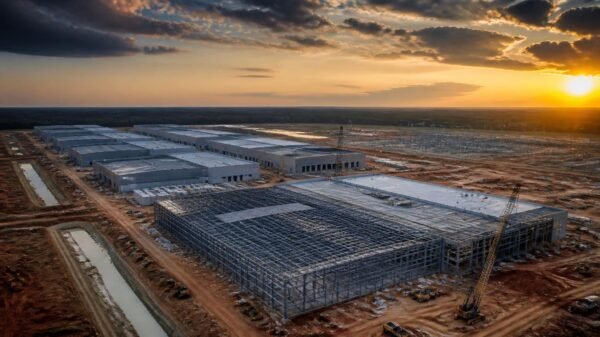
America’s construction industry has a new dominant client, and it is not building offices, warehouses or homes. It is building power plants disguised as computers.
Across Texas, Louisiana, Indiana, Ohio and a widening ring of states, hyperscalers, AI labs and a new class of energy-first developers are pouring hundreds of billions of dollars into data centre campuses so large that some now rival the physical footprint of Manhattan and the electricity demand of entire cities.
For contractors, equipment suppliers, electrical trades and heavy-civil firms, this is now one of the largest sources of new work in the country, and its scale has few historical parallels outside wartime industrial mobilisation.
Below, CCE News profiles four of the largest data centre projects currently under construction in the United States, sets out the numbers behind the wider boom, and looks at what the buildout means for the construction and equipment sectors on both sides of the Atlantic.
The Scale of the Boom
The headline figures are difficult to overstate. ConstructConnect is tracking 76 U.S. data centre projects due to break ground in the next six months alone, worth more than US$88 billion — already a double-digit increase on total data centre construction spending for all of 2025.
A December 2025 industry tally counted 4,149 active data centres nationwide, with a further 2,788 under construction or publicly announced.
McKinsey projects that roughly US$7 trillion will be spent on data centre infrastructure worldwide by 2030, with more than 40% of that landing in the United States and around 70% of global spend coming from hyperscalers such as Amazon, Microsoft, Google and Meta.
| Metric | Figure |
| U.S. data centre projects starting construction (next 6 months) | 76 projects, valued at over US$88 billion |
| States leading construction activity (March 2026) | Texas (140 under construction), Virginia (136) |
| Active + under-construction/announced U.S. data centres | 4,149 active; 2,788 more under construction or announced |
| Projected global data centre capex by 2030 | US$7 trillion (McKinsey), 40%+ in the U.S. |
| Construction jobs tied to the current U.S. pipeline | Approx. 4.7 million temporary construction-related jobs |
Sources: ConstructConnect/Equipment World, American Edge Project, McKinsey & Company, Visual Capitalist/Aterio (2026 data).
Texas and Virginia have pulled decisively ahead of the rest of the country, each with well over 100 data centres under construction as of March 2026, followed at a distance by Georgia and Ohio.
Virginia’s advantage rests on the fibre density and hyperscaler presence of Northern Virginia’s long-established “Data Center Alley,” while Texas is winning new projects on cheap land, a permissive grid operator in ERCOT, and the ability to bring on-site gas generation online faster than utilities can build transmission.
Analysts increasingly describe energy availability, not chip supply, as the real bottleneck constraining how fast this pipeline can be built out.
Four Flagship Projects Under Construction
Meta’s Hyperion project is the single largest data centre under construction in the country by planned investment.
The company has committed more than US$27 billion to the first phase of a campus that could ultimately cost in excess of US$200 billion as it scales, and which Meta has said will eventually draw up to 5 gigawatts of computing power — roughly what New York City uses on a winter day.
Construction on the 2,250-acre core site began in early 2025, with Meta since acquiring an additional 1,400 acres for expansion.
The build involves one primary data centre building alongside four large support structures, with peak on-site employment expected to exceed 5,000 construction workers.
To power it, Louisiana utility Entergy is building ten new gas-fired power plants with a combined capacity of roughly 7.5 gigawatts — an increase equal to more than 30% of the state’s entire existing grid capacity — financed entirely by Meta, alongside 240 miles of new transmission lines and battery storage.
Phase 1 is targeted to reach 1.5 gigawatts by late 2027, with the full 5-gigawatt build-out phased through 2030.
Meta has structured the project off-balance-sheet through a special-purpose vehicle in which Blue Owl Capital holds an 80% stake, allowing the company to build at this scale without carrying the full cost on its own books — a financing model other hyperscalers are now studying closely.
Stargate Abilene is the flagship site of OpenAI’s US$500 billion, roughly 10-gigawatt Stargate initiative, and the most advanced project in that programme.
Two of a planned eight buildings — spanning nearly one million square feet — went live in September 2025, with Crusoe reporting in June 2026 that it had topped out the final building on the second phase, bringing the campus toward its designed capacity of about 1.2 gigawatts across 4 million square feet.
The build has leaned on speed above all else: workforce at the site peaked above 7,000 electricians, tradespeople and construction personnel, and the campus is powered by a hybrid of on-site natural-gas generation and grid supply, including local wind power, to avoid multi-year interconnection queues.
That approach has not been without cost or delay — reporting in mid-2026 indicated some later buildings slipped several months behind their original permitted completion dates, and OpenAI subsequently scaled back a planned expansion beyond 1.2 gigawatts, redirecting that capacity to newer Stargate sites in Texas, New Mexico, Wisconsin, Michigan and Ohio.
Taken together, Oracle’s seven confirmed Stargate sites are expected to deliver more than 5.5 gigawatts of capacity and in excess of 25,000 on-site construction and operations jobs, part of a programme OpenAI executives have described as building compute capacity faster than any comparable industrial project in history.
HyperGrid is the most energy-ambitious data centre project under construction in the United States, and arguably the most unusual.
Rather than seeking a utility interconnection, developer Fermi America is building its own 11-gigawatt private power complex — combining natural gas, solar, wind, battery storage and, eventually, four Westinghouse AP1000 nuclear reactors — to feed a planned 18 million square feet of AI data centre space across roughly 5,800 leased acres adjacent to the U.S. Department of Energy’s Pantex nuclear weapons site.
Geotechnical and site works are already under way, with the company targeting three 500,000-square-foot data centre buildings and 1 gigawatt of gas-and-solar power online by the end of 2026.
Texas regulators have granted preliminary approval for the first 6 gigawatts of gas-fired capacity, while construction on the nuclear component is not expected to begin before 2027, with first reactors targeted for roughly 2032.
If completed as designed, HyperGrid would rank among the largest single energy-and-compute complexes anywhere in the world, and its ‘build the grid you need, rather than wait for the one you have’ model is being watched closely by other developers wrestling with the multi-year interconnection queues that have become the industry’s central constraint.
Project Rainier is the clearest evidence yet that on-site power generation is not the only route to gigawatt-scale AI infrastructure — grid-connected build-outs can move just as fast when the site and utility partnership are right.
Construction on the 1,200-acre St Joseph County campus began in September 2024, and within seven months seven of an eventual 30 buildings were operational; AWS says 18 of 32 planned buildings are now active, with the remainder under construction.
The finished campus will span roughly 6.5 million square feet and draw 2.2 to 2.25 gigawatts of power, delivered through a partnership with Indiana Michigan Power, a subsidiary of American Electric Power.
The US$11 billion first phase — the largest single capital commitment in Indiana’s history — is projected to create more than 1,000 permanent jobs, and Amazon has since announced a further US$15 billion, 2.4-gigawatt Phase 2 expansion across northern Indiana, bringing its total in-state commitment to roughly US$26 billion.
The campus runs almost entirely on Amazon’s own Trainium AI chips rather than Nvidia GPUs, hosting what AWS describes as the world’s largest cluster of non-Nvidia AI accelerators, co-designed with Anthropic engineers specifically to train and serve the Claude family of models.
The Wider Pipeline
These four projects sit within a much broader wave of construction. xAI continues to expand its Colossus cluster around Memphis, Tennessee, including the conversion of a former logistics warehouse in Southaven, Mississippi, into a third cornerstone facility.
Microsoft is building Fairwater-class AI campuses in Wisconsin and Georgia, while Google broke ground on a West Memphis, Arkansas site directly across the Mississippi River from xAI’s cluster.
In Ohio, Meta’s Prometheus campus — its first gigawatt-scale facility — is expected to begin coming online later this year, and Amazon, Google and Vantage all have active projects clustered around Columbus.
KKR has entered the sector directly, launching Helix Digital Infrastructure with more than US$10 billion in committed capital from partners including the Kuwait Investment Authority and Nvidia.
The common thread across nearly every project on this list is that power, not construction capacity or chip supply, is now the binding constraint.
Developers that can secure firm generation — whether through utility partnerships, on-site gas turbines, or in Fermi America’s case, private nuclear generation — are moving fastest, and the industry’s financing structures are evolving accordingly, with private-credit vehicles like Blue Owl’s Hyperion joint venture increasingly used to keep multi-billion-dollar builds off hyperscalers’ own balance sheets.
What It Means for Contractors and Suppliers
For the construction and heavy-equipment sector, the implications extend well beyond the handful of general contractors — Turner, DPR, Mortenson and Crusoe among them — currently managing these flagship sites.
- Skilled-trades demand: peak workforces of 5,000–7,000 electricians, pipefitters and tradespeople per site are straining local labour markets in Texas, Louisiana and Indiana, echoing the skilled-labour shortages already constraining data centre and infrastructure construction programmes in African markets.
- Heavy equipment and earthworks: multi-thousand-acre site preparation, grading and utility works ahead of vertical construction represent sustained demand for graders, haul trucks, crawler cranes and compaction equipment throughout 2026 and beyond.
- Power infrastructure as a parallel construction market: gas turbines, substations, transmission lines and battery storage tied to these campuses now represent a construction opportunity as large as the data halls themselves.
- Financing innovation: off-balance-sheet joint ventures and private-credit-backed special purpose vehicles, pioneered at this scale by Meta and Blue Owl, are likely to become a template for future large infrastructure financing outside the data centre sector.
With McKinsey projecting that 40% of a US$7 trillion global data centre spend will land in the United States by 2030, and contractors surveyed by the Associated General Contractors overwhelmingly expecting the market to keep growing through 2026, this buildout looks set to remain one of the defining construction stories of the decade — for U.S. firms directly involved, and for the global equipment and engineering supply chains feeding them.
Also Read
Data Centre Cooling Systems in Africa: HVAC and Liquid Cooling Guide for Hyperscale Projects
Africa Data Centres breaks ground on new Sameer facility in Nairobi

- SODECA Highlights Industrial Ventilation Technology at Mega Clima Expo Kenya 2026 - October 14, 2026
- How They Were Built: Inside the Engineering of the Lesotho Highlands Water Project - October 11, 2026
- Africa’s Water Reuse Opportunity: Building the Infrastructure for a Water-Secure Future - September 28, 2026