

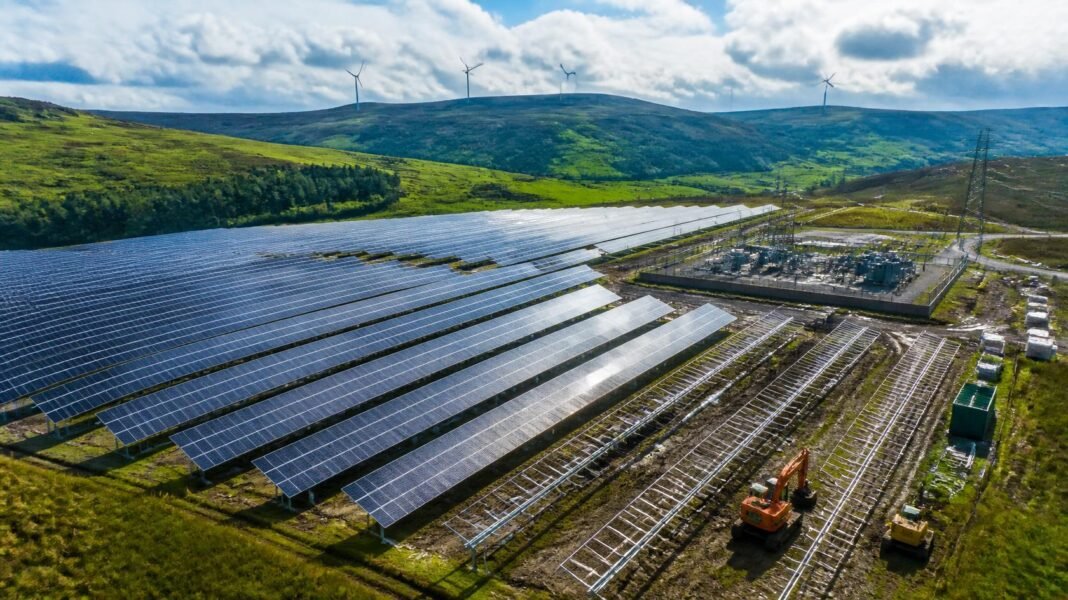
Scotland’s renewable energy sector posted its strongest quarterly performance on record between January and March 2026, generating 13.4 TWh of electricity from renewable sources — a 22% increase on the same period last year, according to the Scottish Government’s latest Energy Statistics for Scotland report, published in June 2026.
The record output came as the country’s total renewable electricity capacity climbed to 18.1 GW by the end of March 2026, up 3.2% from 17.6 GW a year earlier.
Within that growth, solar photovoltaics quietly crossed a milestone of its own, with cumulative capacity reaching 0.9 GW — a 0.1 GW increase over the past 12 months that puts solar on par with onshore wind as the fastest-growing renewable technology in the country over the period.
A Small Slice of a Bigger Picture
While solar’s 0.9 GW remains modest next to Scotland’s dominant renewable technologies — onshore wind and offshore wind together account for the bulk of the country’s 18.1 GW operational base — its growth rate signals that the technology is gaining steady traction in a market long defined by wind and hydro.
The wider numbers underline how far Scotland’s renewables sector has come. A decade ago, operational capacity stood at a fraction of today’s total.
Now, low-carbon sources have all but displaced fossil fuels from the country’s generation mix: fossil fuels contributed just 7.0% of Scotland’s electricity generation in 2024, down from roughly half two decades earlier.
Grid carbon intensity has followed the same trajectory, falling to an estimated 20.6 grams of CO2 equivalent per kilowatt hour in 2024.
Scotland has kept emissions below the 50 gCO2e/kWh threshold set out in its previous Climate Change Plan since 2017, and the country’s newly updated Climate Change Plan for 2026–2040 sets a tighter ambition of holding grid intensity below 40 gCO2e/kWh going forward.
Storage and Pipeline Point to Further Growth
Battery and pumped hydro storage also expanded over the quarter, with 1,583 MW of electricity storage operational in Scotland as of the end of March 2026 — comprising 843 MW across 22 battery storage projects and 740 MW from two pumped hydro schemes.
The development pipeline suggests the current growth is only an early chapter.
As of the end of March 2026, Scotland had 1,236 renewable energy projects in planning with a combined estimated capacity of 85.4 GW — nearly five times the country’s current operational base.
Battery storage represents the single largest share of that pipeline at 32.8 GW, followed by onshore wind (18.7 GW) and offshore wind (17.3 GW).
Of the projects awaiting development, 426 are electricity storage schemes with an estimated 41.8 GW of capacity, 748 are renewable electricity generation projects totalling 39.8 GW, and a further 62 span other renewable technologies with 3.8 GW between them.
What It Means for Scotland’s Energy Transition
The Q1 2026 figures reinforce a trend that has defined Scotland’s power sector for much of the past decade: rapid, broad-based renewable expansion running well ahead of the rest of the UK’s transition timeline.
With solar now growing in step with onshore wind, and a planning pipeline nearly five times larger than the current operational fleet, Scotland’s energy mix looks set to keep shifting further away from fossil generation in the years ahead.
For now, solar remains a minor contributor to Scotland’s renewable capacity relative to wind — but its steady climb toward the 1 GW mark, combined with the scale of storage capacity now in the pipeline, points to a power system that is diversifying beyond its traditional wind-and-hydro base.
Also Read
Africa’s Solar Capacity Surges 54% as Financing Barriers Persist
The $40 Billion Problem: Why Africa’s Solar Financing Is Built for the Wrong Market

- From Operator to Algorithm: Bedrock Puts Autonomous Excavators to Work on Live Construction Sites - September 7, 2026
- Built For The Rough Stuff: Inside Titan’s new ForestEDGE™ Tyre Line - September 4, 2026
- South Africa Has R395 Billion in Infrastructure Projects — But Can the Industry Deliver Them? - August 26, 2026
