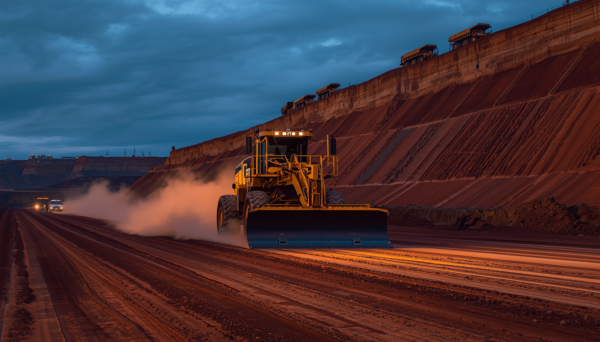
Most people drive over their work every day without giving it a second thought.
The smooth, even surface of a road — whether it is a city highway or a mine site haul road in Limpopo — owes its precision to one of the most underappreciated machines in the construction world: the motor grader.
And while the standard grader quietly blades suburban subdivisions and rural roads, a very different breed of machine operates at the extreme end of the scale — one that can weigh as much as 75 tonnes, swing a blade the length of a shipping container, and keep a 300-tonne haul truck from destroying its own road in a single pass.
A motor grader becomes ‘mega’ when it transitions from general construction into dedicated mining support.
At that scale, the machine is no longer smoothing gravel for a new estate — it is maintaining haul roads that carry billions of dollars of ore every year, where surface irregularities translate directly into tyre wear, fuel burn, and haul truck damage.
The economic stakes of poor grading are enormous, and so the machines that do the work must be equally formidable.
From the legendary but tragic ACCO one-off built in Italy for a Libyan desert project that never was, to the current production title-holder, the Caterpillar 24, the history of mega motor graders is as much about ambition and engineering as it is about horsepower.
This article profiles the biggest, most powerful motor graders ever built — and the industries and landscapes that demand them.
| The blade on the world’s largest production motor grader stretches 7.3 metres — wider than the lane markings on a three-lane motorway. |
- The Machine at a Glance: Key Specifications
The reigning champion of large-scale production motor graders is the Caterpillar 24 (successor to the 24M), which is the largest motor grader currently in series production in the world. It is purpose-built for one application: building and maintaining haul roads in large open-pit mining operations. Here are its verified specifications:
For historical comparison, the Champion 100-T (introduced in the late 1970s by Dominion Road Machinery) also carried a 24-foot blade and was powered by a 700 hp Cummins engine, with an operating weight of approximately 92,000 kg (202,000 lb).
It was the largest production motor grader of its era but was eventually discontinued due to limited market demand.
The Cat 24M preceded the current Cat 24, with the newer model adding an 11 percent weight increase and the more powerful C27 engine replacing the C18.
- How It Works: The Technology in Simple Terms
At its heart, a motor grader is a precision instrument. The machine moves forward while its blade — mounted between the front and rear axles — cuts, shifts, and redistributes material with extraordinary accuracy.
But on a machine the size of the Cat 24, that precision operates at a scale that requires sophisticated engineering throughout.
The Moldboard and Circle: The blade, known as the moldboard, hangs from a large steel ring called the circle.
Hydraulic motors rotate the circle, allowing the blade to be angled in virtually any direction — from a straight cut ahead, to a sharp diagonal that casts material to the side.
This circle rotation is what gives a grader its unique ability to work material to either side, cut ditches, and form road camber, all without turning the entire machine.
Articulated Steering: Like most large graders, the Cat 24 uses articulated frame steering — the rear half of the machine pivots relative to the front.
This gives the operator precise control over blade positioning relative to the direction of travel, especially critical when cutting precise cross-slopes on wide haul roads.
Combined with the ability to ‘crab steer’ (offset the front and rear axles), the grader can exert maximum blade force on tough surfaces while staying on course.
Consistent Power-to-the-Ground: One of the Cat 24’s standout technical features is its Consistent Power-to-the-Ground system, which automatically adjusts engine output in real time to offset losses caused by the cooling fan, ambient temperature changes, and altitude variations.
The result is that the operator always receives the power they expect at the blade, regardless of operating conditions — eliminating the frustration of power drop-off during heavy cuts.
High Performance Circle (HPC): The Cat 24 introduced a sealed, maintenance-free circle assembly that replaces the traditional open drawbar and circle arrangement.
It requires no adjustment over the machine’s life, reducing service downtime significantly on remote mine sites where maintenance resources are limited.
Operator Environment: The cab is engineered for extended shifts in remote, dusty conditions. Joystick controls replace traditional levers, reducing hand and arm movement by up to 78 percent compared to lever-operated systems.
Multiple cameras, digital grade monitoring, and telematics integration via Cat VisionLink allow remote fleet managers to monitor grader performance in real time from anywhere in the world.
Key Technology Features — Cat 24 Motor Grader
- Cat C27 ACERT Engine: Produces up to 694 hp with Variable Horsepower (VHP) and maintains full performance without altitude derate up to 10,000 ft.
- Consistent Power-to-the-Ground: Automatically adjusts engine output in real time to deliver steady traction and consistent blade performance.
- High Performance Circle (HPC): A sealed, maintenance-free circle drive requiring no lifetime adjustments, improving durability and uptime.
- Articulated Frame Steering: Features crab-steer capability for exceptional maneuverability and precise grading accuracy.
- Advanced Joystick Controls: Reduce operator hand and arm movement by 78% compared with traditional lever controls, helping minimize fatigue.
- Cat VisionLink™ Telematics: Enables real-time remote monitoring of machine location, utilization, fuel consumption, and maintenance status.
- Optional 28-ft (8.5 m) Moldboard: Ideal for maintaining extra-wide mine haul roads while reducing the number of grading passes required.
- Fire Suppression-Ready Design: Chassis is prepared for installation of fire suppression systems, making it suitable for demanding mining operations.
- Where It’s Used: Projects and Industries
Mega motor graders operate wherever the movement of material at scale creates roads that must be maintained at scale. Their primary environments include:
Open-Pit Mining Haul Roads: This is the defining application for the Cat 24 and its predecessors.
In a large open-pit mine, haul trucks carrying 200 to 360 tonnes of ore travel the same road hundreds of times per day.
Without constant maintenance by large motor graders, these roads develop ruts, windrows of spilled material, and uneven surfaces that increase tyre wear and rolling resistance dramatically.
A poorly maintained haul road can add millions of dollars in fuel and tyre costs annually — making a properly specced grader one of the highest-ROI machines on any mine site.
Large-Scale Road Construction: In countries building significant new road infrastructure — a category that includes much of sub-Saharan Africa — large motor graders are used during base preparation for highways, rural roads, and arterial routes.
In South Africa, Tanzania, Ethiopia, and across the Sahel, major road programmes depend on graders to establish precise sub-base grades before compaction and surfacing.
Airfield Construction: Runways and taxiways require some of the most precise grading work in the construction industry.
Tolerances for airfield surfaces are measured in millimetres over long distances, and large graders equipped with GPS machine control systems are used to achieve this level of finish efficiently.
Earthworks and Land Reclamation: Large graders are used in land-clearing projects, land reclamation operations, and the establishment of platforms for industrial facilities.
In Africa’s resource sector, this includes creating pads for processing facilities, waste rock dumps, and tailings storage facilities at mine sites.
African Deployment Context: Southern Africa has the continent’s highest concentration of ultra-class motor graders.
Mines in the Northern Cape (iron ore, manganese), Limpopo (platinum, coal), and North West Province of South Africa rely heavily on the Cat 24M and Cat 24 to maintain high-tonnage haul roads.
In Zambia and the DRC, copper mining operations also deploy large graders for road maintenance on complex multi-level pit access roads.
- Notable Manufacturers: Leading Companies in the Market
The large motor grader market is concentrated among a handful of manufacturers with the engineering capacity to produce machines at mining scale:
In the African market, Caterpillar’s dominance in the ultra-large segment is reinforced by its dealer service infrastructure.
The Cat 24 is supported by Barloworld Equipment across southern Africa and Mantrac across East and West Africa — both of which maintain parts stockpiles and field service capabilities critical for machines operating in remote mine locations.
Komatsu’s growing GD955-7 is expected to challenge Cat’s near-monopoly in the ultra-large segment as the machine gains market penetration beyond North America.
- Record-Breaking Facts: Biggest, Fastest, Strongest
The world of large motor graders is rich with engineering milestones and astonishing statistics that put the scale of these machines in perspective:
RECORD-BREAKING FACTS
- Largest Ever Built: The legendary ACCO Motor Grader weighed about 180,000 kg, produced 1,700 hp, rode on 12 dual tyres, and featured a massive 10 m (33 ft) blade. Built for Libya, it never entered service.
- Largest Production Grader: The Caterpillar 24 remains the world’s biggest production motor grader, weighing up to 75 tonnes with an optional 28 ft moldboard.
- Most Powerful Production Model: The Cat 24 VHP delivers up to 694 hp—more power than a modern Formula 1 racing car.
- Heaviest Production Grader Ever: The Champion 100-T (1977) tipped the scales at approximately 92,000 kg (202,000 lb).
- Widest Production Blade: The Cat 24’s optional 28 ft (8.5 m) moldboard can grade two standard traffic lanes in one pass.
- Altitude Record: Its Cat C27 engine maintains full rated power up to 4,572 m (15,000 ft) above sea level (Tier 2 configuration).
- Highest Auction Price: A John Deere 872GP with only 68 operating hours sold for an incredible US$660,000 in August 2025—the highest auction price ever recorded for a motor grader.
- Operator Comfort: The Cat 24’s joystick controls reduce hand and arm movement by 78%, significantly lowering operator fatigue during long shifts.
- The Future: Electrification, Automation, and AI
The motor grader has been a remarkably stable design for over a century — a blade between axles, an engine behind.
But the next decade will bring more change to this machine than the previous five decades combined, driven by three converging forces: decarbonisation pressure from mining companies, advances in GPS and autonomous systems, and the maturation of AI-assisted grade control.
Autonomous Grading: Semi-autonomous and fully autonomous motor graders are no longer a distant prospect.
Caterpillar has been developing autonomous earthmoving technology across its product range, and motor grader autonomy has specific appeal for mining applications where the task is repetitive and the operating environment is relatively controlled.
A grader maintaining a haul road in a closed mine site — the same road, the same path, the same blade adjustments — is a strong candidate for automation.
Early trials in Australia and Chile have demonstrated that autonomous graders can maintain grade tolerances comparable to experienced operators, around the clock, without fatigue-related degradation.
AI-Assisted Grade Control: Current systems like Trimble’s and Leica’s 3D machine control already automate much of the blade’s pitch and roll adjustment.
The next generation integrates AI that learns optimal blade settings for specific material conditions, road sections, and wear patterns — adapting in real time rather than following pre-set parameters.
For mining operations managing thousands of metres of haul road, AI-assisted grading could significantly reduce pass counts while maintaining tighter tolerances.
Hybrid and Electric Powertrains: At the 75-tonne scale of the Cat 24, full battery-electric propulsion remains a significant engineering challenge, primarily due to the energy density required and the duty cycle of continuous grading over long shifts.
However, hybrid diesel-electric systems — using electric motors to supplement diesel power during heavy cutting — are feasible in the near term and could reduce fuel consumption by 15 to 25 percent.
Komatsu and Caterpillar have both signalled intent to electrify larger equipment as battery technology matures.
Hydrogen Fuel Cells: For ultra-class equipment where battery weight and charging infrastructure are barriers, hydrogen fuel cell technology is being explored as a longer-term pathway.
Liebherr’s announcement of hydrogen-powered mining equipment development signals where the industry may be heading over the next 15 to 20 years.
African Implications: For African mining operations, autonomous graders represent both an opportunity and a challenge.
The opportunity lies in addressing the persistent shortage of skilled heavy equipment operators — a bottleneck across mining regions from the Northern Cape to the DRC’s copper belt.
The challenge lies in the connectivity infrastructure required to support remote fleet management, and the capital investment that autonomous systems demand.
As digital infrastructure continues to expand across the continent, the barriers to autonomous grader deployment in African mining will steadily fall.
| The motor grader that built the roads of the 20th century will reshape the mining landscapes of the 21st — autonomously, efficiently, and with far less carbon. |
From an Italian engineer’s desert dream machine that never turned a blade of earth, to a 75-tonne precision instrument that maintains haul roads across the world’s deepest mines, the story of the mega motor grader is one of relentless engineering ambition.
The largest of these machines do not just move dirt. They make the entire mining supply chain possible.
Also Read
Mega Machines: Meet the Biggest Wheel Loaders Ever Built
JCB Brings Its Heaviest Excavator to Kenya and Uganda as Infrastructure Demand Intensifies

- How They Were Built: Inside the Engineering of the Lesotho Highlands Water Project - October 11, 2026
- Africa’s Water Reuse Opportunity: Building the Infrastructure for a Water-Secure Future - September 28, 2026
- Why Water Reuse Is Becoming a Business Imperative for African Industry - September 28, 2026