
Britain is in the grip of an extraordinary heatwave. On 24 and 25 June 2026, the UK Met Office issued a Red Extreme Heat Warning for parts of England and Wales, with temperatures forecast to exceed 37°C — and potentially approach 38°C by Thursday.
Elevated humidity is compounding the heat, making conditions feel even more oppressive in homes and workplaces that were simply never designed for this kind of weather.
The demand for cooling has been dramatic. Air conditioning use has increased by 90% across the UK over just two years, and an estimated eight to 19 per cent of households now have some form of air conditioning — with around 80 per cent of all purchases made since 2022.
Portable units, priced between £250 and £650, have become the go-to choice for renters, flat-dwellers and homeowners who cannot install fixed split systems.
But the surge in demand has also produced a surge in buying errors. Across retailers including Currys, John Lewis, Argos and Amazon UK, consumers are making avoidable mistakes that leave them overheated, out of pocket, and facing returns queues.
Here are the biggest ones to watch out for.
Mistake 1: Confusing an Air Cooler with an Air Conditioner
This is by far the most common and most costly error.
Evaporative air coolers and portable air conditioners look similar in online listings, carry comparable price tags, and are often shelved side by side — but they are fundamentally different technologies.
An evaporative cooler draws air through water-saturated pads. The evaporation process releases cooler, more humid air.
It requires no exhaust hose, consumes as little as 50–150W, and works reasonably well in dry conditions — but in a typical UK heatwave, where humidity is high, it simply cannot function effectively.
Sweat cannot evaporate from your skin when the surrounding air is already saturated, which is exactly what an evaporative cooler worsens.
A genuine portable air conditioner uses a compressor and refrigerant cycle — like a split-system unit on wheels.
It removes heat from indoor air and expels it outside via an exhaust hose vented through a window. It also dehumidifies as it cools, which is precisely what humid British heatwave conditions require.
| “The big mistake is buying an evaporative ‘air cooler’ expecting air-conditioner results. In typical humid UK heatwave conditions, the difference matters enormously.” |
Always check whether the product listing specifies ‘compressor,’ ‘refrigerant,’ and a ‘BTU’ cooling capacity rating. If it does not, it is almost certainly an evaporative cooler, not an air conditioner.
Mistake 2: Getting the BTU Rating Wrong
Cooling capacity is measured in British Thermal Units (BTU) per hour. Matching this figure to your room size is the single most critical purchasing decision — and it is where a large proportion of buyers go wrong.
Too few BTUs and the unit will run continuously without ever making a dent in the heat. Too many and you overpay upfront and in ongoing energy costs. As a general guide:
| Room Size | Recommended BTU | Approx. Running Cost (per hour)* |
| Up to 15 m² | 7,000–9,000 BTU | ~19–22p |
| 15–25 m² | 9,000–12,000 BTU | ~22–28p |
| 25–40 m² | 12,000–16,000 BTU | ~28–40p |
| Above 40 m² | Consider split system | — |
*Based on Ofgem Q2 2026 electricity rate of 24.67p/kWh. Actual costs vary.
Room size alone is not the only factor. South-facing rooms with significant glazing can require an additional 10 per cent capacity. Rooms with multiple occupants or heat-emitting equipment need further upward adjustment. And always treat a portable unit as a single-room solution — not a whole-home cooling system.
Mistake 3: Ignoring the Exhaust Hose Requirement
A portable air conditioner requires a window, vent, or suitable opening to exhaust warm air outside.
This is non-negotiable: a unit running in a fully sealed room with no outlet for the exhaust hose will pump hot air back into the space, raising the temperature rather than reducing it.
Many buyers discover this after the unit arrives, particularly in properties without suitable casement or sash windows.
Most units include a window kit, but it must seal properly. Any gap between the hose fitting and the window frame allows warm outdoor air to seep back in, significantly degrading performance.
Check your window type before purchasing, and ensure your chosen model includes the appropriate window kit — some manufacturers, such as Meaco, supply both sash and casement kits as standard.
Mistake 4: Underestimating Noise Levels
Portable air conditioners are substantially louder than split-system units. Budget models frequently operate at 64–65dB — comparable to a normal conversation and clearly audible in a bedroom.
Mid-range and premium models typically operate at 52–58dB, which is more tolerable for overnight use, but still noticeable in a quiet environment.
| Noise Reference Guide
50dB — Quiet office / light rainfall 55dB — Average restaurant background noise 60dB — Normal spoken conversation 65dB — Budget portable AC unit (most models) |
Always check the decibel rating in the product specifications before purchasing. If the unit will be used in a bedroom, prioritise models rated at or below 55dB, and look for a dedicated ‘sleep mode’ that reduces fan speed during overnight operation.
Mistake 5: Panic-Buying Without Checking Running Costs
The UK’s Ofgem electricity unit rate for April–June 2026 stands at 24.67p/kWh. A 9,000 BTU portable air conditioner consuming around 0.9kWh per hour costs approximately 22p per hour to run.
Used four hours per day during a two-week heatwave, that amounts to around £12 — an entirely manageable outlay.
Also Read: Top AC Repair Companies in the U.S
The problem arises when buyers purchase an undersized unit at a lower price point, then run it continuously at maximum output in a failed attempt to cool an oversized space. The result is higher cumulative energy consumption, poor cooling performance, and accelerated wear on the compressor. The cheapest unit is rarely the cheapest to operate.
| “A cheaper unit that’s undersized or poorly set up can cost more over a summer, because you run it harder for less comfort.” |
Mistake 6: Overlooking Energy Efficiency Ratings
Not all units of the same BTU output consume the same electricity. Energy efficiency ratings — increasingly displayed as SEER (Seasonal Energy Efficiency Ratio) ratings — can make a meaningful difference in running costs over a full summer season.
A-rated models will typically cost less to run than non-rated equivalents of identical cooling output, with inverter technology reducing power consumption by up to 40 per cent compared to fixed-speed compressors.
In a market where buyers are rushing purchases during a heatwave, efficiency labels are easily overlooked. They should not be.
Mistake 7: Assuming the Unit Can Move Between Rooms Easily
The ‘portable’ designation in portable air conditioners is somewhat misleading. Units typically weigh between 18 and 30 kg.
More importantly, the exhaust hose — usually 1.2 to 1.5 metres in length — must reach an external vent point wherever the unit is positioned.
Moving a unit between rooms means repositioning the window kit and hose each time.
Buyers who envisage using a single unit to cool a bedroom at night and a living room during the day often find the process more cumbersome than expected.
For multi-room cooling, budget for multiple units or consider whether a fixed split-system installation makes better long-term economic sense — particularly given the frequency with which UK heatwaves are now occurring.
Buying Smart: A Pre-Purchase Checklist
Before purchasing a portable air conditioner, run through this quick checklist to avoid costly mistakes and ensure you choose the right model for your home.
- ✅ Confirm it is a refrigerant-based air conditioner (not an evaporative cooler).
- ✅ Measure your room size and match it to the appropriate BTU rating.
- ✅ Check your window type and verify that the correct window kit is included.
- ✅ Review the noise level (dB) and aim for models below 55dB if using it in a bedroom.
- ✅ Compare the unit’s energy efficiency or SEER rating to reduce electricity costs.
- ✅ Estimate operating expenses using your local electricity tariff (e.g., 24.67p/kWh).
- ✅ Check the unit’s weight and portability to ensure you can move and install it comfortably.
The Bigger Picture
Britain’s heatwave problem is structural. According to the UK Green Building Council, 55 per cent of UK homes are already overheating during relatively cool summers.
The country’s housing stock was designed for insulation and heat retention — not heat management.
As climate change drives more intense and more frequent extreme heat events, the demand for effective home cooling will only grow.
Purchasing a portable air conditioner is a reasonable response to an immediate problem.
But doing so without understanding the technology, matching capacity to space, and accounting for installation requirements will leave many buyers no cooler, and considerably out of pocket.
Take thirty minutes to research before you buy.
In a summer where retailers are reportedly selling fans at three units per minute, that considered approach may be the most heat-resistant decision you make.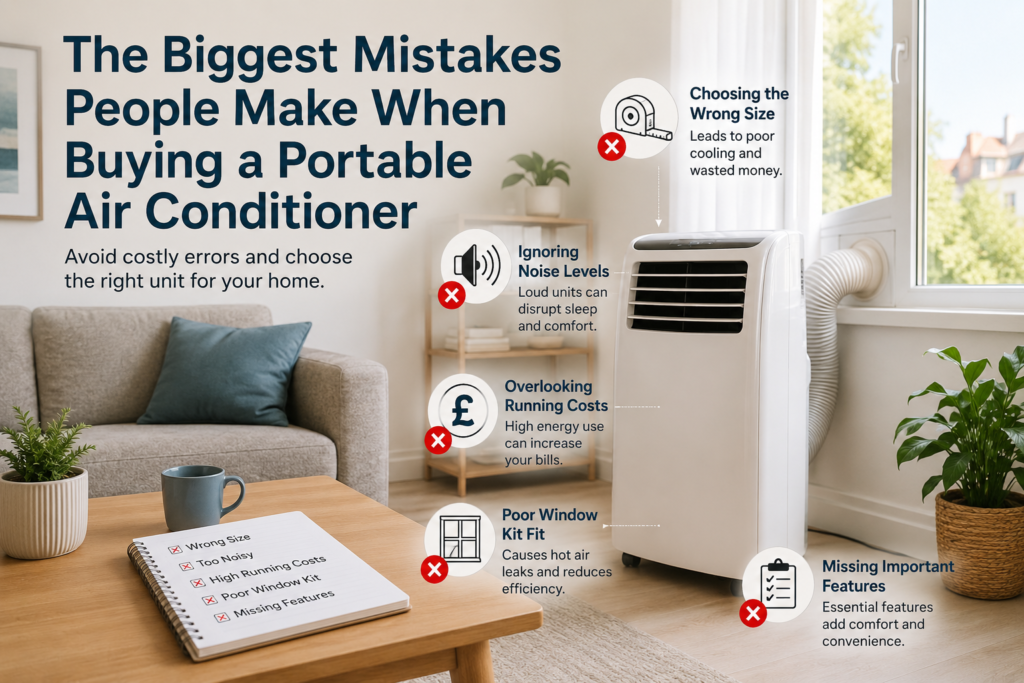
Also Read
Best Portable Air Conditioners in the UK for 2026: Top Picks for Staying Cool This Summer
How Much Does Emergency AC Repair Cost in the US IN 2026?

- PV Guangzhou 2027 to Highlight Solar and Energy Storage Technologies - October 22, 2026
- Accurate and Reliable Measurement and Monitoring of Industrial Plant Water Treatment - October 21, 2026
- SODECA Highlights Industrial Ventilation Technology at Mega Clima Expo Kenya 2026 - October 14, 2026