

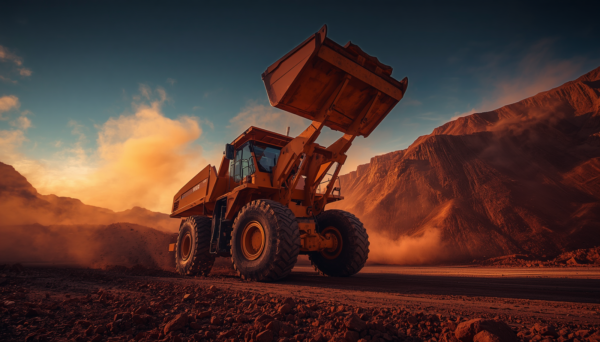
In the world of heavy equipment, size is not just a selling point — it is an engineering statement.
A standard wheel loader might scoop a couple of tonnes of gravel and tip it into a truck in a matter of seconds. A mega wheel loader does the same thing with 30, 40, even 50 tonnes per bite. These are not machines you would find on a typical construction site.
They belong in the world of open-pit copper mines, iron ore quarries, and bulk material terminals — places where moving mountains is, quite literally, part of the job description.
What separates a mega wheel loader from its smaller cousins is a combination of bucket capacity, engine output, operating weight, and articulated power that defies everyday comprehension.
We are talking about machines that stand four storeys high, burn hundreds of litres of diesel per hour, and are operated from a pressurised cab that resembles a fighter jet cockpit.
Their tyres alone can cost more than a family home. And yet, despite their scale, modern mega wheel loaders are engineered for efficiency — maximising payload per litre of fuel, reducing cycle times, and integrating smart technology that would have seemed like science fiction just a decade ago.
This article takes a deep dive into the biggest, boldest wheel loaders ever built — the machines rewriting the limits of what is physically possible.
| A single bucket on the world’s largest wheel loaders can hold more material than a fully-loaded cement truck. |
- The Machine at a Glance: Key Specifications
No single machine holds a monopoly on the title of ‘world’s largest wheel loader’ — that crown has shifted between manufacturers over the decades.
But the Le Tourneau L-2350, built by Komatsu Mining Corp (formerly P&H Mining / Joy Global), stands as the undisputed heavyweight champion in terms of bucket capacity and operating weight. Here is how it stacks up:
| SPECIFICATION | DETAIL |
| Manufacturer | Komatsu Mining Corp (Le Tourneau) |
| Model | L-2350 Electric Drive Wheel Loader |
| Operating Weight | 262,000 kg (262 tonnes) |
| Engine | Two Cummins QSK60 diesel engines |
| Engine Power | 2 x 1,305 kW = 2,610 kW (3,500 hp) combined |
| Bucket Capacity | 40.5 m³ (standard) — up to 53 m³ with rock configurations |
| Payload Capacity | Up to 72 tonnes per bucket pass |
| Tyre Size | 4.00 m diameter (approx.) |
| Machine Height | ~7.9 m to top of cab |
| Overall Length | ~20 m |
| Drive System | Electric wheel motors (diesel-electric drive) |
| Top Speed | ~16 km/h (laden) / ~19.3 km/h (unladen) |
For African operations, the Caterpillar 994K and the Liebherr L 586 also rank among the largest machines actively deployed on the continent, particularly in South African and West African mining operations.
- How It Works: The Technology in Simple Terms
At its core, a wheel loader is elegantly simple: a bucket on the front, driven forward, scooped into material, and tipped into a truck.
But scale everything to the L-2350’s proportions and the engineering challenges become extraordinary.
Electric Drive System: Unlike conventional loaders that use a torque-converter transmission, the L-2350 uses a diesel-electric drive system.
The onboard diesel engines act as generators, producing electricity that powers individual electric wheel motors on each axle.
This system delivers full torque from zero rpm — critical for ripping into hard-packed ore without wheel slip — and provides regenerative braking capability, recovering energy on downhill grades.
Articulated Steering: The machine bends in the middle rather than turning with a traditional steering wheel.
The rear half of the machine pivots relative to the front half, giving the loader a surprisingly tight turning radius despite its enormous footprint.
Hydraulic rams drive the articulation, with computer controls preventing over-articulation that could stress the chassis.
Hydraulic Lifting Arm: Massive hydraulic cylinders raise the boom arm against the weight of both the loaded bucket and the arm itself. On the L-2350, the lift cylinders are each wider than a human torso and operate at extremely high pressure.
The entire lift-and-dump cycle — from ground level to full dump height — takes approximately 14 seconds.
Operator Cab: Far from the dusty, noisy cabs of earlier generations, modern mega loader cabs are sealed, air-conditioned, and fitted with joystick controls, multiple camera feeds, payload monitoring systems, and ride-control suspension.
The operator rides on a seat equipped with full-body vibration dampening, and many newer models feature ROPS/FOPS certified structures capable of withstanding rollover and falling-object impact.
| KEY TECHNOLOGY FEATURES
• Diesel-electric drive for full torque at zero RPM • Articulated chassis for tight turning radius • High-pressure hydraulic lift cylinders (boom and tilt) • Sealed, climate-controlled operator cab with camera systems • Integrated payload weighing for truck-loading accuracy • Ride-control hydraulic suspension for bucket stability at speed • Onboard telematics and remote diagnostics |
- Where It’s Used: Projects and Industries
Mega wheel loaders are purpose-built for environments where conventional equipment simply cannot achieve the required productivity levels.
Their primary domains include:
Open-Pit Mining: This is the natural habitat of the mega loader. In open-pit copper, gold, iron ore, and coal mines, vast quantities of overburden and ore must be moved continuously.
The L-2350 was specifically designed to load 360-tonne haul trucks in as few as three passes — what the industry calls a ‘3-pass match.’
Every additional pass adds cycle time and cost, so bucket sizing is carefully matched to haul truck payload.
Quarrying and Aggregates: In large limestone, granite, and sandstone quarries, mega loaders move blasted rock to primary crushers.
Their speed and capacity allow them to keep crusher feed rates high, preventing costly downtime further down the processing line.
Bulk Material Handling: Port terminals and stockpile operations use oversized wheel loaders to reclaim material from large stockpiles and load conveyor belts or ship holds.
The combination of reach, speed, and bucket volume makes them significantly faster than conveyor-only systems for irregular stockpile shapes.
African Context: On the African continent, mega loaders operate at sites including the Jwaneng Diamond Mine in Botswana (one of the richest diamond mines by value on earth), the Sishen Iron Ore Mine in South Africa, the Katanga copper belt in the DRC, and several major gold mines across Ghana and Tanzania.
Southern Africa, in particular, has some of the highest concentrations of ultra-class loading equipment in the world.
- Notable Manufacturers: Leading Companies in the Market
The ultra-class wheel loader market is dominated by a small group of manufacturers with the engineering capacity and capital to develop machines at this scale:
| SPECIFICATION | DETAIL |
| Komatsu Mining (Le Tourneau) | L-2350 — the world’s largest production wheel loader by bucket capacity. |
| Caterpillar (CAT) | 994K and 994H — widely deployed in Africa and the Americas; 23.5 m³ bucket, 80 t payload. |
| Liebherr | L 586 XPower and L 566 XPower — German precision engineering with hydrostatic-mechanical drive. |
| Volvo CE | L350H — not quite ultra-class but widely used in large quarry and port applications across Africa. |
| Hitachi | ZW550-6 — popular in Asian markets, growing African presence through Hitachi Construction Machinery Africa. |
| LiuGong (China) | 899H — Chinese-built contender in the large loader segment; increasingly competitive in African tenders. |
| XCMG (China) | LW1200KN — one of the largest Chinese-made loaders, targeting emerging market infrastructure projects. |
For African buyers, the choice between these manufacturers often comes down to after-sales support infrastructure.
Caterpillar’s Barloworld Equipment and Mantrac networks across sub-Saharan Africa make them a default choice for many large mines.
Liebherr and Komatsu Mining have specialist mining support divisions, while Chinese OEMs are increasingly competitive on price, though their service footprints in Africa are still maturing.
- Record-Breaking Facts: Biggest, Fastest, Strongest
The world of mega loaders is rich with astonishing statistics. Here are some of the most remarkable:
| RECORD-BREAKING FACTS
• LARGEST BUCKET: The L-2350 can be configured with a bucket of up to 53 m³ in high-density rock applications — equivalent to the volume of a small terraced house. • HEAVIEST MACHINE: At 262 tonnes operating weight, the L-2350 weighs more than 40 African bull elephants combined. • MOST POWERFUL: The dual Cummins QSK60 engines deliver a combined 3,500 hp — roughly the output of 30 family cars. • TYRE COST: Each of the four tyres on an L-2350 costs between $60,000 and $100,000 USD. A full set can cost more than a luxury apartment. • FUEL CONSUMPTION: At peak load, a mega wheel loader can consume 200–250 litres of diesel per hour. • FASTEST LOADING RATE: In ideal conditions, the L-2350 can load a 360-tonne haul truck in under 90 seconds. • TALLEST DUMP HEIGHT: The L-2350 can dump material from a height of approximately 6.7 m — clearing the side of even the largest mining trucks. • LONGEST PRODUCTION RUN: The Le Tourneau L-series has been in continuous production evolution since the 1980s, making it one of the longest-running mega loader lineages in history. |
- The Future: Electrification, Automation, and Sustainability
The mega wheel loader of 2030 will look similar to today’s machines on the outside but will be fundamentally different on the inside. Three major forces are reshaping this segment of the market:
Full Battery-Electric Propulsion: While the L-2350 already uses an electric drive system powered by onboard diesel generators, the next frontier is eliminating the diesel engine entirely.
Liebherr has announced prototype battery-electric loaders, and Caterpillar has its Cat 950 GC electric concept in testing.
The challenge at ultra-class scale is enormous: charging a 200-tonne battery-electric machine requires infrastructure investment comparable to a small power station.
Trolley-assist systems — where the machine plugs into a fixed overhead wire in certain zones — are emerging as an interim solution in closed mining environments.
Autonomous Operation: Komatsu’s Autonomous Haulage System (AHS) for trucks is well-established, and autonomous loaders are the logical next step.
Pilot programmes at several Australian and Chilean mines are testing loaders that can identify ore faces, position themselves, scoop, and load trucks with minimal human intervention.
For Africa, autonomous loading could address the shortage of skilled heavy equipment operators in remote mining regions — a persistent constraint across the DRC, Zambia, and Zimbabwe.
AI-Assisted Payload Optimisation: Modern loaders already integrate payload weighing systems, but next-generation AI will use real-time ore-face analysis (via LiDAR and camera arrays) to predict optimal bucket angles, penetration speeds, and fill factors — maximising payload per pass without over-stressing the machine.
The goal: approach the theoretical maximum payload on every single cycle, automatically.
Sustainability Pressure: Mining companies are under growing pressure from investors and regulators to decarbonise their mobile fleets.
The wheel loader, as one of the highest fuel consumers on any mining site, is a prime target.
Hydrogen fuel cell powertrains are being explored by Liebherr and others, though commercial viability at ultra-class scale remains a decade or more away.
| The next generation of mega loaders will not just be bigger — they will be smarter, cleaner, and increasingly capable of operating without a human in the cab. |
For Africa, where mining drives significant economic output — from the platinum belt of South Africa to the lithium deposits of Zimbabwe and the oil sands of Angola — the evolution of the mega wheel loader is not an abstract equipment story.
It is a direct driver of extraction efficiency, cost competitiveness, and ultimately the revenues that fund roads, schools, and infrastructure across the continent.
The biggest wheel loaders ever built are already here. The even bigger, smarter, and cleaner versions are already on the drawing boards.
Also Read
Next-Gen Excavators Heading to Steinexpo: Efficiency, Automation & Power
Cost of Excavators in 2026: New vs Used

- SODECA Highlights Industrial Ventilation Technology at Mega Clima Expo Kenya 2026 - October 14, 2026
- How They Were Built: Inside the Engineering of the Lesotho Highlands Water Project - October 11, 2026
- Africa’s Water Reuse Opportunity: Building the Infrastructure for a Water-Secure Future - September 28, 2026