

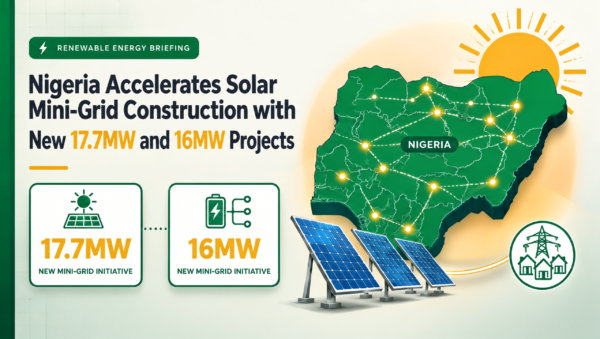
Nigeria is expanding its decentralised renewable energy infrastructure, with new interconnected solar mini-grids and battery storage projects entering construction in Oyo and Gombe states, as the government intensifies efforts to improve electricity access and stimulate rural economic activity.
Nigeria is stepping up investment in distributed renewable energy, with several solar-powered mini-grid developments highlighting the growing role of private-sector participation and multilateral financing in the country’s electricity expansion strategy.
Among the latest developments are five interconnected solar mini-grids with a combined capacity of 17.7 megawatts (MW) in Ibadan, Oyo State, and a separate 16MW network in Gombe State.
Both projects incorporate battery storage and are designed to provide more reliable electricity to underserved communities and businesses.
In Ibadan, the Minister of Power, Joseph Olasunkanmi Tegbe, recently led the groundbreaking ceremony for five interconnected solar mini-grids serving communities across Akinyele, Ido, Ibadan North, Egbeda and Lagelu local government areas.
The project brings together the Rural Electrification Agency (REA), private energy developer Paras Energy and Ibadan Electricity Distribution Company (IBEDC).
The installations will combine solar generation with battery energy storage to improve electricity reliability, reduce dependence on petrol and diesel generators and extend operating hours for businesses.
The government expects the infrastructure to support investment, employment creation and commercial activity across the participating communities.
Gombe advances interconnected mini-grid development
In Gombe State, construction has commenced on another 16MW interconnected solar mini-grid network covering Dukku, Bajoga, Kumo and Kaltungo.
The project is being implemented through collaboration between the Federal Government, the Gombe State Government and private-sector partners.
The development is complemented by a separate 1MW solar mini-grid commissioned in Tallasse, Balanga Local Government Area.
The operational installation incorporates a 2.4-megawatt-hour (MWh) battery energy storage system.
The Tallasse facility serves 6,028 connections, including residential, commercial and productive-use customers.
Its supporting infrastructure includes electric groundnut oil processing equipment, a modular rice mill, flour-grinding machinery and electric tricycles.
The integration of agricultural processing equipment illustrates how mini-grid investments can extend beyond household electrification to support rural industries and local value chains.
Reliable electricity can help agricultural businesses reduce their dependence on diesel-powered machinery, improve processing efficiency and add value to commodities closer to production areas.
Jigawa attracts private investment
A further development in Jigawa State highlights the increasing involvement of private developers and infrastructure financiers in Nigeria’s decentralised energy market.
Electrify Microgrid Limited is developing nine solar-hybrid mini-grids with a combined generation capacity of 609 kilowatt-peak (kWp).
The installations will incorporate battery storage and inverter systems and are expected to provide approximately 4,557 connections, reaching more than 22,000 people and around 400 businesses.
The project has a financing structure involving InfraCredit and the UK-funded Climate Finance Blending Facility, alongside support through the World Bank-backed Distributed Access through Renewable Energy Scale-up (DARES) programme.
Planned productive applications include solar-powered rice and groundnut processing, irrigation, grain milling and electric mobility.
According to InfraCredit, the project is expected to create up to 399 direct jobs, with approximately 15% of the positions targeted for women. It is also projected to avoid an estimated 888 tonnes of carbon emissions annually.
Multilateral financing supports expansion
The projects form part of Nigeria’s wider strategy to attract private investment into distributed renewable energy infrastructure.
The World Bank-backed DARES programme is supporting the expansion of interconnected mini-grids, isolated renewable energy systems and other distributed electricity solutions.
In May 2026, Nigeria also launched a pilot Green Finance and Investment Facility targeting $188 million to support 40 interconnected mini-grid projects.
The planned developments are expected to deliver approximately 188.4MW of generation capacity and around 226,000 household and business connections.
Blended financing arrangements are particularly important in the mini-grid market because developers face substantial upfront construction costs, while revenue is generated gradually through electricity sales.
Opportunities for infrastructure suppliers
Nigeria’s expanding mini-grid programme is creating opportunities across the renewable energy and electrical infrastructure supply chain.
Solar panel manufacturers, battery storage suppliers, inverter manufacturers, electrical equipment providers and engineering contractors are among the businesses positioned to participate in the growing market.
Construction activities will also require transformers, cables, distribution networks, metering systems, protection equipment and monitoring technologies.
Beyond electricity generation, reliable decentralised power could support rural agro-processing facilities, irrigation systems, cold storage installations and grain-handling operations.
The integration of electric mobility into projects such as the Tallasse installation also points to opportunities for cleaner transportation within rural commercial networks.
However, the long-term success of the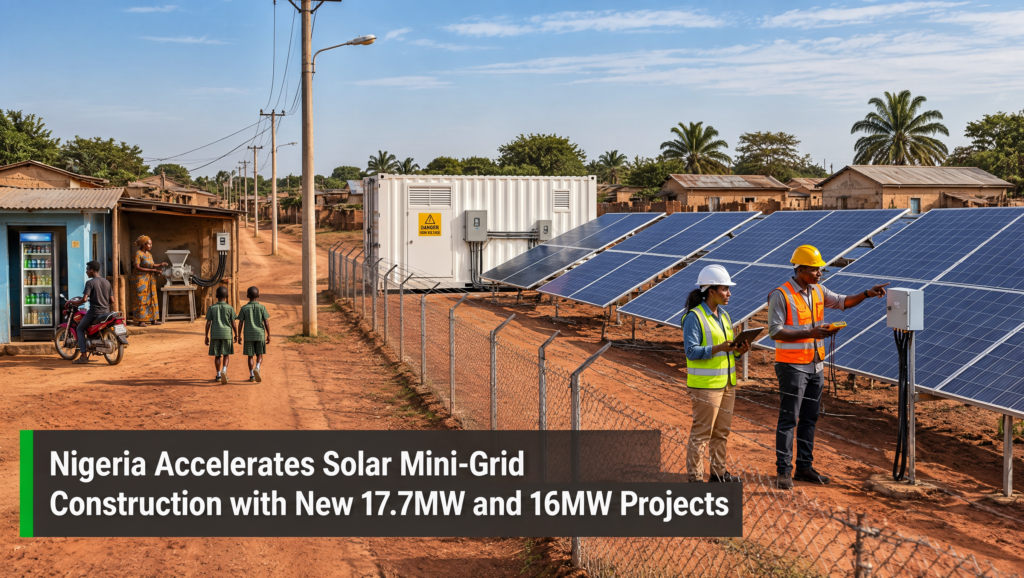 programme will depend on reliable equipment, affordable tariffs, effective maintenance and commercially sustainable operating models.
As construction progresses in Ibadan and Gombe, alongside developments in Jigawa, Nigeria’s mini-grid expansion is demonstrating how solar generation, battery storage and private-sector financing can contribute to closing electricity access gaps.
The challenge will be translating the growing project pipeline into dependable power supplies, stronger rural enterprises and sustained economic activity.
Also Read
- Africa’s Solar Boom Is Much Bigger Than Previously Thought
- What Indian Solar Firms Need to Know Before Entering Africa’s Market
- Navitas Solar’s Zambia Project Signals India’s Growing Role in Africa’s Solar Infrastructure Race

- Nigeria Accelerates Solar Mini-Grid Construction with New 17.7MW and 16MW Projects - November 13, 2026
- ASEE 2027 to Bring Global Energy Industry Leaders to Bangkok for Smart Energy and Storage Expo - October 30, 2026
- PV Guangzhou 2027 to Highlight Solar and Energy Storage Technologies - October 22, 2026