

The evolution of quarrying equipment is no longer being defined solely by greater size, power or payload.
Increasingly, the intelligence built into the machine — and the ability to connect that machine to a wider digital ecosystem — is becoming just as important.
At steinexpo 2026, this shift is reflected in the growing emphasis on safety systems, machine assistance, connectivity and digital services.
For Liebherr, these technologies are most powerful when they work together, helping quarry and construction operators improve safety, productivity and machine availability.
The company sees the combination of advanced safety systems, machine connectivity and digital solutions as a key driver of future equipment performance.
In quarrying, where equipment utilisation and uptime can have a direct impact on the economics of an operation, the ability to understand what is happening across a fleet is becoming increasingly important.
Intelligence starts with the operator
Safety remains one of the most immediate areas where intelligent technology can make a difference.
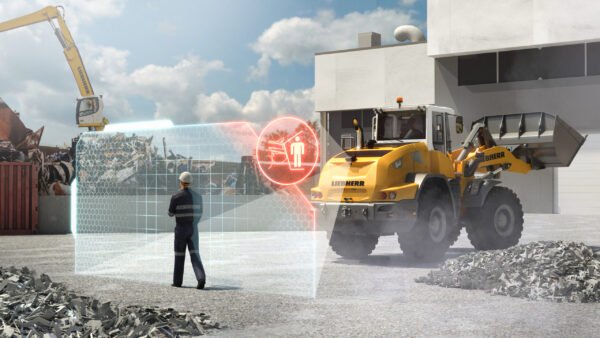
Liebherr points to solutions such as Skyview 360° and Active Personnel Detection for wheel loaders which are designed to help operators identify potential hazards at an earlier stage.
In environments where large machines operate around people, haul roads, stockpiles and other equipment, improving visibility and situational awareness can form an important part of a wider site-safety strategy.
The same principle extends to machine assistance.
Technologies such as machine-control solutions are designed to support operators during repetitive machine operations. The Bucket Filling Assist helps to achieve more consistent performance.
Rather than replacing the operator, such systems provide additional information or assistance that can help make machine operation more controlled and repeatable.
For quarry operators, that consistency matters. Small variations in loading cycles, bucket filling or machine operation can accumulate over thousands of cycles.
Assistance technologies therefore have the potential to contribute not only to ease of operation, but also to productivity and more predictable machine performance.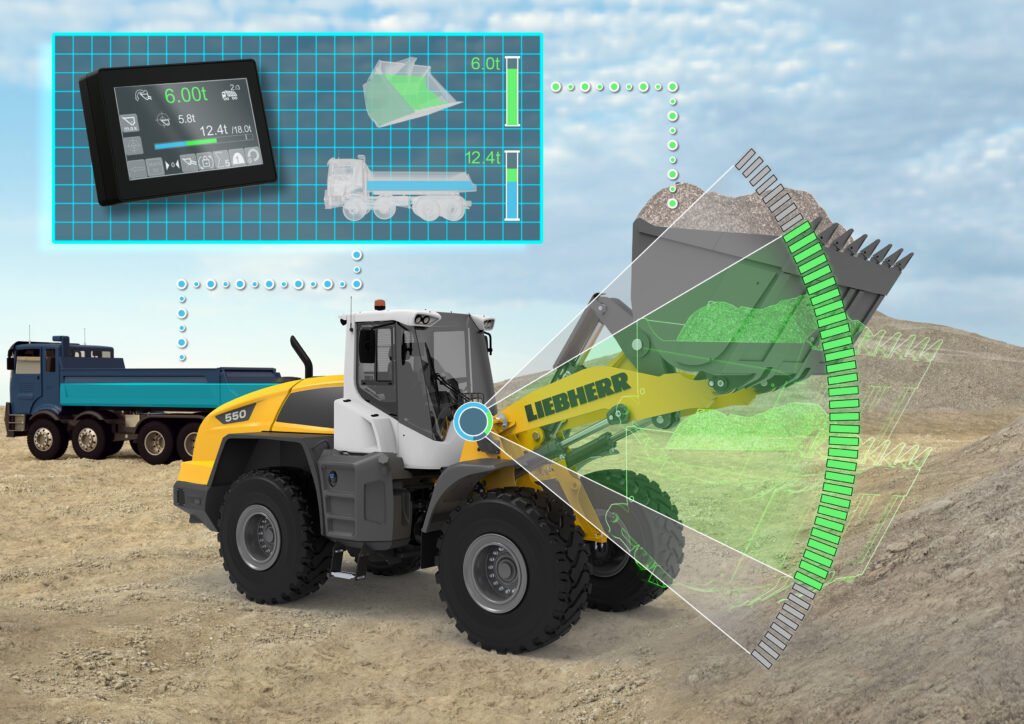
From individual machines to connected fleets
The bigger transformation, however, is taking place beyond the machine itself.
Connectivity is changing the way equipment owners and fleet managers understand their machinery.
Instead of relying primarily on physical inspections, scheduled maintenance or responding to failures, operators can increasingly use machine data to gain a more continuous view of equipment condition and performance.
Liebherr describes connectivity as fundamentally transforming fleet management by making machine condition, service requirements and performance information more transparent and centrally accessible.
This creates the possibility of moving from reactive to more proactive maintenance.
If information about machine condition and service requirements is available in advance, maintenance activities can be planned more effectively. This can help reduce the disruption associated with unexpected failures while improving machine availability.
The value of connectivity also extends beyond maintenance.
Performance data can provide insight into how machines are being utilised across an entire fleet.
For a quarry operating multiple excavators, loaders or other equipment, this wider perspective can help managers identify differences in utilisation and productivity and make better-informed decisions about fleet operation.
In this sense, digitalisation is becoming less about simply collecting data and more about turning that data into operational information.
The quarry as a digital production environment
This development is particularly significant in quarrying because machines rarely operate in isolation.
An excavator may load material that is transported by a haul truck before entering a crushing and screening circuit. A change in the performance of one part of that process can affect the productivity of the wider operation.
The growing connectivity of individual machines therefore creates opportunities to consider equipment as part of a broader production system.
This is where the development of intelligent machines intersects with the wider transformation taking place across quarry technology.
Automation, machine control, digital fleet management and increasingly sophisticated assistance systems can provide operators with more information about what is happening on site.
The challenge is then to use that information effectively.
For equipment manufacturers and quarry operators alike, the objective is not simply to add more technology.
The technology must contribute to tangible operational outcomes — improved safety, higher productivity, greater availability and more effective use of equipment.
Moving towards increasingly intelligent machines
Liebherr sees the industry as approaching an important transition: the movement from intelligent tools towards intelligent machines.
The distinction is significant.
An intelligent assistance system can help an operator perform a particular task. A more advanced intelligent machine could increasingly combine assistance, connectivity, automation and data analysis to perform routine activities with less direct intervention while continuously adapting its operation.
According to Liebherr, future construction machinery will increasingly automate routine tasks, provide data-driven support to operators and become more closely integrated into connected production environments.
For quarrying, this points towards machines that are not simply powerful pieces of mobile equipment, but connected components of a larger production environment.
Such a development could change the role of the operator as well. As intelligent machines increasingly take over routine and repetitive tasks, operators can focus more on complex decision-making, process optimisation and other activities that benefit from human expertise.
The direction of travel is therefore clear: quarry equipment is becoming more connected, more assisted and increasingly capable of using data to support its own operation.
At steinexpo 2026, that transition forms part of a much wider technology story.
From crushing and screening systems to excavators, haulage equipment, tyres and digital platforms, the modern quarry is becoming an environment where the performance of individual machines is increasingly linked to the intelligence of the entire operation.
For Liebherr, the next generation of quarry machinery will be defined not by one technology alone, but by how safety, productivity, connectivity and automation come together.
Also Read
- From Operator to Algorithm: Bedrock Puts Autonomous Excavators to Work on Live Construction Sites
- Hyundai’s New HX210L: Why Earthmoving Contractors Should Pay Attention
- Why African Equipment Buyers Need Reliable OEM Parts Networks

- Liebherr: From Intelligent Assistance to Connected Quarry Machines - November 25, 2026
- Africa’s Water Reuse Challenge: Why Scaling Matters More Than Technology - September 22, 2026
- UK Construction Sector Contracts Again as Housing Weakness Weighs on Industry - July 16, 2026