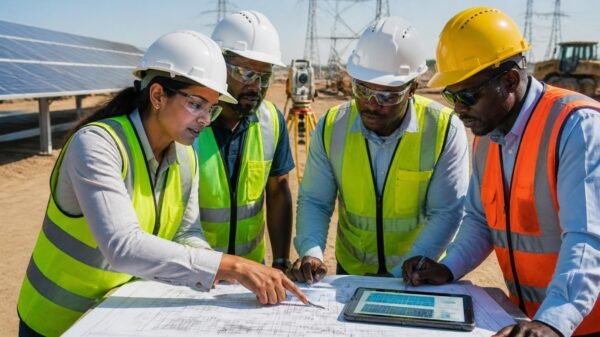
Africa is fast becoming the next major growth frontier for Indian renewable energy companies looking beyond a crowded domestic market.
The latest signal came from Surat-based Navitas Solar, which has moved from simply supplying solar modules to executing a full utility-scale project overseas — a shift that industry watchers say marks a turning point for Indian solar EPC ambitions on the continent.
From Module Supplier to EPC Player
Navitas Solar, through its EPC arm Navitas Planet, has secured a contract to develop a 54 MW captive solar power project worth close to ₹200 crore in Zambia’s Serenje Province.
The plant is being built to meet the power needs of a mining company and is expected to be commissioned in the third quarter of FY27.
“This project is meant to meet the captive power needs of a mining company. It should set the ball rolling for a lot more opportunities in the region,” says Vijay Menon, Chief Operating Officer, Navitas Solar
The company will deploy its own TOPCon bifacial modules for the project, while inverters and other balance-of-system equipment will be sourced from an established Chinese manufacturer with service centres already in the region.
Navitas plans to source nearly half the total equipment from India. Founded in 2013 with a module manufacturing capacity of 3 GW, this marks the company’s first utility-scale EPC assignment in Africa, following a smaller 0.5 MW project in Latin America last year.
A Continent Historically Dominated by China
Navitas is not alone. A handful of Indian renewable energy firms are now working to establish an EPC presence on a continent that has, for years, been dominated by Chinese contractors.
While Indian companies have supplied solar modules to African markets for some time, utility-scale EPC opportunities have remained concentrated among relatively few players.
Sterling and Wilson Renewable Energy secured a ₹1,313-crore, 240 MW AC solar EPC order in South Africa last year and now has four utility-scale projects under execution in the country.
Jakson Green has already executed a 50 MWp solar EPC project in the region and is currently implementing a 24 MWp solar-plus-storage project in West Africa.
Why Africa Is Attracting Indian Developers
Industry experts believe Africa could become one of the most significant overseas growth markets for Indian renewable energy companies — but success will require far more than competitive EPC pricing.
“Africa has abundant solar resources, rising electricity demand and a significant power access gap, making it one of the most attractive long-term renewable energy markets globally,” says Atanu Mukherjee, CEO, Dastur Energy
Africa’s power gap is creating long-term demand
Africa remains home to some of the world’s fastest-growing economies and one of its largest electricity deficits.
According to the International Energy Agency (IEA), hundreds of millions of people in Sub-Saharan Africa still lack access to reliable electricity, while rapid industrialisation, urbanisation and population growth continue to increase power demand.
At the same time, the continent possesses some of the world’s strongest solar resources.
Countries stretching from North Africa through Southern Africa enjoy exceptionally high solar irradiation, making photovoltaic generation increasingly competitive against diesel generation and, in many regions, conventional grid electricity.
These conditions are attracting growing investment from governments, independent power producers, mining companies and international development finance institutions.
For Indian EPC firms, this creates opportunities across:
- Utility-scale solar farms
- Captive solar projects for mining companies
- Commercial and industrial (C&I) solar systems
- Solar-plus-storage projects
- Rural electrification
- Mini-grids and hybrid power systems
Why Zambia matters
Navitas Solar’s first African EPC project is particularly significant because it targets Zambia’s mining sector.
Mining remains one of Africa’s largest industrial electricity consumers, with companies increasingly seeking dedicated renewable energy projects to reduce operating costs, improve energy security and meet sustainability targets.
Unlike traditional grid-connected projects, captive power plants provide electricity directly to industrial customers, offering developers long-term revenue certainty while helping mines reduce dependence on unreliable public electricity systems.
The model is expected to become increasingly common across copper-producing Zambia, the Democratic Republic of the Congo, Namibia and other resource-rich African markets.
Africa is not one market
Perhaps the biggest misconception among international developers is treating Africa as a single investment destination.
In reality, every country presents different opportunities, regulations, financing structures and commercial risks.
Energy advisory firm Dastur Energy believes successful market entry depends on recognising these differences.
Chief Executive Officer Atanu Mukherjee explains: “Africa has abundant solar resources, rising electricity demand and a significant power access gap, making it one of the most attractive long-term renewable energy markets globally.”
However, he cautions against viewing the continent simply as another EPC destination.”The winning model will not be just low-cost EPC execution.”
Instead, he argues that success requires companies to develop:
- Strong engineering capability
- Local partnerships
- Energy storage integration
- Long-term operations and maintenance expertise
- A detailed understanding of country-specific risks
Not all African markets offer the same opportunity
Investment decisions should be based on market fundamentals rather than continental averages.
According to Mukherjee, countries including South Africa, Egypt, Morocco, Kenya, Nigeria, Ghana, Tanzania, Zambia, Namibia and Ethiopia each present different opportunities depending on factors such as:
- Utility financial strength
- Regulatory maturity
- Power purchase frameworks
- Grid capacity
- Tariff structures
- Political stability
- Currency risk
- Project bankability
For example, South Africa currently offers one of Africa’s most mature utility-scale renewable energy markets, supported by private generation reforms and strong demand from commercial and industrial customers.
“Indian renewable energy companies entering Africa will need to compete through engineering capability, partnerships and long-term asset performance rather than price alone, according to Atanu Mukherjee, CEO of Dastur Energy.”
IN THEIR WORDS
“The winning model will not be just low-cost EPC execution.”
Meanwhile, Zambia and the Democratic Republic of the Congo present compelling opportunities linked to mining operations, while East African countries continue investing in mini-grids and distributed renewable energy systems.
Companies entering Africa therefore need country-specific strategies rather than a continent-wide business model.
Competing with China requires differentiation
Chinese companies continue to dominate many of Africa’s utility-scale renewable energy projects, supported by extensive manufacturing capacity, integrated supply chains and competitive financing.
For Indian firms, competing solely on equipment price is unlikely to be sustainable.
Mukherjee believes differentiation should instead focus on:
- Engineering quality
- Reliable project execution
- Lifecycle asset performance
- Technical innovation
- Comprehensive risk management
These capabilities align well with the experience many Indian EPC firms have gained while operating in one of the world’s most competitive renewable energy markets.
Local partnerships are becoming essential
One recurring lesson from successful infrastructure projects across Africa is that local partnerships matter.
Whether working with EPC subcontractors, logistics providers, engineering consultants or maintenance companies, firms with established local relationships generally navigate permitting, procurement and operational challenges more effectively.
Local partnerships also strengthen after-sales support—an increasingly important consideration for utility-scale solar assets expected to operate for more than two decades.
For Indian manufacturers, building regional networks may ultimately become as important as manufacturing competitive solar modules.
Financing and risk remain critical
Despite its long-term potential, Africa presents commercial realities that developers cannot ignore.
Mukherjee identifies several issues requiring careful evaluation before committing capital:
- Payment security
- Utility financial health
- Currency volatility
- Regulatory consistency
- Project financing structures
- Political and sovereign risk
Projects backed by mining companies, multinational industrial customers or development finance institutions may offer stronger commercial foundations than those relying exclusively on financially constrained public utilities.
As a result, risk assessment should become an integral part of project development rather than an afterthought during financial close.
Beyond EPC: the next opportunity
Africa’s renewable energy transition is expanding beyond conventional solar farms.
Demand is growing for:
- Battery energy storage systems (BESS)
- Hybrid renewable power plants
- Microgrids
- Commercial and industrial energy systems
- Green hydrogen infrastructure
- Electrification of mining operations
Companies capable of integrating engineering, storage, digital monitoring, operations and maintenance under a single offering may enjoy a competitive advantage as these markets mature.
Market intelligence will matter as much as technology
Africa’s renewable energy story is no longer defined solely by resource potential.
Increasingly, success depends on understanding regulation, financing, industrial demand and local partnerships.
Navitas Solar’s Zambia project illustrates how Indian companies are beginning to move higher up the value chain—from exporting equipment to delivering complete energy infrastructure solutions.
Whether more Indian firms follow will depend not only on engineering capability but also on their ability to tailor investment strategies to individual African markets.
As Mukherjee concludes:”Africa should be viewed as a strategic long-term market rather than simply an EPC export destination. Companies that combine engineering excellence with financial discipline, local partnerships and strong project structuring will be best placed to build a sustainable presence.”
For Indian renewable energy companies, the message is clear: Africa’s solar opportunity is real—but capturing it will require patience, partnerships and market intelligence as much as competitive technology.
Also Read
- The Future of Solar Energy in Africa:Trends, Challenges, and Opportunities Through 2035
- Belle Rive Solar Farm South Africa: Inside the Country’s Largest Off-Grid Agricultural Solar Project

- Africa’s Water Reuse Challenge: Why Scaling Matters More Than Technology - September 22, 2026
- UK Construction Sector Contracts Again as Housing Weakness Weighs on Industry - July 16, 2026
- What Indian Solar Firms Need to Know Before Entering Africa’s Market - July 15, 2026