Africa’s construction industry is under growing pressure to deliver more infrastructure, housing and industrial buildings, while improving construction speed, quality and predictability.
For precast concrete manufacturers, that is creating an opportunity to move beyond conventional, labour-intensive production towards more industrialised manufacturing.
Yet the transition is not simply a matter of buying more sophisticated machinery.
Production capacity has to match the market, equipment must be maintainable, operators must be trained and the entire manufacturing process has to work as an integrated system.
This is the market in which Spanish manufacturer Moldtech has built its international business.
Founded in 1986, Moldtech designs and manufactures moulds, machinery and integrated production systems for residential, industrial and civil-engineering applications.
The company says its projects now extend across more than 80 countries on five continents, with its offering ranging from individual equipment to complete precast plants.
Its growing involvement in Africa provides a window into how the continent’s precast industry is developing — from major infrastructure projects requiring highly engineered prestressed elements to drainage and road projects where flexible, mobile and configurable production equipment can be more appropriate.
From Moulds to Complete Production Systems
Moldtech designs and manufactures moulds, prestressing systems and integrated production solutions for residential, industrial and civil-engineering applications. Its African projects range from individual moulds and specialised equipment to complete precast production plants.
From moulds to complete production systems
Moldtech’s proposition is based on treating precast production as an industrial process rather than simply a collection of individual machines.
Depending on the application, a production system can incorporate moulds, casting tables, prestressing equipment, vibration systems, concrete distribution, curing, handling and circulation equipment, as well as hydraulic and digital control systems.
The company supplies solutions for industrial buildings, residential construction and civil engineering, including tilting tables, prestressing beds, moulds for bridge and U-girders, self-reacting prestressing systems, wall-panel equipment and 3D moulds for modular construction.
For Moldtech, however, the appropriate level of technology depends on the manufacturer’s actual requirements.
That distinction is particularly important in Africa, where markets differ significantly in industrialisation, infrastructure pipelines, access to skilled personnel, power reliability and availability of spare parts.
Rather than assuming that every customer requires a fully automated factory, Moldtech’s approach is to assess the product, expected output, manufacturing sequence, available resources and future expansion requirements before defining the equipment.
The objective is to create a plant that can operate reliably today while providing a pathway for expansion as demand develops.
Engineering for Africa’s diverse requirements
There is no single African precast market.
Egypt and Morocco have more established industrial bases and major infrastructure programmes, while markets such as Nigeria, Ghana and Côte d’Ivoire are experiencing different combinations of urbanisation, infrastructure development and local manufacturing investment.
East African markets including Kenya and Tanzania also present opportunities linked to housing, infrastructure and industrial development.
Moldtech’s experience reflects that diversity.
Its African projects range from highly specialised production systems for major transport infrastructure to equipment for drainage channels, culverts and road-safety barriers.
That range illustrates an important characteristic of precast manufacturing in Africa: the opportunity is not confined to one product category.
Large infrastructure programmes can require thousands of repetitive structural components, while urban development creates demand for drainage, sanitation, flooring, wall panels and other standardised products.
For manufacturers, the challenge is therefore to identify where industrial production can generate sufficient volume and then build a production system around that demand.
Moldtech Across Africa
From prestressed metro girders and airport structures to drainage channels, box culverts and road barriers, Moldtech’s African experience covers a wide range of precast applications across Egypt, Morocco, Nigeria and West African markets.
Alexandria Metro: engineering production at infrastructure scale
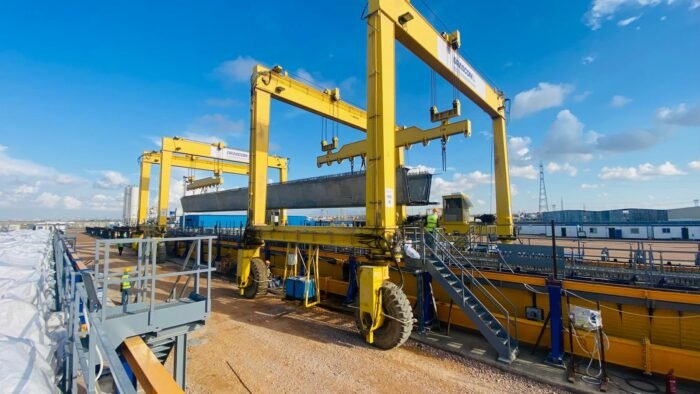
One of Moldtech’s most significant African projects is in Egypt, where the company developed a complete plant for producing prestressed U-girders for the new Alexandria Metro.
The metro network extends approximately 21.7 kilometres and includes 20 stations, with elevated sections requiring structural elements for viaducts and overpasses.
Moldtech’s plant incorporates two self-reacting production lines designed to withstand stressing and detensioning forces of up to 1,900 tonnes.
The moulds use collapsible internal cores to facilitate demoulding while protecting the geometry of the girders.
A centrally controlled vibration system supports concrete compaction, while specialised equipment assists with the handling of large structural elements.
The project demonstrates the level of engineering required when precast production becomes an integral part of a major infrastructure programme.
It is no longer simply a question of manufacturing a concrete component. Prestressing, mould design, vibration, handling, safety and production control must operate together, with sufficient repeatability to maintain the construction programme.
Alexandria Metro: The Numbers
- 21.7 km — approximate metro network length
- 20 — stations
- 2 — self-reacting production lines
- 1,900 tonnes — stressing and detensioning force capacity
- U-girders — prestressed elements produced for viaduct and elevated sections
From airports to long-span beams
Moldtech’s work in Morocco provides another example of how precast production can be configured around a major project.
For the expansion of Rabat Airport, the company supplied equipment for the manufacture of precast elements required for the new terminal.
The installation included a 100-metre self-reacting mould for double-tee slabs and an 80-metre, 600-tonne universal prestressing bed for L-, T- and rectangular beams. It also incorporated a column mould with provisions for casting corbels and a tilting table.
In Nigeria, Moldtech supplied a 400-tonne self-reacting prestressing bed for manufacturing variable-depth beams up to 52 metres long.
The application highlights another advantage of self-reacting systems: long-span elements can be manufactured without requiring conventional external abutments anchored into substantial foundations.
For producers working on infrastructure and industrial projects, such flexibility can be important when production requirements change between contracts.
Production beyond the major projects
While large metro, airport and bridge projects demonstrate the upper end of precast technology, Moldtech’s African experience also extends into more basic but essential infrastructure.
The company has supplied equipment for drainage channels, channel covers, New Jersey barriers and box culverts in several West African markets.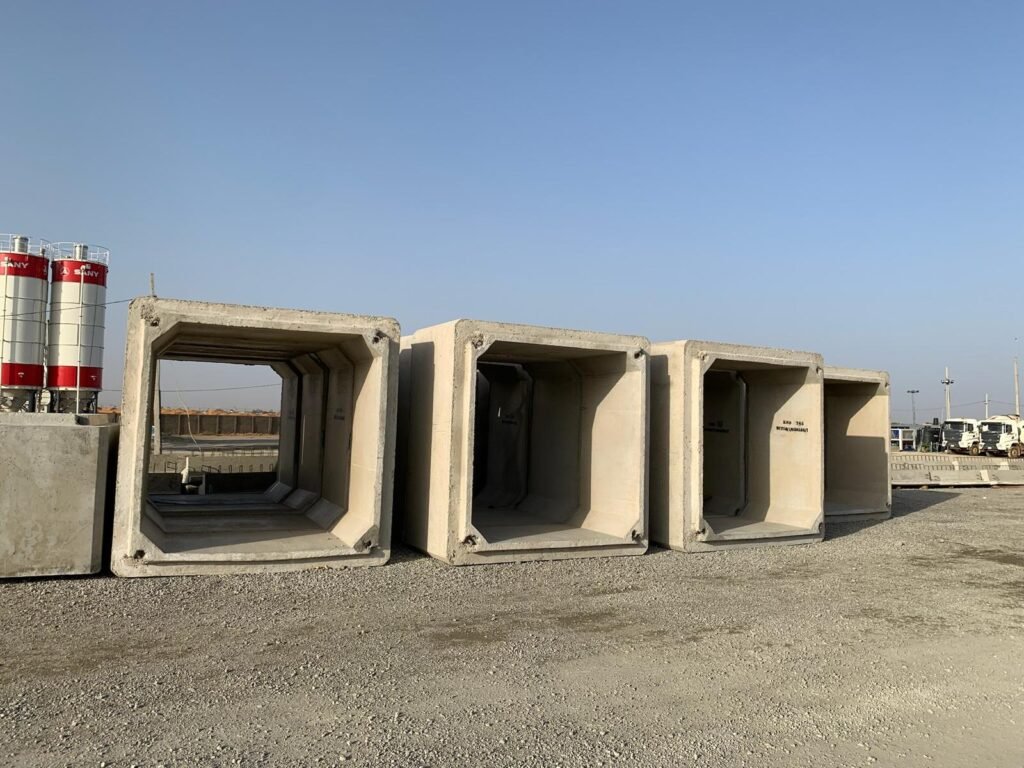
For one project designed to operate through mobile plants in several countries, Moldtech supplied 80 drainage-channel moulds, casting tables for channel covers, 20 moulds for two-metre New Jersey barriers and two concrete distribution vehicles.
The project also included handling equipment, assembly, commissioning and on-site technical support.
In Côte d’Ivoire, Moldtech supplied 28 customised drainage-channel moulds together with moulds for precast box culverts and New Jersey barriers.
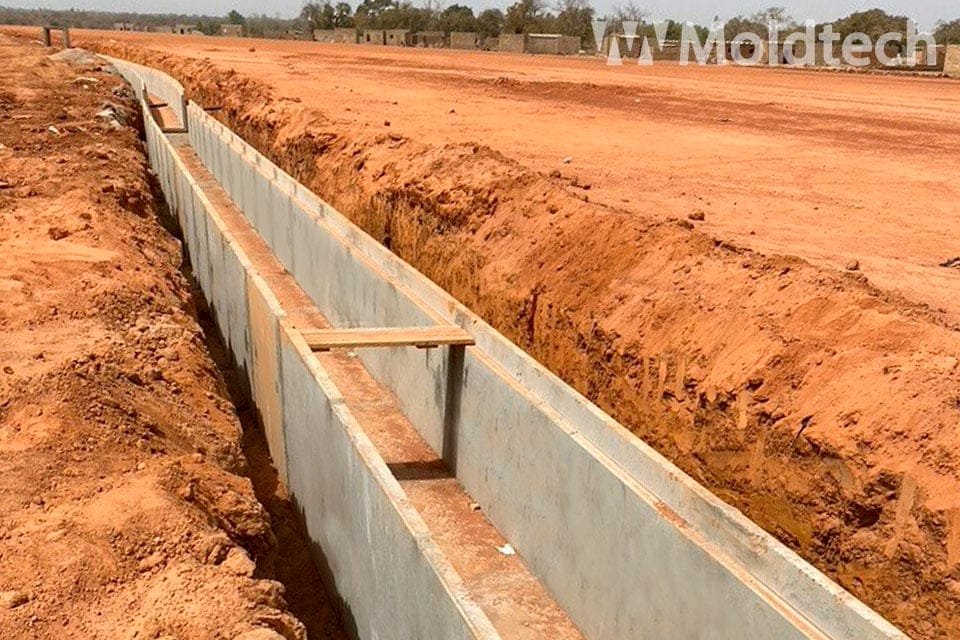
The company has also supplied drainage-channel moulds in Guinea and is developing a configurable system in Ghana using 19-metre side forms and interchangeable bases capable of producing different geometries.
These projects point to an important role for configurable equipment in developing markets.
Instead of investing in a separate machine for every product dimension, manufacturers can use adaptable systems to respond to changing project requirements.
Automation with a purpose
For Moldtech, automation is not about making a plant as technologically complex as possible.
The greater opportunity lies in automating the operations that directly affect quality, productivity and repeatability.
These can include mould opening and closing, concrete placement, vibration, prestressing, demoulding, internal transport and curing.
When these processes are controlled, manufacturers can reduce variation between shifts and production batches. Cycle times become easier to measure, production capacity becomes more predictable and quality control can move beyond simply inspecting the finished element.
“The most suitable technology is not necessarily the most complex, but the one that delivers stable, safe and maintainable production.”
— Moldtech
Sensors and digital systems can also record parameters such as curing temperature, vibration frequency, hydraulic pressure, cycle times and stressing forces.
Over time, that information can support maintenance planning and identify deviations before they become recurring production problems.
Moldtech also sees increasing potential in connecting digital design with production.
Linking BIM models, engineering information, production drawings and equipment settings can reduce errors before concrete is cast — particularly important in precast construction, where dimensional deviations can affect installation of an entire structure.
But the technology has to suit the operating environment.
Reliable power, spare-parts availability, technical expertise and maintenance capability all influence whether automation will deliver sustainable benefits.
Building plants that can grow
Moldtech’s Scalable Approach
1. Identify demand
Define the products, geometries and expected production volumes.
2. Mechanise critical operations
Introduce the equipment required to improve productivity, quality and safety.
3. Expand with the market
Add handling, circulation, curing and control systems as production requirements increase.
Perhaps the most important consideration for Africa’s emerging precast manufacturers is scale.
A factory that is significantly larger than the available project pipeline can leave a producer carrying unnecessary capital costs and underutilised equipment.
Conversely, insufficient capacity can prevent a manufacturer from meeting major contracts.
Moldtech therefore advocates a scalable approach in which manufacturers can begin by mechanising critical operations and subsequently add handling, circulation, curing or control systems as demand increases.
The principle is straightforward: production capacity should be connected to identifiable demand.
That means understanding which elements will be manufactured, their required geometries, expected volumes, available labour, utilities and logistics before selecting equipment.
For local manufacturers, the benefits extend beyond production efficiency.
Manufacturing precast elements closer to construction sites can reduce dependence on imported finished products, create industrial employment and develop local technical expertise. It can also allow construction and factory production to take place in parallel, potentially improving project scheduling.
Technology transfer is part of the plant
Equipment alone does not create a successful precast operation.
A modern plant requires operators who understand safety and machinery, production managers capable of managing cycle times and workstations, maintenance personnel familiar with mechanical and hydraulic systems, and quality teams able to monitor concrete properties, dimensions and traceability.
Moldtech therefore incorporates installation, commissioning and training into its project approach.
Its technicians can support equipment assembly, functional testing and initial production, helping local teams understand not only how the machinery operates but also the production logic behind its design.
This becomes increasingly important as automation increases.
The objective is not simply to transfer machinery to Africa, but to transfer the knowledge required to operate, maintain and eventually expand the production system.
A manufacturing industry in its own right
Moldtech’s African projects point towards a broader change in the continent’s construction industry.
Precast concrete is increasingly being considered not simply as an alternative construction technique, but as an industrial manufacturing process capable of supporting large infrastructure and building programmes.
The opportunity spans major transport projects, housing, industrial and logistics buildings, drainage, sanitation, water infrastructure and energy projects.
The next phase will require manufacturers to combine machinery with production planning, engineering, quality control, maintenance and skills development.
For Moldtech, that is where its role extends beyond manufacturing individual moulds.
The company is increasingly positioning its engineering, manufacturing, installation and commissioning capabilities around the complete production requirement — from assessing what needs to be manufactured to helping establish a plant capable of producing it consistently.
Africa’s precast industry will not develop at the same pace everywhere.
But as project pipelines become more established and local manufacturers invest in production capacity, the demand for reliable, adaptable and scalable technology is likely to grow.
The long-term opportunity is therefore larger than supplying equipment.
It is about helping create a domestic manufacturing base capable of producing the concrete components Africa’s next generation of infrastructure will require.
Moldtech’s experience across the continent shows what that transition can look like in practice: from the high-capacity prestressed girders of Alexandria Metro to airport infrastructure in Morocco, long-span beams in Nigeria and configurable drainage systems across West Africa.
The common thread is industrialisation — turning concrete production into a controlled, repeatable and scalable manufacturing process.
Also Read
- From Design to Construction: The Benefits of Automated Precast Concrete Wall Making Machines
- How Modular Housing Could Accelerate Africa’s Affordable Housing Drive
- Inside Algeria’s $878 Million Railway Project: Engineering a New Trans-Saharan Corridor

She brings insightful analysis and in-depth reporting to the sector, highlighting innovations and developments that shape Africa’s built environment.
- Moldtech: Engineering Africa’s Next Generation of Precast Concrete Production - September 23, 2026
- How They Were Built: Inside the Construction of the Grand Ethiopian Renaissance Dam - September 4, 2026
- CNH Construction Sales Rise 12% as North American Demand Offsets Tariff Headwinds - August 3, 2026