

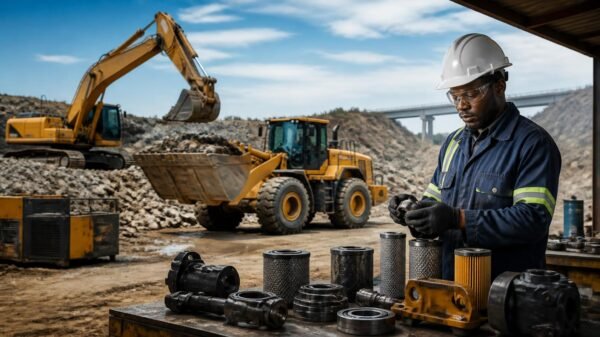
Modern construction equipment is becoming increasingly sophisticated.
Machines contain more sensors, electronic control units, telematics systems and electronically controlled hydraulics than previous generations, with estimates suggesting excavators contain around 20% more embedded electronics than they did five years ago.
For African equipment buyers, that evolution creates a hidden vulnerability. A replacement component can fit mechanically and still fail electronically.
When sophisticated diagnostics are required to identify or resolve a fault, access to OEM-level technical support can become the difference between a one-day repair and a week-long shutdown.
More Electronics Means More Points of Failure
The pace of change across construction is accelerating. For example, the construction market is estimated to spend at least $4 billion (approximately R64.62 billion) on artificial intelligence.
This reflects the sector’s growing investment in technologies that improve planning, productivity, safety and equipment operations.
At the machine level, that same technological shift is visible in the growing number of sensors, control systems, telematics and other embedded electronics built into modern equipment.
Construction equipment was once dominated by mechanical and hydraulic systems. Today, those systems increasingly rely on electronic controls to operate efficiently.
Modern excavators, loaders, graders and other machines may use sensors to monitor temperature, pressure, position and engine performance, while electronic control units manage everything from fuel injection to hydraulic functions.
Telematics systems can also transmit machine data remotely, helping operators monitor utilisation, location and machine health.
This integration improves performance and efficiency, but it also makes equipment more interconnected.
A replacement sensor, actuator or control module is no longer just a physical component. It needs to communicate correctly with the rest of the machine.
Electrical characteristics, calibration, software configuration and communication protocols can all affect whether a component actually works as intended.
That means mechanical compatibility doesn’t necessarily equal electronic compatibility.
Why Generic Parts Can Create Bigger Problems
Aftermarket components can have an important role in equipment maintenance, particularly for suitable commodity and mechanical parts.
The risk arises when buyers assume that any component that physically fits is an acceptable substitute.
An electronic component can appear to work while producing inaccurate readings, triggering intermittent fault codes or communicating incorrectly with other systems.
This risk is widely recognized across the equipment industry. Major OEMs — from excavator and loader manufacturers to specialized equipment producers — emphasize in their technical documentation that replacement parts must meet original specifications.
EDCO, which manufactures concrete surface preparation equipment for harsh jobsite conditions, warns in its technical manuals that “to ensure product safety and reliability, always use genuine EDCO replacement parts when making repairs to the equipment.”
While equipment categories differ, the principle is consistent: replacement components affect more than just mechanical function.
Instead of immediately identifying a failed component, technicians may need to investigate wiring, sensors, control modules, software, power supplies and communication networks before finding the underlying problem.
This is where OEM-level diagnostics become even more valuable.
Manufacturer-supported technicians have access to machine-specific diagnostic procedures, technical documentation, electronic schematics, and, where required, proprietary diagnostic equipment and software.
They can determine whether a fault is actually related to the replacement component or to another part of the system. The result is less guesswork and potentially much shorter downtime.
Import Dependence Magnifies the Risk
The challenge is particularly significant in Africa, where heavy equipment markets have substantial import dependence due to a small, but growing, local market.
In many countries, there is limited local manufacturing capacity for sophisticated construction machinery and its specialist components.
When a machine fails, the replacement part may therefore have to cross international and regional supply chains before reaching the jobsite. A component that’s technically available somewhere in the world is not necessarily available where it’s needed.
Customs clearance, international freight, port congestion and inland transportation can all be add time. For remote projects, the final journey can be particularly challenging. This makes regional parts availability a strategic advantage.
A distributor with critical OEM components already positioned within the region can potentially reduce the gap between failure and repair from days or weeks to something much more manageable.
Harsh Conditions Make Reliability Even More Important
African construction equipment operates across highly varied and often demanding environments. Extreme heat, dust, humidity, vibration and heavy workloads can place considerable stress on mechanical and electronic systems.
The right replacement component needs to be suitable for the machine and for its operating environment.
OEM parts are designed and validated for specific equipment applications, while OEM support can provide guidance on installation, calibration and troubleshooting. That becomes particularly valuable when a machine is operating far from a major service centre.
Buyers Should Evaluate the Network, Not Just the Machine
Equipment procurement should extend beyond the machine’s initial specification and purchase price.
Buyers should ask:
- Which critical OEM parts are stocked locally or regionally?
- How quickly can specialist components be supplied?
- Is trained technical support available in the country?
- Can technicians access OEM diagnostic tools and documentation?
- How are electronic control modules configured and calibrated?
- What happens when a local technician cannot resolve a complex fault?
- Is there a clear escalation process to regional or factory-level specialists?
These questions reveal how quickly the machine can realistically be returned to productive operation when something goes wrong.
Uptime Is the Real Measure of Value
The cheapest replacement component isn’t necessarily the lowest-cost option. A modest saving on a generic electronic part can quickly disappear if the component creates diagnostic problems, requires additional labour or contributes to repeat failures.
The cost becomes even greater when a machine sits idle while the correct part is sourced internationally.
For a contractor working on a major road, mining or infrastructure project, downtime can affect operators, schedules, subcontractors and productivity far beyond the machine itself.
That makes a reliable OEM parts network an uptime strategy.
The Parts Network Is Part of the Equipment
As construction machinery becomes more electronic, African equipment buyers need to consider more than machine performance and purchase price.
With high import dependence, challenging operating conditions and potentially long replacement-part supply chains, equipment support can have a direct impact on project continuity.
Also Read
- From Operator to Algorithm: Bedrock Puts Autonomous Excavators to Work on Live Construction Sites
- South Africa Has R395 Billion in Infrastructure Projects — But Can the Industry Deliver Them?
- Kenya’s Steel Industry Is Running at Just 36% Capacity Despite Construction Boom

She specialises in covering innovative construction equipment, green building solutions, and the integration of automation and efficiency in modern construction projects across residential and commercial sectors.
- Why African Equipment Buyers Need Reliable OEM Parts Networks - September 14, 2026
- Nature-Based Soil Stabilisation: How Bamboo Could Transform Erosion Control in Southeast Nigeria - August 10, 2026
- Data Centre Cooling Systems in Africa: HVAC and Liquid Cooling Guide for Hyperscale Projects - July 8, 2026