

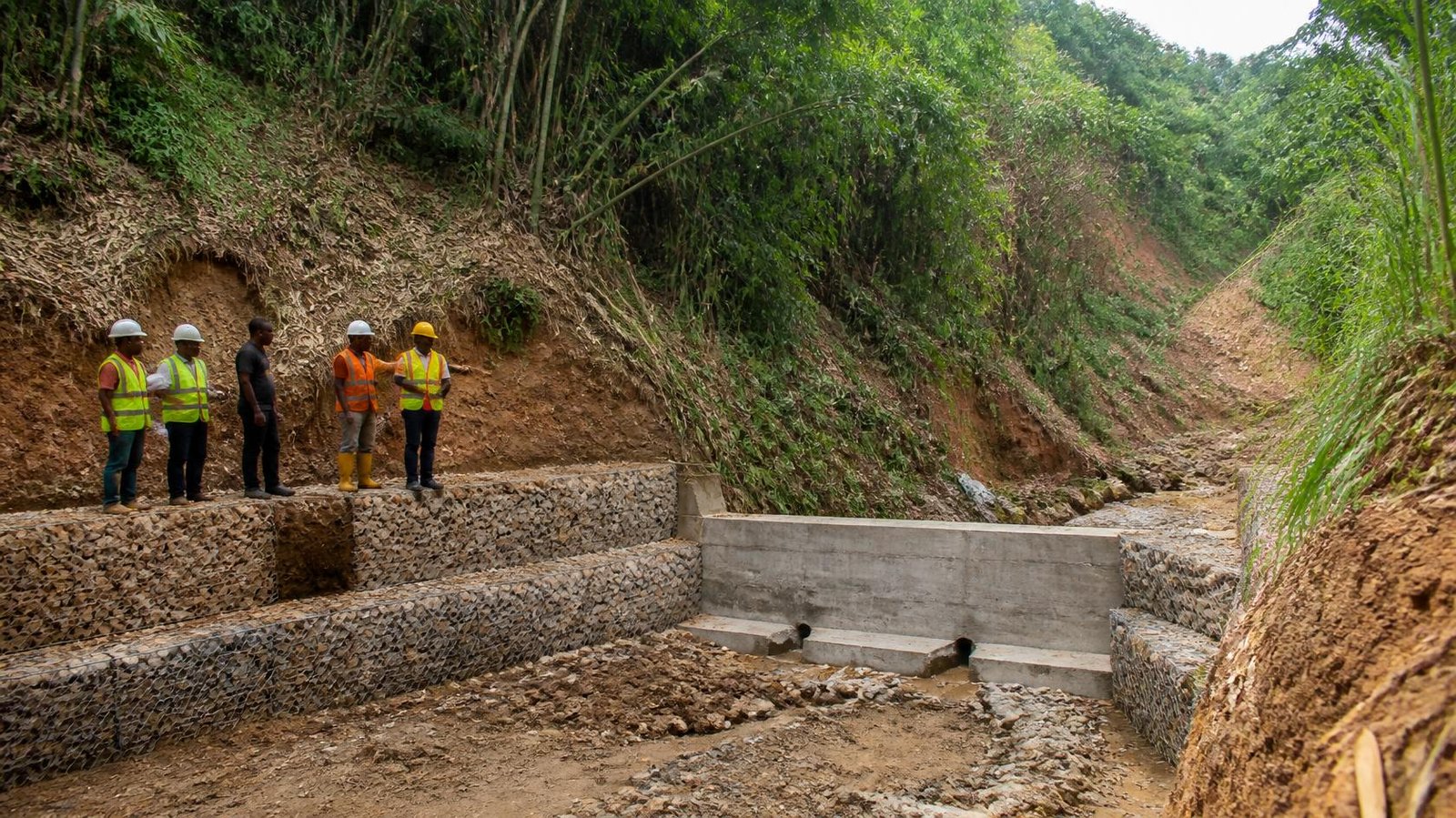
When erosion becomes severe, the instinct is often to build. Concrete check-dams, gabions, retaining walls and other hard-engineering structures can slow water and hold unstable ground in place.
Yet in Southeast Nigeria, some of the region’s most aggressive erosion systems have exposed the fact that structures can fail when the surrounding soil continues to move, water finds pathways beneath foundations, drainage is inadequate or vegetation is absent.
A 2026 systematic review published in Frontiers in Sustainable Food Systems points to the use of Bambusa vulgaris, or common bamboo, as part of an integrated nature-based restoration strategy.
The review found evidence that bamboo can improve infiltration, reduce runoff, lower soil bulk density and stabilise steep developing gully slopes, offering civil engineers and contractors a valuable complement to conventional infrastructure.
Why Southeast Nigeria Is a Difficult Erosion Environment
Southeast Nigeria presents a perfect storm for severe erosion. The region’s Ultisols and Alfisols are often sandy loams or sandy clay loams with low organic matter and high susceptibility to structural degradation.
Add intense seasonal rainfall, steep terrain, disturbed vegetation and poorly designed drainage, and surface water rapidly becomes a destructive force.
Soil composition also directly affects how unstable ground must be managed. In excavation projects, unstable and soft soils may require specialised soil stabilisation treatments and equipment, underscoring the importance of evaluating ground conditions before selecting an intervention.
Related Stories
The Agulu-Nanka gully complex illustrates the scale of the problem. Gully systems in the region can expand dramatically, stripping agricultural land, damaging infrastructure and threatening communities.
This is where conventional erosion control techniques can encounter a fundamental problem.
A concrete structure may control water at one point, but it cannot automatically improve the surrounding soil. If water infiltrates beneath the structure or concentrates elsewhere, erosion can simply move around the intervention.
Concrete check-dams, gabions, retaining walls and mechanical terracing have experienced long-term failures in Southeast Nigeria associated with inadequate foundation preparation, poor drainage, insufficient vegetative reinforcement and limited maintenance.
The Numbers Behind Bamboo’s Erosion-Control Potential
The 2026 review synthesised 63 studies, of which 38 provided quantitative data. Across the evidence base, bamboo plantations were associated with 10% to 25% reductions in soil bulk density, 20% to 40% increases in water-stable aggregates and two- to four-fold improvements in infiltration compared with degraded or cultivated controls.
Those changes can have a major effect on erosion-prone slopes.
Better infiltration means more rainfall enters the soil instead of immediately becoming surface runoff.
Lower bulk density can indicate a less compacted soil structure with greater capacity to accept and store water. Meanwhile, stronger aggregates are better able to withstand the impact and shearing forces associated with intense rainfall.
The review also reports up to a 25% reduction in runoff under bamboo-based systems. These figures should not be interpreted as a guarantee for every site, because outcomes depend on species, stand age, soil, climate and management.
Still, they demonstrate why natural erosion control deserves serious consideration alongside conventional engineering.
Bamboo Changes the Problem From the Ground Up
The strength of bamboo as a soil stabilisation method lies as much underground as above it. Bambusa vulgaris develops an extensive root and rhizome system that can physically reinforce soil.
Instead of simply resisting moving water with a rigid structure, the plant becomes part of the soil profile itself.
Bamboo’s roots can:
- Bind soil particles and increase resistance to surface detachment.
- Create channels that allow water to infiltrate rather than rapidly flow downhill.
- Improve soil aggregation as organic matter accumulates.
- Increase vegetation cover on exposed slopes.
- Reduce the amount of bare soil directly exposed to intense rainfall.
- Contribute organic material through root turnover and litter.
This distinction matters, as effective soil erosion prevention is rarely about stopping water altogether. It is about slowing its movement, increasing infiltration and keeping soil particles attached to the landscape.
Bamboo Succeeds Where Hard Infrastructure Fails
The answer is not that bamboo is inherently stronger than concrete — it is that bamboo performs a fundamentally different engineering function.
A concrete check-dam and a gabion are human-made structural interventions, while bamboo is a living system.
That means it can continue developing as its root network expands. Instead of creating an abrupt boundary between structure and soil, the vegetation integrates with the ground it is intended to protect.
This makes bamboo particularly promising for slope stabilisation methods that need to address surface erosion and shallow instability rather than relying exclusively on rigid structures.
Importantly, this does not mean engineers should remove concrete and gabions from every erosion-control project.
Bamboo can stabilise upper slopes and surfaces while engineered structures continue to manage the most critical channel or toe conditions.
Designing a Nature-Based Erosion-Control System
For contractors and civil engineers, the practical lesson is not to plant bamboo and walk away. Successful erosion control techniques require site-specific design.
A potential restoration package could combine:
- Bamboo on upper slopes: Establishing B. vulgaris where surface erosion and shallow soil instability are major concerns.
- Vetiver at lower elevations: Using deeper-rooted vegetation where deeper reinforcement is required.
- Brush layering: Placing bamboo stakes and woody material across exposed gully faces to provide immediate surface protection.
- Check-dams at critical points: Retaining masonry or gabion structures where channel-grade control and flow reduction are necessary.
- Drainage management: Ensuring concentrated runoff is safely intercepted and dispersed rather than redirected towards vulnerable slopes.
- Long-term maintenance: Monitoring establishment, drainage pathways, sediment accumulation and structural performance.
The goal is not to choose nature over engineering, but to combine engineering with ecology.
A More Cost-Effective Way to Think About Soil Erosion
Nature-based approaches can also change the economics of erosion management. Concrete and gabion systems require materials, transportation, skilled construction, foundations and continuing maintenance. On remote or severely degraded sites, those costs can quickly rise.
Vegetation requires establishment and management too, but it can multiply in place and provide benefits beyond structural stabilisation.
Bamboo is one of the quickest-growing plants on the planet, growing 58 centimetres per day. That makes bamboo an intriguing option for contractors working on large landscapes rather than isolated structures.
The Future of Erosion Control May Be Hybrid
The most important takeaway is not that bamboo has made concrete obsolete, but that high-erosion environments demand a broader definition of infrastructure.
A successful intervention may involve a concrete gully, gabions where channel velocities need to be controlled, vetiver where deep roots are required and bamboo across upper slopes where surface reinforcement and infiltration are priorities.
That is natural erosion control working alongside civil engineering rather than against it.
When the Strongest Foundation Is Alive
The future of erosion management may not be about choosing between concrete and nature, but understanding where each works best.
Bambusa vulgaris shows how living root systems can improve infiltration, reinforce vulnerable soils and reduce runoff while delivering carbon and ecological benefits along the way.
Combining proven infrastructure with natural erosion control could offer a more resilient, adaptable and cost-effective path forward.
What This Means for Contractors
- Reduced dependence on hard structures on suitable slopes
- Greater use of bioengineering
- More demand for drainage design
- Vegetation establishment and maintenance contracts
- Hybrid erosion-control projects
Also Read
- 5 Critical Investments That Define a High-Efficiency Construction Site in 2026
- Top projects in Subsurface Modelling and Analysis: 2024 Going Digital Awards in Infrastructure
- Essential geotechnical software for modern construction projects

She specialises in covering innovative construction equipment, green building solutions, and the integration of automation and efficiency in modern construction projects across residential and commercial sectors.
- Why African Equipment Buyers Need Reliable OEM Parts Networks - September 14, 2026
- Nature-Based Soil Stabilisation: How Bamboo Could Transform Erosion Control in Southeast Nigeria - August 10, 2026
- Data Centre Cooling Systems in Africa: HVAC and Liquid Cooling Guide for Hyperscale Projects - July 8, 2026