

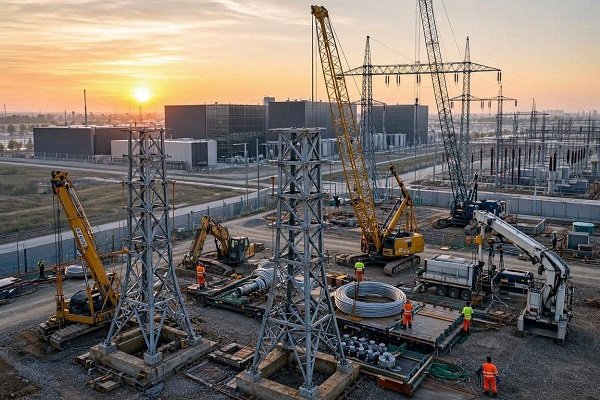
America’s construction industry is entering a new era, and this time the driving force is not highways, airports or commercial real estate.
Instead, the country’s aging electrical grid, surging electricity demand, and rapid expansion of artificial intelligence (AI) data centers are creating one of the largest infrastructure investment cycles in decades.
The latest financial results from Quanta Services, one of North America’s largest infrastructure contractors, provide compelling evidence that the boom is already underway.
The Houston-based company delivered record second-quarter 2026 revenue of $9.56 billion, a 41% increase from a year earlier, while reporting a record $53.4 billion backlog and raising its full-year financial outlook across every major metric.
For contractors, equipment manufacturers and investors, the results signal more than a strong earnings quarter—they highlight a structural transformation that is reshaping the US construction industry.
America’s power grid faces unprecedented demand
For decades, America’s electric grid was designed around predictable growth in residential, commercial and industrial electricity consumption. That model is rapidly changing.
The explosive rise of AI-powered data centers, advanced manufacturing facilities, electrification of transportation, renewable energy integration and continued economic expansion are placing unprecedented pressure on transmission and distribution infrastructure.
Quanta Services President and CEO Duke Austin said the company’s strong performance reflects accelerating customer investment in critical infrastructure.
“We believe these results, and our long-term track record, are a clear differentiator of Quanta’s ability to compound profitable growth as our customers accelerate investment in the electric grid, power generation and mission-critical infrastructure that underpin the economy.”
That statement underscores one of the biggest shifts taking place across the construction sector: utilities are no longer simply maintaining aging infrastructure—they are expanding it at an unprecedented pace.
Grid modernization is creating billions in construction work
Unlike traditional building projects, power infrastructure requires a highly specialized construction workforce capable of delivering complex electrical and mechanical installations.
Quanta’s second-quarter performance illustrates where much of this investment is flowing.
The company’s Electric segment generated $7.84 billion in quarterly revenue, accounting for more than 82% of total company sales while posting double-digit operating margins.
Projects include:
- High-voltage transmission lines
- Electrical substations
- Grid modernization
- Renewable energy interconnections
- Utility infrastructure
- Industrial electrical systems
- Communications infrastructure
As utilities expand transmission capacity and replace aging equipment, demand for electrical contractors is expected to remain strong for years rather than months.
Related News
AI data centers are changing construction priorities
One of the most significant themes emerging from Quanta’s results is the growing influence of AI and hyperscale data centers on construction demand.
Electricity consumption from large-scale computing facilities continues to increase rapidly, forcing utilities to build new transmission networks, substations and supporting infrastructure.
Recognizing this opportunity, Quanta recently acquired electrical contractor Phalcon and industrial services company Enerfab, both of which strengthen its capabilities in technology, power generation and mission-critical infrastructure.
According to the company, Phalcon expands its electrical capabilities across the Northeast and Mid-Atlantic while strengthening its position in the rapidly growing data center market.
Enerfab adds fabrication, electrical, mechanical and construction expertise supporting power generation, advanced manufacturing and data center customers.
The acquisitions form part of a broader strategy to increase self-perform capabilities in electrical, mechanical and fabrication disciplines rather than relying heavily on subcontractors.
Acquisitions point to the next phase of infrastructure construction
Quanta completed four acquisitions during the second quarter and July:
- Phalcon
- Enerfab
- Percheron
- PSD
Together, the businesses strengthen the company’s electrical construction, fabrication, engineering, surveying and manufacturing capabilities across the United States and Australia.
Management expects the acquisitions to contribute between $1.2 billion and $1.4 billion in revenue and $120 million to $140 million in adjusted EBITDA during 2026.
The deals highlight an important trend across the construction industry: major infrastructure contractors are investing heavily in specialized capabilities as demand shifts toward complex energy and technology projects.
Manufacturing is becoming part of the construction supply chain
Another notable development is Quanta’s decision to expand into domestic manufacturing.
In June, the company formed a joint venture with Hyosung HICO to manufacture high-voltage circuit breakers in the United States.
The facility will produce equipment rated up to 800 kV, helping utilities address rising electricity demand driven by data centers, electrification and grid modernization while reducing supply chain risks for critical infrastructure projects.
The move reflects a broader industry trend in which contractors are increasingly integrating manufacturing and fabrication into their operations to improve project delivery and strengthen supply chain resilience.
A record backlog signals years of work ahead
Perhaps the strongest indicator of future construction activity is Quanta’s backlog.
At the end of the second quarter, the company reported:
- Remaining Performance Obligations: $33.6 billion
- Total Backlog: $53.4 billion
Both represent record levels for the company.
Backlog represents contracted and expected future work, providing valuable insight into long-term market demand.
For construction suppliers, equipment manufacturers and subcontractors, such a backlog suggests that infrastructure spending is likely to remain elevated well beyond 2026.
Contractors with skilled electrical workforces stand to benefit
Quanta repeatedly highlighted the importance of its self-perform, craft-skilled workforce as a competitive advantage.
Rather than relying primarily on subcontractors, the company continues investing in electricians, mechanical specialists, fabrication experts and engineering professionals capable of delivering increasingly complex infrastructure projects.
As grid modernization accelerates, shortages of skilled electrical workers could become one of the industry’s biggest constraints, increasing demand for companies with experienced workforces.
Outlook remains strong
Following its record first-half performance, Quanta raised its full-year 2026 guidance.
The company now expects:
- Revenue of $39.3 billion to $39.7 billion
- Adjusted EBITDA of $4.09 billion to $4.21 billion
- Free cash flow of $2.0 billion to $2.5 billion
The improved outlook reflects strong project execution, growing customer investment and contributions from recent acquisitions.
The construction boom is shifting toward energy infrastructure
While roads, bridges and commercial buildings remain essential components of the construction industry, the next wave of investment is increasingly centered on electricity.
Utilities are expanding transmission networks, manufacturers are building advanced production facilities, and AI data centers are driving unprecedented demand for reliable power infrastructure.
Quanta Services’ record earnings and growing backlog provide a clear indication that this is more than a short-term trend.
As electricity demand continues to rise, companies involved in transmission, substations, fabrication, utility construction and grid modernization are likely to remain among the biggest beneficiaries of America’s next construction boom.
Related Articles:
- Top Data Centre Projects Under Construction in the U.S
- Wall Street Is Pouring Billions Into AI Data Center Construction. Here’s Why
- Why Construction Cost Data Is Becoming a Competitive Advantage

With years of experience covering infrastructure projects, equipment, and engineering solutions, Yvonne brings in-depth analysis and practical insights to contractors, engineers, and industry stakeholders.
She is passionate about highlighting sustainable construction practices and the latest advancements that drive efficiency and safety on worksites.
- Why America’s Grid Expansion Is Creating a New Construction Boom - July 31, 2026
- U.S. Housing Starts Surge 19% in June, Signalling Strong Construction Activity Despite Decline in Building Permits - July 23, 2026
- 10 Benefits of Smart Buildings: How Intelligent Buildings Are Transforming Commercial Real Estate - July 21, 2026