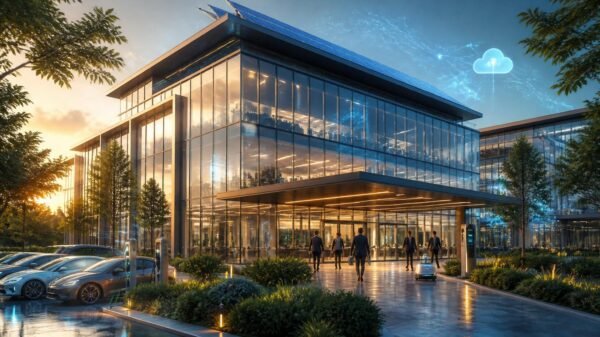
Commercial real estate is going through its biggest operational shift since the introduction of central air conditioning.
Owners, developers, and facility managers are no longer just asking whether a building keeps the lights on and the lifts running — they’re asking whether it can think.
Smart buildings, once a niche upgrade for flagship towers, are becoming the baseline expectation for tenants, investors, and regulators alike.
This shift matters for markets far beyond the usual smart-city headlines out of Singapore or Dubai.
Across Africa, the UK, and North America, developers are retrofitting ageing stock and specifying intelligent systems into new builds because the economics — energy costs, maintenance budgets, ESG reporting requirements — increasingly demand it.
This article breaks down what a smart building actually is, how the technology works, and the ten measurable benefits reshaping commercial property performance.
What Is a Smart Building?
A smart building is a structure that uses connected technology to monitor, analyse, and automatically adjust its own systems — heating, cooling, lighting, security, and more — based on real-time data rather than fixed schedules or manual control. The concept rests on several core technologies working together.
Building Management Systems (BMS) sit at the centre of most smart buildings. A BMS is the software backbone that centralises control over mechanical and electrical equipment — HVAC, lighting, fire safety, lifts — allowing facility teams to monitor and adjust performance from a single dashboard instead of walking floor to floor.
IoT sensors are the nervous system. Small, networked devices measure temperature, humidity, occupancy, air quality, light levels, and equipment vibration throughout the building, feeding a continuous stream of data back to the BMS.
Artificial intelligence turns that raw data into decisions. Machine learning models can spot patterns humans would miss — a chiller drawing slightly more power each week, a floor that’s consistently over-cooled after 6pm — and adjust settings or flag issues automatically.
Building automation is the execution layer: once a decision is made, automated controls physically carry it out, dimming lights, shifting thermostat setpoints, or locking down a zone, without a human pressing a button.
Connected devices extend intelligence to individual assets — smart thermostats, connected lift motors, networked fire panels — each capable of reporting its own status.
Cloud platforms aggregate data from single buildings or entire portfolios, giving asset managers portfolio-wide visibility and enabling remote monitoring, benchmarking, and reporting from anywhere.
How Smart Buildings Work
The practical operation of a smart building follows a simple loop: sense, analyse, act, learn.
Sensors placed throughout the building continuously capture conditions — occupancy in a meeting room, CO2 levels in an office floor, vibration in a rooftop chiller. Controllers receive this data and compare it against target parameters, deciding whether an adjustment is needed.
From there, systems act across every major building function:
- HVAC systems modulate heating and cooling in real time based on occupancy and weather forecasts rather than fixed timetables.
- Lighting dims or switches off automatically in unoccupied zones and adjusts to complement natural daylight.
- Security systems combine access control, video analytics, and intrusion detection into a single monitored network.
- Elevators use predictive dispatch algorithms to reduce wait times and group trips efficiently, cutting energy use during off-peak hours.
- Energy monitoring tracks consumption at the sub-meter level, isolating which floor, tenant, or system is driving costs.
- Predictive analytics layers historical and real-time data to forecast equipment failures, demand spikes, and maintenance needs before they become costly problems.
Together, these systems don’t just automate a building — they continuously optimise it, learning from every data point to run more efficiently over time.
10 Benefits of Smart Buildings
1. Significant Energy Savings
Energy is usually the largest controllable operating cost in a commercial building, and it’s where smart technology delivers the fastest, most visible returns.
AI-driven HVAC systems adjust heating and cooling based on real occupancy and weather data instead of static schedules, cutting waste from conditioning empty floors.
Smart lighting paired with occupancy sensors ensures energy is only spent where people actually are.
Demand response systems allow buildings to automatically reduce consumption during peak-price periods or grid strain, and integration with on-site renewable energy — solar arrays, in particular — lets buildings offset grid draw directly.
Together, these measures commonly reduce total energy consumption by 20–40% compared to conventionally managed buildings.
2. Lower Operating Costs
Energy savings are only part of the cost picture. Smart buildings reduce operating expenditure through preventive maintenance that catches problems before they escalate into expensive repairs, reduced downtime from equipment failures, and optimised staffing since automated systems handle routine adjustments that once required manual rounds.
Equipment also lasts longer when it’s run within optimal parameters rather than pushed through inefficient cycles, spreading capital costs over a longer asset life.
3. Predictive Maintenance
Traditional maintenance is reactive — fix it when it breaks — or calendar-based, which wastes resources servicing equipment that doesn’t need it.
Smart buildings flip this model. Sensors monitor vibration, temperature, and performance trends on critical equipment like chillers, pumps, and lift motors, detecting the early signatures of failure — a bearing running hot, a motor drawing irregular current — long before a breakdown occurs.
This shifts maintenance from guesswork to evidence, reducing emergency repair costs, extending equipment lifespan, and minimising disruptive downtime for tenants.
4. Improved Occupant Comfort
Comfort has become a competitive differentiator in leasing, and intelligent systems deliver it with a precision manual controls never could.
Indoor air quality sensors track CO2, particulate matter, and humidity, triggering ventilation adjustments that keep air fresh — a factor increasingly tied to cognitive performance and wellbeing research.
Personalised climate control lets zones, or even individual desks in advanced fit-outs, be tuned to occupant preference. Daylight optimisation balances artificial and natural light to reduce eye strain and glare.
The cumulative effect is a healthier, more comfortable workplace that supports tenant retention.
5. Enhanced Security
Security in a smart building extends well beyond a guard at the front desk. Facial recognition and smart access control systems replace easily-duplicated keycards with more secure, auditable credentials.
Visitor management platforms digitise sign-in processes and flag unauthorised access attempts instantly. Video analytics can detect unusual behaviour patterns in real time rather than relying on staff reviewing footage after an incident.
As these systems become more connected, cybersecurity becomes equally critical — building networks need the same rigour as corporate IT systems, since a compromised sensor network can be an entry point into far more sensitive data.
6. Better Space Utilisation
Hybrid work has made space efficiency a board-level concern, and occupancy analytics give owners and tenants the data to act on it. Sensors track how often desks, meeting rooms, and common areas are actually used, revealing the gap between leased space and space that’s genuinely needed.
This data supports hot-desking programmes, informs meeting room booking systems that reduce no-show bookings, and helps organisations right-size their footprint for hybrid work patterns — often the single largest lever for reducing real estate costs.
7. Sustainability and ESG Compliance
Environmental, social, and governance reporting has moved from a nice-to-have to a requirement for institutional investors, lenders, and increasingly, regulators.
Smart buildings generate the granular data ESG reporting demands: automated carbon reduction tracking, water consumption monitoring that flags leaks and waste, and waste management systems that measure diversion rates.
This data underpins green building certifications and streamlines what used to be a manual, error-prone reporting process — a meaningful advantage when institutional capital increasingly screens for sustainability performance before committing to an asset.
8. Real-Time Building Analytics
Centralised dashboards give facility managers and asset owners a live view of building performance rather than a monthly report compiled after the fact.
Key performance indicators — energy intensity, occupancy rates, maintenance response times — are tracked continuously.
Fault detection and diagnostics automatically flag underperforming systems, and portfolio-wide benchmarking lets owners compare performance across buildings to identify which assets are lagging and why.
This visibility turns building management from a reactive discipline into a continuous optimisation process.
9. Increased Property Value
Smart features are increasingly a factor in how commercial assets are valued and leased. Buildings with strong energy performance, verified sustainability credentials, and tenant-facing technology tend to attract premium occupants willing to pay for lower operating costs and better working environments.
Tenant satisfaction — driven by comfort, security, and reliability — supports retention and reduces costly vacancy periods.
As institutional buyers factor operational efficiency and ESG credentials into underwriting, well-instrumented smart buildings are increasingly positioned to command stronger valuations than comparable conventional stock.
10. Future-Proof Infrastructure
Regulatory requirements, tenant expectations, and energy markets will keep evolving, and smart buildings are built to adapt rather than require costly retrofits. AI integration continues to deepen as models improve.
Digital twins — virtual replicas of physical buildings — allow scenario testing and system upgrades to be modelled before implementation.
Autonomous building management, where systems self-optimise with minimal human input, is moving from pilot projects to mainstream deployment.
And as smart city connectivity expands, buildings equipped with the right connected infrastructure will be positioned to plug into wider urban energy grids, transport systems, and data networks rather than operating as isolated assets.
Examples of Smart Building Technologies
The benefits above are delivered through a growing stack of specific technologies now common in commercial developments:
- Smart HVAC systems that adjust in real time to occupancy, weather, and air quality data
- Smart lighting with daylight harvesting and occupancy-based dimming
- Occupancy sensors feeding space utilisation and energy management systems
- Smart elevators with predictive dispatch and energy-efficient regenerative drives
- Access control systems using biometrics, mobile credentials, and visitor management
- Energy management software that tracks consumption at building, floor, and tenant level
- Digital twins for modelling performance, testing upgrades, and planning retrofits
- Smart meters providing granular, real-time utility data
- Building analytics platforms that unify data across all systems into a single performance view
The Future of Smart Buildings
The next phase of building intelligence is already visible in leading developments. AI-driven autonomous buildings are beginning to manage themselves with minimal human intervention, learning occupant patterns and adjusting continuously.
Robotics is entering routine maintenance and cleaning roles, particularly in large commercial and logistics facilities. Net-zero buildings, once experimental, are becoming a standard specification for major new developments as carbon regulations tighten globally.
Edge AI — processing data locally on-site rather than routing everything to the cloud — is reducing latency and improving the responsiveness of building systems, while widespread 5G connectivity supports the growing volume of connected devices without network bottlenecks.
Digital twins are expanding beyond design and maintenance into live operational tools that simulate energy strategies before they’re deployed.
Renewable energy integration and on-site battery storage are turning buildings into active participants in energy markets, capable of storing power during low-demand periods and feeding it back during peaks.
And carbon-neutral construction methods — from low-carbon concrete to mass timber — are extending sustainability considerations from a building’s operation back into how it’s built in the first place.
Smart buildings are no longer a premium add-on reserved for trophy assets — they represent where commercial real estate is heading as a matter of course.
What began as simple automated structures with programmable thermostats and basic access control has evolved into connected, data-driven environments that continuously optimise for efficiency, sustainability, and occupant experience.
For owners, developers, and facility managers, the question is no longer whether to invest in building intelligence, but how quickly they can integrate it before the market — and their tenants — expect nothing less.
Also Read
How Modular Housing Could Accelerate Africa’s Affordable Housing Drive
Mobile & Modular Batching Plants: The Future of On-Site Concrete Production

With years of experience covering infrastructure projects, equipment, and engineering solutions, Yvonne brings in-depth analysis and practical insights to contractors, engineers, and industry stakeholders.
She is passionate about highlighting sustainable construction practices and the latest advancements that drive efficiency and safety on worksites.
- Why America’s Grid Expansion Is Creating a New Construction Boom - July 31, 2026
- U.S. Housing Starts Surge 19% in June, Signalling Strong Construction Activity Despite Decline in Building Permits - July 23, 2026
- 10 Benefits of Smart Buildings: How Intelligent Buildings Are Transforming Commercial Real Estate - July 21, 2026