

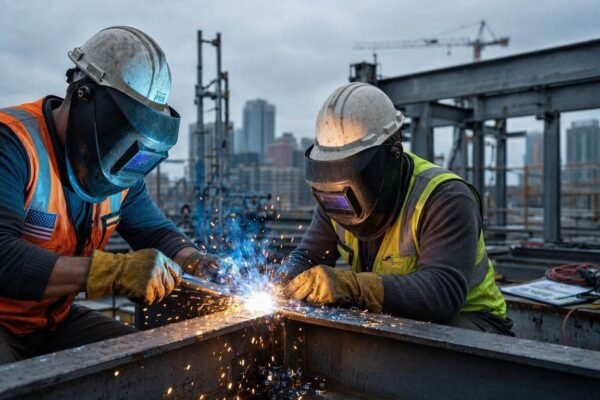
The construction industry entered 2026 with strong demand from infrastructure investment, manufacturing projects and data center construction.
Yet one challenge continues to slow progress across the sector: finding enough skilled workers.
While the latest ADP National Employment Report showed that U.S. construction employment continued to grow modestly and construction workers changing jobs enjoyed annual pay increases of nearly 13%, the figures also highlight a market where employers are competing fiercely for experienced talent rather than benefiting from an abundant labor supply.
Demand for Skilled Workers Remains High
Contractors across North America continue to report shortages of heavy equipment operators, electricians, welders, carpenters, plumbers and project managers.
Large infrastructure programs, semiconductor plants, energy projects and hyperscale data centers are all drawing from the same pool of skilled labor. As more projects break ground simultaneously, competition for qualified workers has intensified.
The result is higher wages, aggressive recruitment efforts and longer hiring times for construction companies.
Rising Wages Reflect Tight Labor Markets
One of the clearest signs of the labor shortage is wage growth.
According to ADP’s latest employment data, construction workers who changed employers experienced some of the fastest pay increases among all industries, with annual wage growth approaching 13%.
Even workers who stayed with their employers continued to receive healthy wage increases.
For contractors, rising wages are becoming both a recruitment tool and a growing business cost.
Many companies are increasing salaries, offering signing bonuses, improving benefits and investing in employee retention rather than risking losing experienced workers to competitors.
An Aging Workforce
A significant share of skilled construction workers is approaching retirement age.
As experienced operators and tradespeople leave the workforce, fewer young workers are entering the industry to replace them.
This knowledge gap is becoming increasingly evident on complex infrastructure, mining and industrial projects that require years of practical experience.
Without sufficient apprenticeships and vocational training, replacing retiring workers will remain difficult.
Young Workers Are Choosing Other Careers
Construction companies are also competing with technology, logistics and manufacturing industries for younger workers.
Many school leavers perceive construction as physically demanding and less attractive than careers in technology or office-based professions.
As a result, contractors face a shrinking pipeline of new talent despite offering competitive wages.
Industry organizations continue to promote apprenticeships, technical colleges and trade careers to encourage more young people to enter construction.
Mega Projects Are Stretching Labor Capacity
Across the United States, billions of dollars are being invested in highways, bridges, energy infrastructure, manufacturing facilities and data centers.
These projects require thousands of skilled workers, creating regional shortages as contractors compete for the same workforce.
Equipment manufacturers such as Caterpillar, Deere and Terex have all pointed to strong infrastructure demand, while aggregates producers including Vulcan Materials and Martin Marietta continue to benefit from increased construction activity.
However, delivering these projects depends not only on equipment availability but also on skilled people to operate it.
Technology Is Becoming Part of the Solution
Contractors are increasingly turning to technology to improve productivity with fewer workers.
Machine control systems, GPS-guided equipment, drones, telematics, artificial intelligence and autonomous construction equipment are helping crews complete projects more efficiently.
Modern excavators, graders and dozers equipped with automation allow operators to work faster and more accurately while reducing rework.
Digital project management platforms are also helping companies optimize scheduling, equipment utilization and workforce planning.
Although technology cannot fully replace experienced tradespeople, it enables contractors to accomplish more with smaller teams.
Training Is Becoming a Competitive Advantage
Forward-looking contractors are investing heavily in workforce development.
Many companies are expanding apprenticeship programs, partnering with technical colleges and providing in-house operator training.
Upskilling existing employees is often more cost-effective than recruiting experienced workers in a highly competitive labor market.
Manufacturers and equipment dealers are also supporting operator training to improve productivity and equipment performance.
The construction labor shortage is unlikely to disappear quickly. Strong infrastructure spending, continued industrial investment and the expansion of data centers are expected to sustain demand for skilled workers throughout 2026 and beyond.
For contractors, success will increasingly depend on attracting and retaining talent, embracing productivity-enhancing technologies and investing in workforce development.
Companies that combine modern equipment with skilled employees will be better positioned to deliver projects on time while managing rising labor costs in an increasingly competitive market.
Related Articles
Vulcan Materials Reaffirms 2026 Outlook as Infrastructure Projects Drive Aggregates Growth
Martin Marietta Sees Strong Infrastructure Demand as Q2 Revenue Climbs 21%

- SODECA Highlights Industrial Ventilation Technology at Mega Clima Expo Kenya 2026 - October 14, 2026
- How They Were Built: Inside the Engineering of the Lesotho Highlands Water Project - October 11, 2026
- Africa’s Water Reuse Opportunity: Building the Infrastructure for a Water-Secure Future - September 28, 2026