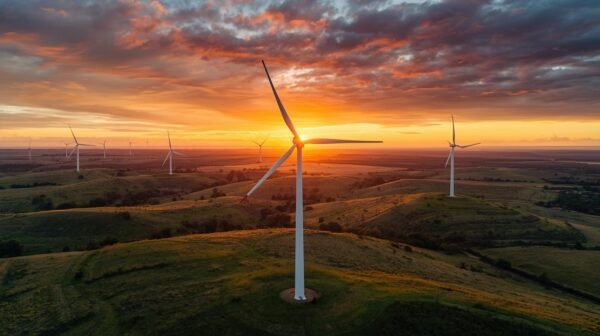
In October 14 2025, Seriti Green achieved a milestone that encapsulates both the promise and complexity of South Africa’s energy transition: financial close on the third phase of its flagship Ummbila Emoyeni wind farm.
With over R15 billion invested and three successive financial closes completed in just two years, this black-owned renewable energy company is demonstrating that South Africa’s Just Energy Transition is moving from aspiration to reality—in the very heartland of the country’s coal industry.
A Historic Financing Achievement in Record Time
Seriti Green’s accomplishment is remarkable not just for its scale, but for its velocity. The company has secured financing for 465MW across three phases since 2024, with the initial phase reaching financial close in early 2024, the second in August 2025, and the third in October 2025.
Each phase represents 155MW of wind capacity, financed through partnerships with South Africa’s major banks: Standard Bank, Rand Merchant Bank (RMB), and Absa.
In the context of renewable energy project finance—where securing funding can take years—closing three successive phases in 24 months represents an exceptional feat.
This rapid succession signals strong confidence from South African financial institutions in both the project’s viability and the broader renewable energy sector.
The R15 billion total investment underscores the scale of capital now flowing into clean energy infrastructure, making Ummbila Emoyeni one of Africa’s largest wind farm developments.
From Coal Giant to Renewable Energy Leader
The transformation of Seriti Resources from a purely coal-focused company into a diversified energy producer through its Seriti Green subsidiary represents a microcosm of South Africa’s broader energy transition.
Seriti Resources, a 91% black-owned mining company, operates six large-scale thermal coal mines that supply power stations including Eskom’s Lethabo, Tutuka, and Kriel facilities.
The company’s strategic pivot wasn’t born from altruism but from pragmatic recognition of shifting market realities. Global coal demand is declining, climate commitments are tightening, and South Africa’s own energy security demands diversification.
By acquiring Windlab South Africa in December 2022 and launching Seriti Green, the company positioned itself to lead rather than react to the energy transition.
This dual approach—maintaining coal operations while scaling renewables—reflects the practical challenges of transition economics. Seriti Green CEO Peter Venn has emphasized that “it is not about either coal or renewables, rather, it is about coal and renewables.” This pragmatic stance acknowledges that South Africa cannot simply switch off its coal-dependent economy overnight without causing severe economic disruption.
The Ummbila Emoyeni Project: Scale and Significance
When complete, the Ummbila Emoyeni renewable energy cluster will deliver more than 900MW across seven phases, comprising five wind farms, one solar photovoltaic facility, and one battery storage facility.
This makes it South Africa’s largest hybrid renewable energy project and positions it among the continent’s most ambitious clean energy developments.
The project’s location between Bethal, Davel, and Morgenzon in Mpumalanga is symbolically and practically significant.
Mpumalanga produces approximately 83% of South Africa’s coal and hosts the majority of the country’s coal-fired power stations.
Building 900MW of renewable capacity in coal country sends a powerful message about the feasibility of transition in traditionally fossil fuel-dependent regions.
The first phase is nearly complete, with 25 wind turbines already installed and commercial operations expected to begin in early 2026.
This timeline demonstrates that Seriti Green isn’t just securing financing—it’s delivering operational assets that will contribute to South Africa’s grid within months.
Economic Structure: Mining Operations Meet Market Trading
One of Ummbila Emoyeni’s innovative features is its revenue structure. Approximately one-third of the electricity generated will power Seriti Resources’ coal mining operations through a wheeling arrangement with Eskom.
This self-consumption model helps the parent company reduce its carbon footprint—potentially cutting emissions by 350,000 tonnes annually—while lowering energy costs.
The remaining two-thirds will be traded through the NOA Group and Energy Exchange of Southern Africa (EXSA), making clean energy accessible to businesses and households nationwide.
This market-based approach represents the growing sophistication of South Africa’s renewable energy sector, which has evolved beyond simple power purchase agreements to embrace more complex trading mechanisms.
This structure also provides revenue diversification. Rather than depending entirely on long-term contracts with single off-takers, Seriti Green can respond to market dynamics and potentially capture higher prices during peak demand periods.
Just Energy Transition: Promise vs. Reality in Mpumalanga
The term “Just Energy Transition” has become ubiquitous in South African energy discourse, but Seriti Green’s project offers a tangible test of whether the concept can deliver on its promises.
The project currently employs 1,200 workers on-site, with expectations to reach 2,000 during peak construction. Approximately 58.6% of workers come from local communities.
However, the broader context in Mpumalanga reveals significant challenges. The province faces potential job losses exceeding 85,000 workers as coal mines and power stations close over the coming decades.
Four municipalities—eMalahleni, Steve Tshwete, Govan Mbeki, and Msukaligwa—face particularly concentrated transition risks, as they host clusters of coal operations with limited remaining life-of-mine.
Coal mining jobs in Mpumalanga pay approximately 55% more than local averages, creating a challenging replacement equation.
While Seriti Green has transitioned some former mine staff into renewable energy roles, the skills and wage levels don’t always translate directly.
Construction jobs are temporary, and operational wind farms require far fewer workers than coal mines or power stations.
The project’s commitment to skills development and local procurement demonstrates intent, but the scale of the challenge is sobering.
With over 100,000 workers currently employed in Mpumalanga’s coal sector and their dependents, creating sufficient alternative employment remains the transition’s central challenge.
Financing Confidence: What the Banks See
The willingness of Standard Bank, RMB, and Absa to finance three successive phases in rapid succession reveals important market confidence indicators.
South African banks are typically conservative lenders, particularly for infrastructure projects, making their sustained commitment notable.
Several factors likely underpinned their confidence. First, Seriti Green benefits from parent company strength—Seriti Resources has established operations, revenue streams, and relationships with major power off-takers.
Second, the wheeling arrangement with Eskom for Seriti’s own consumption provides revenue certainty for a significant portion of generation.
Third, South Africa’s renewable energy sector has matured significantly since the early Renewable Energy Independent Power Producer Procurement Programme (REIPPPP) rounds, with proven track records and established contractors.
The broader context also matters. South Africa’s banking sector increasingly recognizes that climate transition represents both risk and opportunity.
Coal-dependent lending portfolios face growing scrutiny from regulators, shareholders, and international partners. Renewable energy financing, conversely, aligns with environmental, social, and governance (ESG) commitments while addressing a growing market need.
Grid Integration and Infrastructure Challenges
While Seriti Green’s financial close represents progress, the project highlights persistent infrastructure challenges. South Africa’s electricity grid faces severe capacity constraints, with Eskom’s transmission network struggling to accommodate new generation capacity in optimal locations.
Eskom’s Transmission Development Plan aims to build 14,000km of new transmission lines and add 37GW of connection capacity between 2025 and 2033.
However, Eskom’s constrained balance sheet—with debt exceeding R400 billion—raises questions about implementation pace. The government is exploring private sector participation in transmission development, but regulatory frameworks remain unclear.
For Seriti Green, grid connection delays could postpone revenue generation even after construction completion.
This risk affects project economics and can complicate refinancing or expansion plans. The company’s concentration of projects in Mpumalanga creates both efficiency and vulnerability—while proximity reduces infrastructure costs, it also concentrates exposure to regional grid constraints.
Comparative Context: South Africa’s Renewable Energy Landscape
Seriti Green’s R15 billion investment forms part of a broader renewable energy boom in South Africa.
Private sector renewable energy developments are expected to reach 6GW for solar photovoltaic and 3.5GW for wind power by 2030, representing total investment value of R132 billion. With approximately 80GW of renewables currently under development, the race for grid connections and wheeling contracts has intensified.
However, only about 32GW of the 80GW pipeline is expected to reach grid connection by 2030, reflecting the sector’s significant execution challenges.
Permitting delays, grid constraints, and financing gaps continue to slow deployment. Seriti Green’s ability to move from planning to construction relatively quickly suggests advantages from parent company resources, established relationships, and integrated project planning.
Policy Framework and Government Support
South Africa’s renewable energy policy framework has evolved significantly since the initial REIPPPP rounds.
The removal of the 100MW generation licensing requirement has accelerated private sector participation, while the Climate Change Act and Just Energy Transition Investment Plan provide legislative backing for decarbonization.
The government’s Renewable Energy Masterplan, approved by Cabinet in early 2025, sets targets for local manufacturing and aims to attract R15 billion in investment by 2030.
This aligns with Seriti Green’s timeline and scale, positioning the company to potentially benefit from local content incentives and supply chain development.
However, policy uncertainty remains a challenge. The Integrated Resource Plan still includes substantial coal capacity, creating mixed signals about long-term energy mix.
Eskom’s unbundling process continues to face delays, and wheeling frameworks remain under development.
For companies like Seriti Green, navigating this evolving policy landscape requires both flexibility and risk tolerance.
International Context: The Just Energy Transition Partnership
South Africa’s energy transition occurs within the framework of the Just Energy Transition Partnership (JETP), announced at COP26 in 2021.
Initial commitments of $8.5 billion from France, Germany, the UK, the US, and the EU have since grown to $11.8 billion with additional pledges from other countries.
However, the US withdrawal in March 2025 removed approximately $1.5 billion from the package.
The JETP funds target six focus areas: electricity sector transformation, green hydrogen, electric vehicles, skills development, just transition measures in Mpumalanga, and municipal capacity building.
Seriti Green’s project, while privately financed, aligns with these priorities and demonstrates the type of investment the JETP aims to catalyze.
The partnership’s success remains uncertain. Funding has been slow to disburse, and coordination challenges between international partners and South African government entities have created delays.
However, Seriti Green’s progress shows that private sector momentum can proceed independently of government programs, provided market conditions and financing structures align.
What This Deal Means for South Africa’s Energy Future
Seriti Green’s R15 billion investment and rapid project execution offer several important signals about South Africa’s energy transition.
First, private sector capital is available and willing to flow into renewable energy at scale when projects demonstrate commercial viability.
The successive financial closes prove that South African banks can support major infrastructure developments without relying primarily on development finance.
Second, the coal-to-renewables transition can be led by companies with roots in fossil fuels.
Seriti’s transformation demonstrates that existing energy companies possess valuable capabilities—project management, stakeholder relationships, construction expertise—that transfer to renewable development.
This suggests transition pathways beyond simply replacing old companies with new ones.
Third, location matters profoundly.
Building renewable energy in Mpumalanga, South Africa’s coal heartland, creates opportunities for skills transfer, community engagement, and symbolic transformation.
However, it also exposes projects to grid constraints, local political sensitivities, and the challenge of creating sufficient alternative employment.
Fourth, speed is possible but not guaranteed. Seriti Green’s two-year timeline from first to third financial close sets a benchmark, but replicating this pace across the sector requires favorable conditions: strong sponsors, established banking relationships, appropriate technology selection, and streamlined approvals.
The Road Ahead: Challenges and Opportunities
As Seriti Green moves toward completing 465MW and planning subsequent phases toward the 900MW target, several challenges loom.
Grid connection timelines remain uncertain, potentially delaying revenue generation. Local content requirements may increase costs or extend construction schedules.
Market conditions for traded electricity could affect revenue projections. And the broader social challenge of ensuring truly “just” transition for displaced coal workers requires sustained attention and investment beyond any single project’s capacity.
Yet the opportunities are equally significant. Successfully delivering Africa’s largest wind farm project would establish Seriti Green as a continental renewable energy leader.
The experience gained in project finance, construction management, and grid integration becomes valuable intellectual property for future developments.
And if the company can demonstrate genuine community benefit—not just employment numbers but sustainable economic development—it could provide a replicable model for transition in other coal-dependent regions globally.
Conclusion: From Promise to Proof
Seriti Green’s R15 billion investment and three successive financial closes represent more than a commercial achievement—they mark a turning point in South Africa’s energy narrative.
For years, the country’s renewable energy transition existed primarily in policy documents, international agreements, and aspirational targets. Seriti Green is building turbines, generating electricity, and employing thousands in coal country.
This doesn’t mean the transition is complete or that challenges have been solved. Mpumalanga’s coal workers still face uncertain futures.
Grid constraints continue to slow renewable energy deployment. And the gap between construction jobs and sustained employment remains wide.
But in October 2025, when Seriti Green announced its third financial close, it demonstrated that South Africa’s Just Energy Transition is no longer theoretical.
It’s happening in the fields between Bethal and Morgenzon, where wind turbines now rise where coal once dominated the economic landscape.
Whether this transition proves truly “just” will depend on choices made in boardrooms, government offices, and communities across Mpumalanga over the coming decade.
The financing is in place. The turbines are spinning. Now comes the harder part: ensuring the benefits flow to those who need them most.
Mike Teke, chairman of Seriti Green, frames the achievement in stark terms: “Wind power in Mpumalanga was dismissed as impossible not long ago. Today, those turbines are spinning. The Just Energy Transition cannot remain an aspiration—it must deliver real outcomes. We’re determined to lead by example.”
Also Read

- SODECA Highlights Industrial Ventilation Technology at Mega Clima Expo Kenya 2026 - October 14, 2026
- How They Were Built: Inside the Engineering of the Lesotho Highlands Water Project - October 11, 2026
- Africa’s Water Reuse Opportunity: Building the Infrastructure for a Water-Secure Future - September 28, 2026