

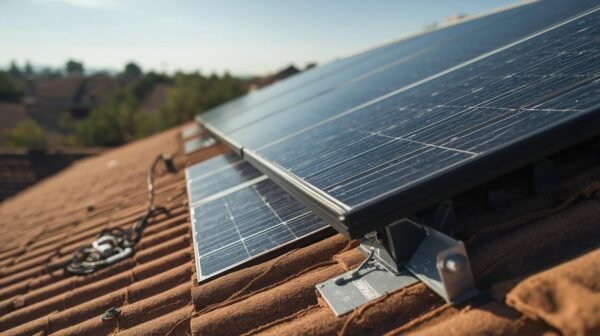
JOHANNESBURG, 15 May 2026 — When South Africa’s load-shedding crisis reached its worst in 2022 and 2023, rooftop solar became the construction sector’s answer to energy insecurity.
Developers fast-tracked solar specifications into residential estates, commercial complexes and industrial parks.
Contractors worked through backlogs to retrofit panels onto warehouses.
Equipment suppliers reported solar installation as one of the only growth segments in an otherwise stressed building market.
Now the regulatory environment that enabled that rush is shifting — and the consequences for green building projects, construction contracts and property development are becoming a live concern.
Eskom has intensified its push to regulate all grid-connected solar photovoltaic installations under its Small-Scale Embedded Generation (SSEG) framework, requiring mandatory registration and a transition to its Homeflex time-of-use tariff.
Simultaneously, Johannesburg’s City Power — which supplies electricity to Africa’s wealthiest municipality — is enforcing its own compliance regime that requires solar users to migrate from prepaid to postpaid metering, a shift the South African Photovoltaic Industry Association (SAPVIA) says is deterring legal registration across the city.
The resulting policy environment is being characterised by some commentators as a war on rooftop solar. Industry groups argue that the framework punishes early adopters.
Eskom insists it is about grid safety and national energy stability. For the construction sector, the debate plays out in project specifications, planning approvals, and asset valuations.
| The resulting policy environment is creating measurable headwinds for specifiers and developers who embedded rooftop solar as a standard building feature during the load-shedding era. |
THE COMPLIANCE FRAMEWORK: WHAT HAS CHANGED
Under national electricity regulations, all grid-connected solar systems below 100 kilowatts must be registered with Eskom or the local municipality.
For buildings in Eskom’s direct supply areas, registration triggers a mandatory conversion to the Homeflex tariff — a time-of-use pricing structure that introduces higher fixed monthly charges in exchange for off-peak discounts.
Eskom’s acting Group Executive for Distribution, Agnes Mlambo, has framed the process as enabling rather than restrictive, stating:
“We recognise the important role customers play in South Africa’s energy transition. Our goal is to ensure installations are safe, compliant and aligned with protecting the national grid.”
The utility has extended its registration fee waiver — which covers connection charges, smart meter costs and conversion fees — to 30 September 2026 for systems up to 50 kilowatts.
However, the financial impact of Homeflex on buildings with high solar generation but low grid draw is proving significant.
Industry estimates cited by Green Building Africa suggest some solar users face electricity bill increases of between 50 and 70 percent, depending on usage patterns, once fixed charges are applied.
For Eskom’s most common residential tariffs, the fixed monthly charge increased by 88 percent — from R192.90 to R362.70 — representing costs incurred before a single unit of electricity is consumed.
For commercial and industrial buildings that installed solar during the load-shedding period to reduce grid dependence, the calculus of that investment is now being recalculated.
Where a solar-plus-storage system was specced to eliminate grid dependency, the Homeflex fixed charge erodes payback assumptions.
Where a developer sold units on the basis of low electricity costs, those promises may face scrutiny.
GREEN BUILDING SPECIFICATIONS UNDER PRESSURE
South Africa’s green building sector built momentum through the load-shedding years partly on the bankable proposition that rooftop solar reduced operational costs and enhanced asset resilience.
Green Star ratings, lender due diligence frameworks and corporate ESG requirements all treated solar integration as a value-adding, risk-reducing feature.
That framing is now more complicated. SAPVIA’s technical and policy manager Sim Khuluse has been explicit about the tension: the transition to the grid must not become a financial burden that punishes early adopters.
In Johannesburg specifically, the organisation flagged that the cost increase from an average prepaid spend of R230 per month to a postpaid range of R1,070 to R1,360 represents a significant deterrent to legal registration — effectively penalising owners of solar-equipped buildings for compliance.
For property developers and construction firms managing large residential or mixed-use schemes, this creates a specific problem: buildings sold or let with solar specifications now carry an energy cost profile that differs materially from what was projected at point of sale or lease.
That gap has contract implications, potential valuation impacts, and reputational risk for green-certified developments.
An industry analysis published by Green Building Africa characterises the broader dynamic directly: market reform is being paced to protect Eskom’s revenues rather than enable real competition.
The analysis notes that declining demand for Eskom-supplied electricity — from approximately 191 TWh in 2021 to around 179–180 TWh by 2026 — is directly eroding the utility’s revenue base, and that regulatory tightening around distributed generation reflects, at least in part, a structural revenue defence.
| For property developers managing large residential schemes, buildings sold with solar specifications now carry an energy cost profile that may differ materially from what was projected at point of sale. |
MUNICIPAL FRAGMENTATION: A CONSTRUCTION-PHASE RISK
A dimension of the compliance landscape that construction professionals are beginning to flag is the inconsistency between Eskom’s framework and those of the approximately 177 licensed municipal electricity distributors across South Africa.
Where Eskom has at least standardised its SSEG documentation and extended the fee waiver, many municipalities have not followed suit.
SAPVIA has called directly for a unified, digital-first approach across all provinces, noting that inconsistent municipal by-laws create a cumulative backlog that intensifies pressure on the national grid’s technical interface and frustrates citizens who are investing their own capital in energy security.
For contractors completing projects in municipal supply areas — the majority of urban commercial and residential construction — this fragmentation creates a construction-phase compliance risk that was not a material factor in project planning just three years ago.
In practical terms, a contractor handing over a solar-equipped commercial building in a City Power area faces a different registration pathway, timeline and cost structure than one handing over a comparable building in an Eskom direct-supply suburb.
Legal clearance for grid connection in some municipal areas may take weeks or months, affecting practical completion and occupation certificate timelines.
IMPLICATIONS FOR CONSTRUCTION CONTRACTS AND SPECIFICATIONS
For construction and engineering professionals, the regulatory shift creates several distinct risk categories worth noting in project delivery and specification work.
First, energy performance warranties and operational cost projections embedded in green building contracts may need to be revisited.
If a building was specified and sold on the basis of solar-offset electricity costs, and the Homeflex tariff structure materially alters that offset, there may be grounds for contract review or warranty claims — particularly in residential developments where energy cost savings were a material marketing representation.
Second, planning applications for new buildings that include rooftop solar in their energy compliance strategy will need to account for the registration compliance cost and timeline as a project deliverable, not an afterthought.
The SSEG registration process — including Certificate of Compliance submission, inverter test certification and installation test reports — must now be project-managed in the same way as occupancy certification.
Third, the commercial case for solar specification in new builds is not undermined, but it is more nuanced.
The levelised cost of solar energy continues to fall. The construction sector’s solar installations remain a sound long-term asset.
What has changed is the interface with the grid — and specifically, the cost of maintaining that interface under Eskom’s and municipalities’ revised frameworks.
The South African Photovoltaic Industry Association and City Power have begun bilateral engagement specifically to address the backlog and compliance friction in Johannesburg, with discussions benchmarking against digital registration models such as the City of Cape Town’s online portal.
Progress on that streamlining will have direct implications for construction project handover timelines in the city.
| The commercial case for solar specification in new builds is not undermined — but the interface with the grid is more expensive and more complex to manage than it was two years ago. |
LOOKING AHEAD: WHAT THE CONSTRUCTION SECTOR SHOULD MONITOR
Several regulatory milestones in the next twelve months will determine how the compliance environment stabilises. The SSEG fee waiver expires at the end of September 2026.
After that date, registration and connection costs — including smart meter installation worth up to R10,000 for urban customers — will be charged in full.
Any projects with solar installations completing after that date, or any existing buildings that have deferred registration, will face the full cost regime.
Eskom is simultaneously advancing a prepaid metering option for residential solar users, which would allow households to remain on prepaid tariffs while integrating solar generation.
This option is currently in testing phase. Its availability at scale would reduce one of the primary deterrents to compliance in residential construction projects — but its timeline is not yet confirmed.
The National Transmission Company of South Africa’s separate trajectory is also relevant for long-horizon construction planning.
Industry analysis notes that more than 14,000 kilometres of new transmission lines are required to unlock planned generation capacity — a figure that represents one of the largest infrastructure construction programmes in the country’s history if it proceeds.
Progress on that programme will shape the grid stability context within which distributed solar operates for the next decade.
For now, the construction sector’s task is to factor compliance cost and timeline into solar specifications with the same rigour previously reserved for structural and electrical sign-off.
The era of solar as an easy, unregulated add-on is over in South Africa. What replaces it is more complex — but not necessarily less viable.
CCE News covers construction, heavy equipment and infrastructure across Africa. For editorial enquiries: info@cceonlinenews.co.za

- SODECA Highlights Industrial Ventilation Technology at Mega Clima Expo Kenya 2026 - October 14, 2026
- How They Were Built: Inside the Engineering of the Lesotho Highlands Water Project - October 11, 2026
- Africa’s Water Reuse Opportunity: Building the Infrastructure for a Water-Secure Future - September 28, 2026