

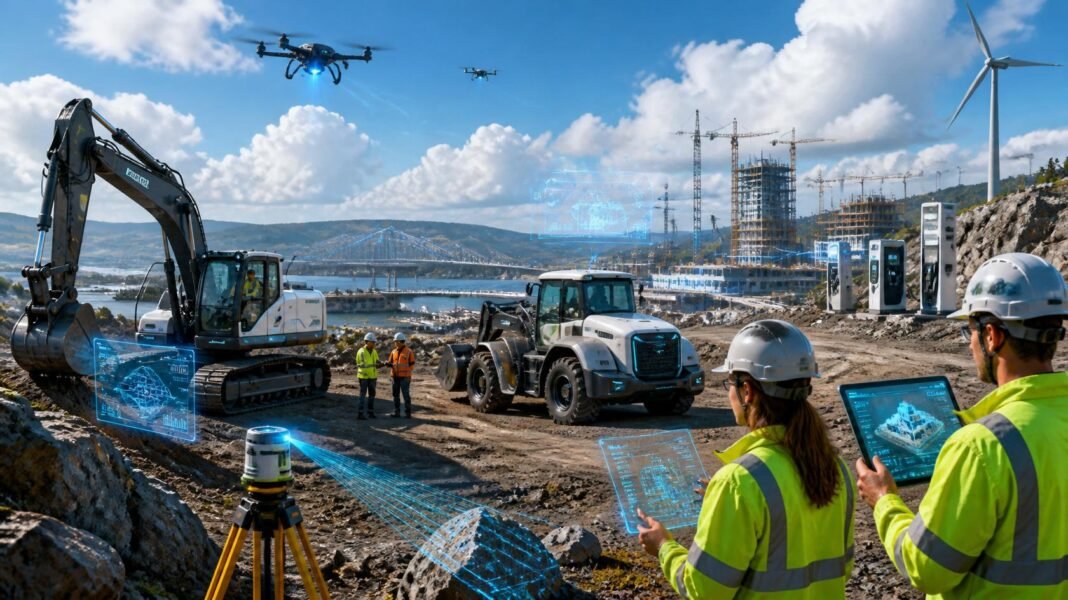
Scotland’s construction plant industry is going through the biggest shake-up in its history, and the evidence is now impossible to ignore.
According to the Scottish Plant Owners Association (SPOA) Annual Review 2025, the sector is moving from a diesel-powered past toward a digitally driven, automated, and increasingly electrified future — a transition with lessons that resonate far beyond the UK, including for Africa’s own fast-growing plant hire and construction markets.
The SPOA, which represents plant owners across Scotland and contributes an estimated £6.4 billion to the UK economy annually through its member base, sent Vice President Gail McEwan to Bauma 2025 in Munich — the world’s largest construction equipment exhibition — specifically to benchmark UK industry practice against global innovation.
Her findings, laid out in the association’s latest annual review, offer one of the clearest snapshots yet of where construction technology is heading, and how quickly.
Automation Moves From Prototype to Practice
For years, autonomous construction machinery has been discussed as a future possibility. Bauma 2025 made clear that this future has already arrived.
Driverless shovels and dumpers were on full display, and remote operation — plant operatives controlling machinery from hundreds of miles away — has moved from concept to commercial reality.
This shift matters enormously for an industry battling chronic skills shortages. The SPOA estimates that Scotland’s plant industry alone will need close to 18,000 additional workers over the next five years to meet demand, a gap driven by an ageing workforce, Brexit-related labour disruption, and the lingering effects of the Covid-19 pandemic on recruitment pipelines.
Remote and autonomous operation offers a partial answer. By allowing a single skilled operator to control equipment from a centralised location, or by removing the need for constant human intervention altogether, contractors can extend the reach of a shrinking skilled workforce.
The SPOA review also highlights a secondary benefit that is often overlooked: centralised plant operation can improve mental health outcomes and communication among operators who might otherwise work in isolation on remote sites.
“The future of construction plant isn’t just coming — it’s already here. From autonomous machines to electric machines, innovation is reshaping how we build.” — SPOA Research & Digitalisation Working Group
For African contractors and plant hire operators, many of whom face similar — and in some cases more acute — skills shortages, the automation trend is worth close attention.
Manufacturers such as Caterpillar and Komatsu are already leading with autonomous machinery designed for hazardous or hard-to-access environments, precisely the conditions found on many African infrastructure and mining-adjacent projects.
Electrification: No Longer a Niche Choice
Battery-electric and hydrogen-powered machines dominated the Bauma show floor, with manufacturers including Volvo CE, JCB, Komatsu, Caterpillar and Wacker Neuson showcasing everything from compact electric diggers to mid-size loaders and telehandlers.
Volvo unveiled what it describes as the world’s first electric hauler, while JCB continues to push its hydrogen combustion engine as an alternative pathway to zero emissions.
According to the SPOA review, electrification is “no longer a niche — it’s rapidly becoming the new standard, especially in urban and low-emission zones.”
But the association is careful to temper enthusiasm with operational realism, and its analysis is instructive for any market considering the switch.
Three practical barriers stand out. First, charging infrastructure remains patchy, particularly on rural or remote sites — a challenge that will feel familiar to plant owners operating across large parts of Africa where grid reliability is inconsistent.
Second, heavy-duty machines required for major construction projects need battery packs so large that runtime and load-carrying capacity are both compromised, meaning electrification has so far progressed further in smaller plant categories than in the heavy machinery that dominates large infrastructure works.
Third, the resale market for electric plant is still unproven. Plant hire businesses typically run a machine for around seven years before reselling it into the secondary market and reinvesting in new fleet — but nobody yet knows what a seven-year-old electric excavator or its battery pack will be worth, making long-term fleet investment decisions genuinely difficult.
There is also a less obvious irony the SPOA flags: many sites still rely on diesel generators to recharge electric machinery batteries, which can cancel out much of the intended carbon saving unless renewable charging infrastructure is in place.
For African markets weighing early investment in electric plant, this is a critical planning consideration — decarbonisation gains only materialise if the electricity supply itself is clean.
Hydrogen power faces its own hurdles. Fuel availability remains extremely limited, and while several manufacturers have signalled that hydrogen-powered machines will officially enter production lines in 2026, the SPOA believes volumes will stay small for the foreseeable future, facing many of the same infrastructure constraints as battery-electric plant.
Digital Platforms Are Becoming Standard Equipment
If electrification is the highest-profile trend, digitalisation may be the most transformative in practical terms. The SPOA review notes that at Bauma 2025, “digitalisation wasn’t just a theme — it was everywhere.”
Fleet managers now have access to dashboards providing real-time insight into fuel consumption, machine performance and operator behaviour, powered by the convergence of AI, the Internet of Things (IoT) and cloud computing.
Several manufacturers demonstrated platforms that are quickly becoming industry standard rather than premium add-ons:
- Trimble and Hexagon showcased intuitive data tools for machine control and precise site positioning.
- Epiroc presented Underground Manager 2.0, unifying drilling and tunnelling equipment into a single connected system.
- Hitachi Construction Machinery Europe unveiled LANDCROS Connect, a platform delivering machine insights and predictive analytics.
These tools are unlocking smarter scheduling, predictive maintenance and genuinely data-driven decision-making — capabilities that reduce downtime, cut costs and improve profitability for fleet owners willing to adopt them.
For African logistics and construction operators managing plant across dispersed, often remote project sites, remote diagnostics and predictive maintenance in particular could deliver outsized returns by reducing costly breakdowns in locations where technical support is not readily on hand.
| Trend | Examples Seen at Bauma 2025 | Relevance to African Plant & Construction Sector |
| Automation | Autonomous plant and machine-controlled concrete kerb placement | Addresses skills shortages and improves site safety on labour-constrained African projects |
| Electrification | Battery-powered excavators and hydrogen fuel-cell machines | Supports emerging decarbonisation targets and lower running costs where diesel is costly |
| Digital platforms | BIM integration, AI fleet monitoring, remote diagnostics | Improves fleet efficiency and project planning across dispersed African operations |
| Skills & simulation | VR operator simulators, remote-control training kits | Modernises training and widens the talent pipeline for new entrants |
| Intelligent monitoring | Real-time compaction feedback, operator fatigue monitoring | Strengthens quality assurance and health and safety on site |
Table: Key technology trends identified at Bauma 2025 and their relevance beyond the UK market. Source: SPOA Annual Review 2025.
Simulation and Skills: Training the Next Generation
Perhaps the most immediately transferable lesson from Scotland’s experience concerns training.
Facing a severe skills shortage, the SPOA has invested heavily in simulation technology, deploying a Tenstar plant simulator and trailer to careers events and schools across the country.
The system allows potential recruits to experience realistic machine operation — excavation, loading and more — in a safe, immersive, and risk-free environment, without the cost or danger of training on live equipment.
At Bauma 2025, this approach was echoed on a global scale. Tenstar Simulation showcased advanced solutions for operator safety and efficiency; Mevea pioneered real-time simulation using excavators fitted with electromechanical actuators; CM Labs partnered with elobau on custom simulation tools that improved return on investment for fleet owners; and the Construction Future Lab created a VR Experience Zone allowing visitors to engage with robotics, alternative drive technologies and machine digitalisation.
The SPOA’s own assessment is unambiguous about the strategic value of this technology: simulation is not only excellent for upskilling existing operators, but also serves as a powerful recruitment tool for attracting young talent who might otherwise never consider a career in plant and construction.
As training becomes more accessible, engaging and realistic, it opens a door for students and job seekers who may have written off the sector as unappealing or inaccessible.
This has direct relevance for African markets confronting their own recruitment and skills pipeline challenges.
Investment in simulator-based training, deployed at career fairs, technical colleges and vocational training centres, could accelerate the development of a skilled operator base without the capital cost and safety risk of training exclusively on live machinery.
Intelligent Monitoring: Safety Meets Productivity
Running alongside automation, electrification and digital platforms is a fourth trend the SPOA identifies as increasingly central to construction operations: intelligent machine monitoring.
Many exhibitors at Bauma integrated real-time data from sensors and connected systems directly into training and operational simulations, offering dynamic feedback on safety, fatigue and efficiency.
Real-world applications include real-time density and compaction feedback for quality assurance on site, and operator fatigue monitoring systems — such as the technology demonstrated by Caterpillar — designed to reduce human error and prevent fatigue-related incidents.
The SPOA notes that implementing such systems can improve site efficiency and potentially reduce insurance costs for businesses, a point that will resonate with plant hire operators anywhere labour and liability costs are under pressure.
What This Means for Africa’s Plant and Construction Sector
Scotland’s plant industry and Africa’s construction markets differ enormously in scale, regulatory environment and infrastructure maturity.
But the underlying pressures driving change in Scotland — skills shortages, rising decarbonisation expectations, and the need to do more with constrained margins — are strikingly familiar to plant owners and contractors operating across Kenya, South Africa, and the wider continent.
The SPOA’s own guidance to its members is a useful framework for African operators evaluating the same technologies.
On electrification, the association urges plant owners to make investment decisions based on solid information, manufacturer warranty guarantees, and — ideally — some form of incentive to accelerate the transition, rather than adopting new technology on hype alone.
It has also called on government to engage directly with the hire companies that purchase the vast majority of plant equipment, rather than confining consultation to manufacturers and Tier 1 contractors, a principle equally applicable to policymakers across African markets shaping their own equipment import and emissions frameworks.
On digitalisation and automation, the message is more straightforwardly encouraging: these technologies are not distant, speculative bets but tools already being deployed at scale, with measurable returns on fleet efficiency, safety and recruitment.
For African plant hire businesses and construction firms looking to improve competitiveness, benchmark against global standards, and attract younger talent into an industry that urgently needs it, the direction of travel identified in Scotland’s 2025 annual review offers a clear signpost.
As the SPOA’s own review concludes, the industry is no longer preparing for a technological future — it is already living in one.
For African construction and plant leaders watching from a distance, the message is the same: the shift from diesel to digital is not a question of if, but how quickly, and how well-prepared operators choose to be.
Also Read
Scotland’s Builders Hold the Line on Workload, But a Skills Crisis Is Now Biting Harder Than Ever
Scotland’s Renewables Surge 22% as Solar Capacity Climbs to 0.9 GW

- From Operator to Algorithm: Bedrock Puts Autonomous Excavators to Work on Live Construction Sites - September 7, 2026
- Built For The Rough Stuff: Inside Titan’s new ForestEDGE™ Tyre Line - September 4, 2026
- South Africa Has R395 Billion in Infrastructure Projects — But Can the Industry Deliver Them? - August 26, 2026
