

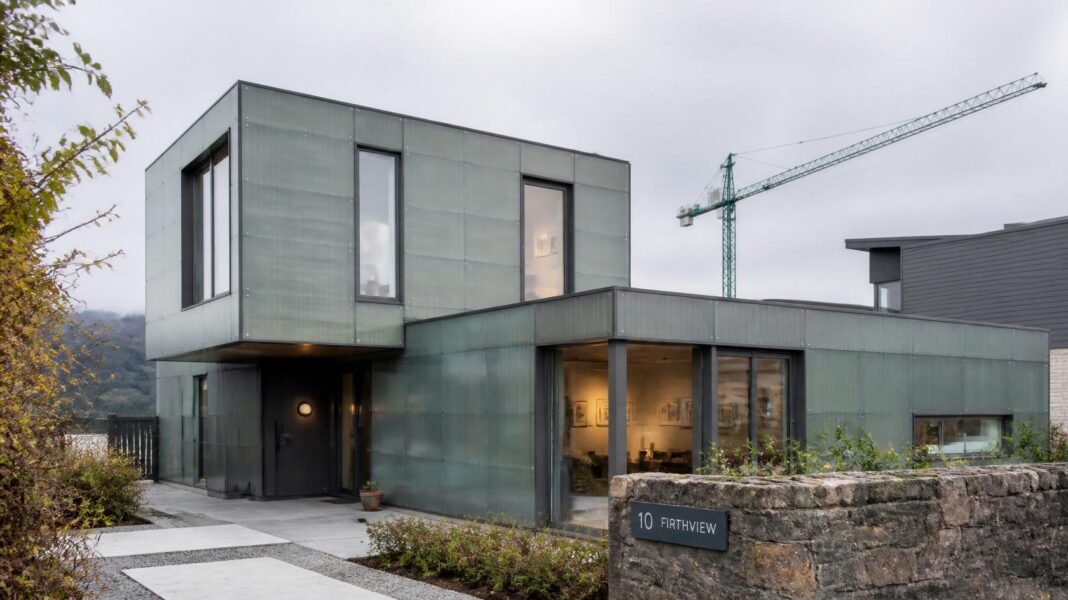
A Dumfries-based construction technology company has secured more than £5 million in combined funding to commercialise a building system that converts waste glass into structural composite panels.
It is a development that lands squarely in a debate familiar to African construction markets: how to build enough homes, fast enough, without the cost and carbon burden of conventional methods.
VASO Global, which describes itself as a housebuilding innovator, has combined digital design, integrated manufacturing and semi-autonomous construction into a system for producing modular, thermally efficient homes from recycled glass.
The company says the approach is aimed squarely at the UK’s housing shortage, but the underlying model — turning a locally abundant waste stream into a structural building material, manufactured close to the point of use — is one that African markets have been circling for years, from fly-ash bricks in Kenya to plastic-waste paving blocks in Côte d’Ivoire.
Where the money came from
The funding round is a blend of private venture capital and public innovation financing, a structure worth noting for African policymakers assembling their own construction-innovation ecosystems.
VASO Global drew £1.4m in seed investment from PXN Ventures, £621,000 from Scottish Enterprise, a £2m loan from Innovate UK Loans Limited (a division of UK Research and Innovation), and £800,000 from ECO GROUP, which will act as delivery partner on the company’s initial build projects.
An earlier £330,000 came from South of Scotland Enterprise to advance commercial roll-out.
| Funder | Amount | Type |
| PXN Ventures | £1.4m | Seed investment |
| Scottish Enterprise | £621,000 | Economic development grant |
| Innovate UK Loans Limited (UKRI) | £2m | Innovation loan |
| ECO GROUP | £800,000 | Investment + delivery partnership |
| South of Scotland Enterprise (prior round) | £330,000 | Commercialisation grant |
Table: VASO Global’s £5m+ Funding Stack. Source: VASO Global funding announcement.
That stack — seed capital, a regional economic development grant, a government-backed innovation loan, and an industry delivery partner co-investing — is a template that African development finance institutions, national innovation funds and construction conglomerates could study directly.
It de-risks a first-of-kind manufacturing facility in stages, rather than asking one investor to underwrite the whole bet.
The manufacturing bet
The capital will fund process development at a new 60,000-square-foot manufacturing site in Dumfries, which VASO Global expects will create up to 70 jobs over five years as it adopts industrialised construction methods.
It will also fund the company’s search for routes to market over the next two years.
A build-time reduction of that magnitude — roughly two-thirds — is the number that should catch the attention of African contractors and public housing agencies alike.
Construction timelines, financing costs and currency exposure are tightly linked across much of the continent; a housing programme that can compress delivery from months to weeks changes the economics of everything from mortgage-linked affordable housing schemes to post-disaster rebuilding.
A crisis with African parallels
VASO Global’s backers frame the UK investment against Scotland’s 2024 declaration of a national housing emergency.
The scale is different, but the shape of the problem is familiar in African capitals: rapid urbanisation outpacing formal housing supply, informal settlements absorbing the gap, and construction costs — cement, steel, skilled labour — rising faster than household incomes.
Why This Matters for African Construction Markets
Waste-to-Material Supply Chains
Africa’s rapidly growing cities generate vast quantities of glass, plastic and demolition waste, much of which ends up in landfills or informal recycling systems. VASO’s model transforms this waste into valuable construction inputs, creating a circular economy opportunity.
Modular Construction Speed
Faster construction cycles help reduce financing costs for affordable housing projects—an important advantage for African developers operating in high-interest-rate environments.
Blended Finance Template
The combination of seed capital, enterprise-agency grants, innovation loans and delivery-partner co-investment closely reflects the blended finance structures that African development finance institutions and green-building funds are increasingly promoting.
Local Manufacturing & Job Creation
A 60,000-square-foot manufacturing facility centred on material innovation demonstrates how value-added manufacturing can be located close to both raw materials and end markets—creating skilled jobs while reducing dependence on imported building systems.
None of this suggests a plug-and-play transplant. Glass waste streams, building codes, seismic and climatic conditions, and construction labour markets differ significantly between Scotland and, say, Nairobi, Lagos or Johannesburg.
But the underlying proposition — that industrialised, digitally designed, waste-derived panel systems can meaningfully compress both carbon footprint and construction time — is technology-and-finance agnostic.
It is a proposition African housing authorities, cement and building-materials manufacturers, and construction technology investors have reason to track closely as VASO Global moves from funded pilot to commercial roll-out over the next two years.
What to watch next
VASO Global’s near-term milestones are worth flagging for African readers tracking the space: the Dumfries manufacturing site coming online, the company’s first delivery-partner build with ECO GROUP, and its route-to-market strategy over the next two years.
Each is a signal of whether the 33-to-10-week build claim holds up outside a controlled pilot — the number that will matter most if the model is ever tested against Africa’s housing deficit.
Also Read
The role of the private sector in affordable housing
7 countries grappling with huge housing deficit in Africa

- Built For The Rough Stuff: Inside Titan’s new ForestEDGE™ Tyre Line - September 4, 2026
- South Africa Has R395 Billion in Infrastructure Projects — But Can the Industry Deliver Them? - August 26, 2026
- How Municipal Water Treatment Works: Inside NYEWASCO’s Journey from Raw Water to the Tap - August 17, 2026
