

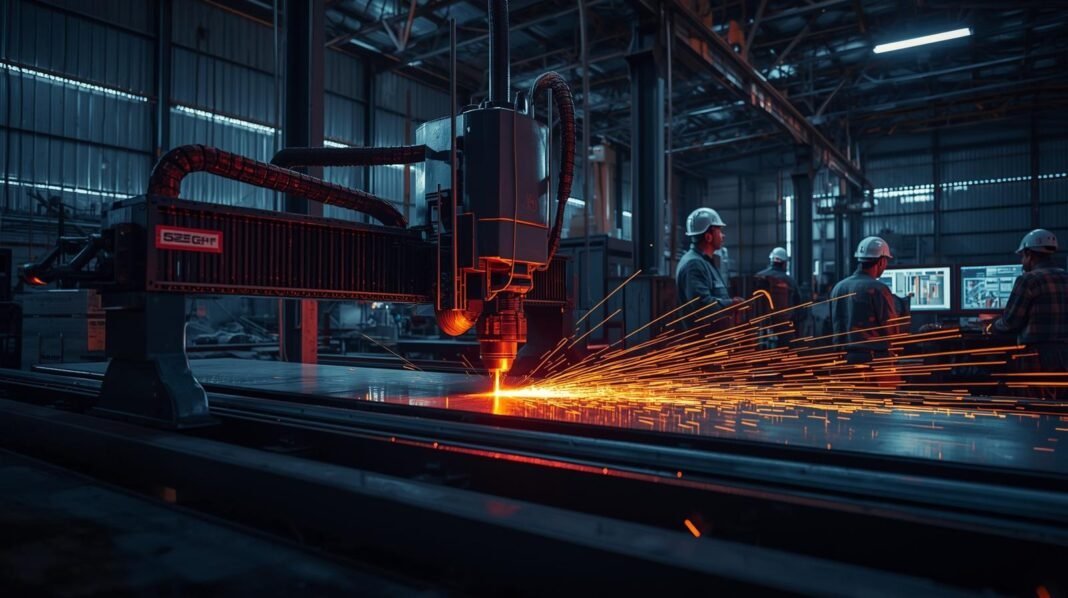
Steel has always been the skeleton of civilisation — the material from which bridges are cast, cranes are built, and cities rise.
For most of Africa’s industrial history, that skeleton was imported, often at crippling cost. But a structural shift is underway.
Across the continent, CNC (Computer Numerical Control) steel processing technology is moving from a niche capability reserved for a handful of large manufacturers into a broad-based industrial force, threading its way into fabrication workshops in Nairobi, rolling mills in Johannesburg, and emerging manufacturing zones in Egypt and Nigeria.
The numbers tell a compelling story. Africa’s steel market stood at approximately 39.24 million tonnes in 2025 and is forecast to reach 54.82 million tonnes by 2035 — a compound annual growth rate of 3.4% over the decade.
Construction is the primary engine, but it is the quality of that steel, and the precision with which it is now processed, that is changing the game for African manufacturers.
What CNC Steel Processing Actually Means
CNC steel processing covers a family of technologies — laser cutting, plasma cutting, waterjet cutting, CNC milling, CNC bending and CNC drilling — all governed by pre-programmed computer code rather than manual operation.
The machines interpret digital designs (CAD files) and execute cuts, bends and profiles with tolerances measured in fractions of a millimetre.
For Africa’s steel sector, this matters enormously. Traditional oxy-fuel cutting and manual fabrication remain common on the continent, but they carry limitations: inconsistency between operators, material waste, slow throughput and limited ability to execute complex geometries.
CNC machines eliminate much of the human error, producing uniform components at speed and with minimal scrap — a significant advantage in a region where raw material costs are elevated by logistics and import tariffs.
“CNC machines eliminate human error, guaranteeing uniform components even for large production runs — and in Africa’s cost-sensitive environment, that efficiency is transformational.”
David Engineering Kenya, one of the country’s established fabrication firms, summarises the value proposition clearly: CNC technology delivers premium components faster and more economically than traditional methods, with automated precision that adapts equally well to simple brackets and geometrically intricate panels.
The key benefit — optimised cutting paths that minimise scrap — improves both sustainability and margins, two pressures that are acutely felt by African fabricators.
East Africa: A Market Coming of Age
Kenya has emerged as a particularly active hub for CNC steel adoption. Nairobi now hosts a cluster of purpose-built CNC fabrication businesses serving construction, architecture, and industrial clients across East Africa.
Companies such as iEndTech Shop, Canton Steel Fabricators, SHEP Engineering and Kens Metal Industries are deploying plasma, laser and waterjet CNC platforms to meet demand from sectors that would previously have sourced precision components from abroad.
SHEP Engineering, founded in 2012, offers CNC plasma cutting to clients across Kenya and East Africa, working from CAD drawings to produce structural parts for mechanical and civil projects.
Canton Steel handles everything from ornamental gates and balustrades to industrial components, using high-definition plasma cutters and CNC laser machines.
The breadth of their client base — from homeowners and architects to construction contractors and manufacturers — reflects how CNC capability is penetrating multiple layers of the market simultaneously.
Tanzania is following a similar trajectory. Both Kenya and Tanzania are identified by regional analysts as emerging steel markets with growing demand for precision-processed inputs in infrastructure and manufacturing projects.
The common thread is the same: as project specifications tighten and international contractors raise quality bars, local fabricators who cannot demonstrate CNC-level precision are being squeezed out of larger tenders.
South Africa: The Continental Benchmark
South Africa remains the continent’s most mature market for CNC steel processing. The country generated 4.063 million tonnes of crude steel from January to October 2024 — the highest output on the continent — underpinned by long-term government investment in infrastructure.
The South African stainless steel and fabrication industry is deeply integrated with CNC technology, with companies like Pure Stainless Steel Manufacturers operating to BS EN 10029 international standards and offering high-definition plasma CNC services to the mining, construction and energy sectors.
South African manufacturers are also at the forefront of adopting the next wave of CNC capability.
Efamatic Machine Tools, a South African CNC producer, has identified several critical trends shaping the sector in 2025: machines are now routinely handling tougher materials — composites, high-strength alloys — that were previously difficult to process locally.
This opens doors to aerospace and automotive export markets that would have been inaccessible a decade ago.
Post-pandemic supply chain disruptions have accelerated a structural preference for locally produced CNC solutions.
Currency volatility and import delays have made the case for onshore machine tool manufacturing increasingly compelling, with South African firms like Efamatic building custom CNC platforms tailored to regional material and operational conditions.
Egypt and North Africa: An Emerging Powerhouse
Egypt is rapidly positioning itself as a regional steel hub and is investing heavily in the advanced processing capabilities that turn raw steel into high-value manufactured goods.
India’s Essar Group has been considering a USD 590 million steel plant investment in the country, while domestic producers like Beshay Steel are expanding capacity.
Egypt’s automotive sector — a growing beneficiary of CNC steel components — is attracting major international brands to set up assembly plants, creating sustained demand for precision-machined steel parts.
Morocco, with its established steel production capacity and its role as a supplier to the automotive and construction sectors, is another North African market where CNC processing is gaining ground.
The country’s proximity to European markets and its role in supplying cross-continental automotive supply chains creates a commercial imperative for international-standard precision that CNC enables.
The Infrastructure Multiplier
The most powerful driver of CNC steel adoption in Africa is not the technology itself — it is the infrastructure boom that makes precision steel components essential.
Africa requires between USD 130 billion and USD 170 billion annually in infrastructure investment, according to the African Development Bank, with a financing gap of USD 68 to USD 108 billion.
Governments, development finance institutions and private investors are pouring capital into roads, bridges, ports, energy projects and housing — all of which depend on steel that meets modern engineering tolerances.
Renewable energy projects are a particularly significant catalyst. Solar mounting structures, wind turbine components, hydropower infrastructure and transmission towers all require CNC-precision steel fabrication for structural integrity and performance.
As Africa accelerates its clean energy transition — with solar, wind and hydro investment expanding across sub-Saharan Africa and North Africa — the demand for precision steel components is growing in lockstep.
In February 2026, African heads of state launched the Africa Infrastructure Financing Facility (AIFF) to fast-track cross-border infrastructure financing under the AfCFTA framework.
The facility is designed to deploy Africa’s domestic capital pools — which exceed USD 2.5 trillion — into projects that will require enormous quantities of precisely fabricated steel. For CNC processors positioned close to these projects, the commercial opportunity is substantial.
AfCFTA and the Scale Question
The African Continental Free Trade Area is the structural underpinning that could elevate Africa’s CNC steel processing from a collection of national markets into a continental value chain.
By creating a single market of 1.4 billion people and progressively eliminating tariffs, AfCFTA gives fabricators in Ghana access to markets in Kenya, and manufacturers in South Africa a route to clients in Ethiopia — without the prohibitive trade barriers that have historically fragmented the continent.
The implications for CNC steel processors are significant. Precision steel components — window frames, structural beams, mining equipment parts, energy infrastructure elements — can now be manufactured in one country and shipped across the continent with fewer regulatory barriers.
This creates the scale needed to justify investment in the most advanced CNC machinery, which requires high throughput to generate returns.
Regional industrial zones in Togo, Gabon and Benin are already being built around this logic, connecting iron ore and manganese resources to CNC-equipped manufacturing facilities with port access to continental and export markets.
Challenges That Cannot Be Ignored
Honest coverage of the sector demands acknowledgement of the barriers that remain formidable. Skills availability is perhaps the most acute.
CNC machines require trained operators, programmers, and maintenance technicians — a specialised workforce that Africa’s technical and vocational education systems are only beginning to produce at scale.
A World Bank Skills for Jobs Policy Academy held in Nairobi in late 2025, drawing over 300 senior policymakers from 25 sub-Saharan African countries, identified the mismatch between industry skills requirements and current training capacity as one of the continent’s most pressing economic constraints.
Power reliability is a parallel challenge. CNC machines are precision instruments that are sensitive to voltage fluctuations and power interruptions — conditions that remain common across much of the continent.
Industrial zones with dedicated power infrastructure are partly a response to this, but off-grid and hybrid energy solutions are also gaining traction as fabricators seek to protect their capital investments.
Access to financing for capital equipment remains difficult, particularly for small and medium fabrication businesses that constitute the majority of Africa’s manufacturing base.
A CNC plasma or laser cutting machine of industrial grade costs between USD 50,000 and USD 500,000, depending on specification — sums that are out of reach without credit facilities that many African banks are reluctant to extend to manufacturers without significant collateral.
Technology Transfer and the China Factor
China’s footprint in Africa’s CNC steel processing story is unavoidable. Chinese equipment manufacturers — producing CNC laser and plasma cutters at price points far below European or American equivalents — have made the technology accessible to a new tier of African fabricators.
Indian manufacturers, particularly in the CNC cutting segment, are also active in East Africa and Southern Africa, providing service infrastructure alongside equipment.
The technology transfer dimension extends beyond hardware.
Chinese construction companies active across Africa — operating on road, dam, port and urban development projects — have brought their own CNC fabrication capabilities to the continent, and local sub-contractors trained alongside these firms have absorbed both skills and equipment procurement channels.
This has contributed to the gradual lowering of CNC capability costs across the continent.
The Road Ahead
The trajectory is clear. CNC steel processing in Africa is not a trend being imported by multinationals — it is being built, shop by shop and plant by plant, by African businesses responding to the demands of an urbanising, industrialising continent.
The market forces are aligned: rising construction standards, infrastructure investment at scale, AfCFTA-driven market expansion, renewable energy growth, and a technology cost curve that is steadily making CNC accessible further down the enterprise size spectrum.
What separates the fabricators who will lead this transformation from those who will be left behind is the willingness to invest in capability — in machines, in people, and in the digital design skills that translate engineering drawings into CNC code.
The continent’s steel story has moved decisively beyond raw production and into value-added processing.
The machines are on the floor. The question now is how fast Africa can train the hands to run them.
Also Read
WoodEX for Africa:Gateway to Africa’s timber trade under one roof
America’s Factories Keep Humming, But Prices Surge to a 4-Year High

- From Operator to Algorithm: Bedrock Puts Autonomous Excavators to Work on Live Construction Sites - September 7, 2026
- Built For The Rough Stuff: Inside Titan’s new ForestEDGE™ Tyre Line - September 4, 2026
- South Africa Has R395 Billion in Infrastructure Projects — But Can the Industry Deliver Them? - August 26, 2026
