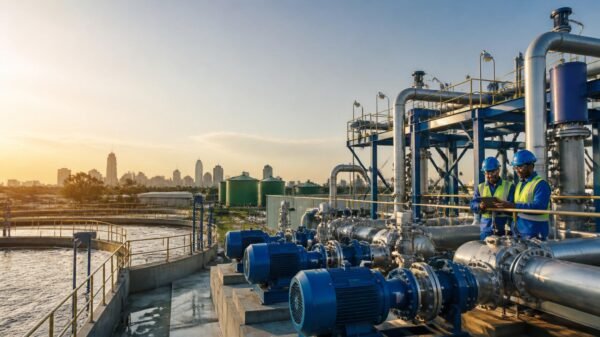
Africa’s wastewater sector is entering one of its busiest construction cycles in decades.
Trunk sewers are being dug under Nairobi, package plants are being containerised for delivery to peri-urban Ghana, and membrane systems are being specified for industrial effluent from Casablanca to the Copperbelt.
Behind every headline project sits the same question utilities, EPC contractors, and equipment buyers are all wrestling with: which machinery, technology, and process configuration actually works at African scale, African budgets, and African grid conditions.
A Continent Playing Catch-Up on Sanitation
The scale of the gap is stark. According to the UN Economic Commission for Africa, the continent needs more than US$50 billion a year to meet Sustainable Development Goal 6 on clean water and sanitation, yet current annual investment sits at only US$12 billion to US$15 billion.
More than 400 million Africans lack access to basic drinking water, and over 700 million remain without safely managed sanitation.
Water and sanitation account for roughly 41 percent of Africa’s total infrastructure financing shortfall, a gap that a 2026 continental infrastructure review put at US$68 billion to US$108 billion a year across all sectors.
That shortfall is precisely why equipment choice matters so much. Utilities cannot afford to over-specify, and they cannot afford systems that fail within a decade of commissioning because of erratic power supply, skills shortages, or poor spare-parts availability.
The next generation of African wastewater infrastructure is being built around equipment that is modular, energy-resilient, and serviceable locally — a marked shift from the concrete-and-civil-works approach that defined the last fifty years of sanitation investment.
From Stabilisation Ponds to Engineered Bioreactors
Much of Africa’s existing municipal treatment capacity was built on waste stabilisation ponds — large, low-cost lagoons that rely on sunlight and natural bacterial action rather than mechanical aeration.
Nairobi’s Dandora works, commissioned decades ago with a design capacity of 80,000 cubic metres a day, remains the largest pond system on the continent.
These systems are cheap to build and forgiving to operate, but they consume large amounts of land and struggle to keep pace with the industrial and domestic loads generated by fast-growing cities.
The equipment response has been a gradual shift toward compact, mechanically intensive technologies: moving bed biofilm reactors (MBBR), sequencing batch reactors (SBR), and membrane bioreactors (MBR).
MBBR systems suspend plastic biofilm carriers inside the reactor tank, giving bacteria a much larger surface area to colonise within a smaller footprint than conventional activated sludge basins — a significant advantage in dense urban sites where land acquisition is often the most expensive and politically difficult part of a project.
MBR systems pair biological treatment with ultrafiltration membranes, producing effluent clean enough for irrigation or industrial reuse, and are increasingly specified for mining, beverage, and food-processing effluent across South Africa, Zambia, and Mali.
The Mechanical Backbone: Pumps, Blowers, and Screens
Whatever the treatment process, the equipment that keeps a plant running day to day is unglamorous but decisive: submersible and dry-pit sewage pumps, coarse and fine screens, grit removal systems, blowers for aeration basins, and dosing pumps for coagulants and disinfectants.
Global suppliers such as Xylem, Grundfos, Sulzer, and Metito have expanded their African distribution and service networks over the past several years, recognising that after-sales support — not just equipment cost — determines whether a plant still functions five years after handover.
Power reliability shapes procurement decisions as much as flow rate does. Solar-assisted pumping stations are now standard in donor-funded rural and peri-urban schemes; a recent Kenyan project south of Nairobi paired 1.5 megawatts of solar capacity with its pumping stations specifically to keep sewer and water infrastructure running through grid outages.
Variable-frequency drives, which let pumps and blowers throttle output to match actual flow rather than running at fixed speed, are also becoming a default specification, cutting energy costs on what is typically a plant’s single largest operating expense.
Package and Containerised Plants: Solving the Last Mile
Perhaps the most consequential equipment trend for Africa is the rise of package and containerised treatment plants.
These are factory-built, skid- or container-mounted systems — often combining MBBR or SBR biological treatment with compact clarifiers — that can be shipped, installed, and commissioned in weeks rather than the years a conventional civil-works plant requires.
For a satellite town, an industrial park, a hospital, a hotel, or a housing estate outside the reach of a municipal sewer network, a package plant sized for a few hundred to a few thousand population-equivalents is often the only realistic way to achieve compliant discharge in the near term.
This matters because sewer network coverage across much of urban Africa remains thin. In Nairobi, a city of more than five million people, the existing trunk sewer network covers well under a third of the built-up area, leaving large populations dependent on septic tanks, pit latrines, or unregulated discharge.
Decentralised package plants, paired with faecal sludge management — vacuum trucks, transfer stations, and dedicated sludge treatment facilities — are increasingly treated by planners as a parallel track to trunk sewer expansion rather than a stopgap ahead of it.
Sludge Handling and Resource Recovery
As treatment capacity expands, so does the volume of sludge that has to be managed, and this is where equipment specification is evolving fastest.
Belt filter presses, centrifuges, and screw presses for sludge dewatering are becoming standard line items in new plant designs, replacing open drying beds that require large land areas and are vulnerable to odour complaints from encroaching settlements.
Utilities from Morocco to South Africa are also beginning to specify anaerobic digestion and biogas capture at larger works, turning a disposal liability into a source of process energy — Morocco’s national water utility ONEE, for instance, has built energy-recovery capability into recent wastewater plant upgrades on its Atlantic coast.
Case Studies: What’s Actually Being Built
Kenya: The Athi Water Works Development Agency is executing a roughly 60-kilometre trunk sewer network along the Nairobi River as part of the wider Nairobi River Basin Regeneration Programme, designed to intercept up to 310 million litres of wastewater a day that currently reaches the river untreated.
Parallel works at the Dandora Estate treatment plant include inlet rehabilitation, capacity expansion, and pumping-infrastructure upgrades, alongside African Development Bank-funded sewer densification projects targeting informal settlements in Kibra, Mathare, Kamukunji, and Embakasi.
Ghana: The African Development Bank approved a US$150 million loan for the Greater Accra Metropolitan Area Water and Sanitation Project, covering pipelines, treatment plants, and household connections for more than 2.5 million residents.
Morocco: ONEE commissioned a new wastewater treatment plant in Agadir capable of treating over 40,000 cubic metres a day, incorporating advanced filtration and energy recovery to cut marine pollution along the coast.
South Africa: Rand Water announced a US$200 million investment in modernising Johannesburg-area treatment and transmission infrastructure, including smart metering and high-efficiency pumping to reduce losses across Gauteng Province — while independent market analysts expect South Africa to be the fastest-growing wastewater treatment market on the continent as regulatory enforcement tightens.
Financing the Equipment Gap
Equipment specification decisions are inseparable from how projects are financed. Multilateral development finance — the African Development Bank, the World Bank, the African Water Facility, and bilateral development agencies — remains the dominant funding source for municipal wastewater infrastructure, and increasingly comes with conditions favouring energy-efficient, low-maintenance equipment over the cheapest available option.
At the African Development Bank’s 2026 Annual Meetings, officials pressed for expanded blended finance and risk-sharing instruments to crowd in private capital, arguing that Africa’s roughly US$400 billion annual overall infrastructure financing gap cannot be closed through concessional lending alone.
For equipment suppliers and EPC contractors, this financing landscape has practical implications: donor-funded tenders increasingly specify lifecycle cost analysis rather than lowest capital cost, favour vendors with an established local service and spares presence, and reward designs that can be phased or expanded incrementally as connections grow — a direct response to decades of plants built for a design horizon the connecting population never reached.
Outlook
The next generation of African wastewater utilities will not look like a single template.
Dense capital cities will keep investing in large, centralised mechanical plants and trunk sewer networks; secondary towns, industrial parks, and informal settlements will lean on containerised package plants and decentralised faecal sludge management; and mining, beverage, and manufacturing operators will keep pushing membrane and zero-liquid-discharge technology to meet tightening effluent regulations and secure water for reuse.
What unites all three tracks is a growing insistence on equipment that can survive African operating conditions — intermittent power, thin technical-skills benches, and long distances to spare parts — without sacrificing treatment performance.
That is the real infrastructure story: not just the concrete being poured, but the pumps, membranes, blowers, and control systems being chosen to keep it working for the next fifty years.
Africa’s wastewater challenge will not be solved by concrete alone. Long-term success will depend on selecting equipment that utilities can maintain, operators can service and cities can afford for decades to come.
As investment accelerates across the continent, the winners will be projects designed not only to be built, but to continue performing long after commissioning
Also Read
- Werner Pumps Expands Namibia Distribution Network
- Why progressive cavity pumps are essential for wastewater and sludge management

With years of experience covering infrastructure projects, equipment, and engineering solutions, Yvonne brings in-depth analysis and practical insights to contractors, engineers, and industry stakeholders.
She is passionate about highlighting sustainable construction practices and the latest advancements that drive efficiency and safety on worksites.
- Why America’s Grid Expansion Is Creating a New Construction Boom - July 31, 2026
- U.S. Housing Starts Surge 19% in June, Signalling Strong Construction Activity Despite Decline in Building Permits - July 23, 2026
- 10 Benefits of Smart Buildings: How Intelligent Buildings Are Transforming Commercial Real Estate - July 21, 2026