

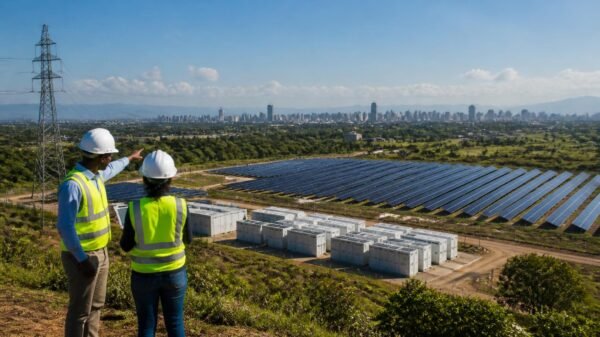
Africa is widely regarded as one of the most promising frontiers for solar energy development anywhere in the world.
The continent holds some of the planet’s highest levels of solar irradiation, a fast-growing population that is only partially connected to reliable electricity, and an economy where diesel generation and grid outages remain a daily cost of doing business.
Against that backdrop, solar power — increasingly paired with battery storage — has moved from a niche or donor-funded technology to a mainstream investment category attracting utilities, mining houses, manufacturers, and private households alike.
According to the Global Solar Council (GSC), Africa recorded its fastest year of solar growth on record in 2025, with new solar photovoltaic (PV) installations rising 54% year-on-year to reach approximately 4.5 gigawatts (GW) of new capacity.
The Africa Solar Industry Association (AFSIA) separately reported that the continent’s cumulative operational solar capacity — spanning utility-scale plants, commercial and industrial (C&I) systems, mini-grids, and solar home systems — surpassed 20 GW during 2025, up from about 19.2 GW at the end of 2024.
These figures differ because the two organisations use different methodologies and data sources, a distinction worth keeping in mind whenever solar statistics for Africa are cited.
This article examines why Africa’s solar potential is so significant, where the market stands today, the technologies and storage systems driving growth, the challenges that persist, and what a reasonable, evidence-based outlook to 2035 looks like.
Why Africa Has Exceptional Solar Potential
Africa’s solar advantage begins with geography. Much of the continent — particularly the Sahara, the Sahel, the Kalahari and Namib deserts, and large parts of Southern and East Africa — sits within what is often described as the world’s largest cloud-free area, receiving some of the highest and most consistent solar irradiation levels on Earth.
Even regions along the equator that experience more cloud cover still receive substantial year-round sunshine compared with most of Europe or North America.
That physical resource is arriving alongside enormous demand pressure. Africa’s population continues to grow faster than any other region, urbanisation is accelerating, and industrialisation — from mining to manufacturing to data centres — is pushing electricity demand up sharply.
Yet an estimated 600 million people across the continent still lack reliable access to electricity, according to figures cited in recent academic reviews of Africa’s energy transition.
The African Union has set a goal of universal electricity access by 2030, a target the World Bank-backed Mission 300 initiative is also working toward, aiming to connect 300 million Africans to power by the end of the decade.
Solar is central to closing that gap for a simple reason: it is now the fastest technology to deploy and, in most markets, the cheapest new source of generation available — a combination that is difficult for any competing technology to match at the pace Africa’s demand is growing.
Current State of Solar Energy in Africa
Africa’s solar market today is really two markets growing in parallel. The first is utility-scale, publicly procured or development-finance-backed generation — large solar parks feeding national grids.
The second is a rapidly expanding, privately financed layer of commercial, industrial, and residential rooftop solar, plus mini-grids and off-grid solar home systems serving communities beyond the reach of national grids.
GSC data indicates utility-scale projects accounted for roughly 56% of Africa’s newly installed solar capacity in 2025, with distributed solar — rooftop, C&I, and residential — making up an estimated 44%, though the true distributed share is likely higher because small-scale systems are harder to track in official statistics.
AFSIA has noted that Africa imported some 18.2 GW worth of solar modules in 2025 alone, far exceeding what utility-scale projects can account for, which points to a large and rapidly growing rooftop and captive-power segment that current data likely undercounts.
Selected country snapshots
South Africa remains the continent’s largest solar market by a wide margin, accounting for roughly half of Africa’s cumulative installed solar capacity.
Its Renewable Energy Independent Power Producer Procurement Programme (REIPPPP) has driven both utility-scale solar farms and a boom in rooftop installation, and the country added around 1.6 GW of new solar capacity in 2025 alone — the largest single-country addition on the continent.
Egypt has built one of the region’s flagship utility-scale projects at Benban in the Western Desert, and is targeting 42% of its electricity from renewables by 2030, up from roughly 11.5% in 2024.
Morocco, guided by the Moroccan Agency for Sustainable Energy (MASEN) and projects such as Noor Midelt, is pursuing a target of more than 52% renewable capacity by 2030 and has increasingly paired new PV capacity with battery storage.
Kenya leads East Africa’s renewable sector, anchored by strong geothermal generation — about 630 MW, over 40% of the country’s electricity — alongside growing solar capacity that includes the 55 MW Garissa solar plant near the equator.
Namibia, Ghana, Nigeria, Zambia, and Rwanda each added meaningful new solar capacity in 2025; Nigeria’s 803 MW of additions made it the second-largest single-country contributor to Africa’s 2025 growth, behind only South Africa.
Technologies Driving Growth
The core technology remains solar photovoltaic (PV) panels, which convert sunlight directly into electricity.
Monocrystalline panels, made from a single silicon crystal, offer higher efficiency and perform better in high-temperature African conditions, while polycrystalline panels remain a lower-cost option still used in some price-sensitive segments.
On the power-conversion side, string inverters dominate smaller commercial and residential systems, while central inverters are typically used on larger utility-scale plants.
Hybrid systems — combining solar PV with battery storage and, in some cases, diesel backup — are becoming the default configuration for commercial and industrial users seeking to avoid grid outages altogether rather than merely supplement grid power.
Smart energy management software and grid-modernisation investments are increasingly bundled with new projects to help utilities and site operators optimise how solar and storage assets are dispatched.
Two more specialised technologies are gaining early traction. Floating solar — PV panels installed on reservoirs and dam surfaces — has been deployed at pilot and small-commercial scale in countries including Ghana, where a floating installation sits on the Bui Dam reservoir.
Agrivoltaics, which combines solar generation with agricultural land use beneath or around the panels, remains an emerging concept in Africa rather than a mainstream one, though interest is growing given the continent’s land-use and irrigation needs.
The Role of Battery Storage
Battery Energy Storage Systems (BESS) have moved from an optional add-on to what many industry participants now describe as an essential component of new solar projects in Africa.
Storage addresses solar power’s core limitation — that generation only happens during daylight hours — by shifting stored daytime energy into the evening and night, when demand often peaks.
BESS also performs a second, increasingly important function: grid stabilisation. As more variable renewable generation connects to African grids and older thermal plants are retired or run less often, storage can inject or absorb power rapidly to manage frequency, reduce network congestion, and cut the technical losses associated with long-distance transmission — services South Africa’s Eskom has specifically highlighted as BESS use cases on its own grid.
Costs have fallen sharply. Recent industry analysis cited in the Africa Solar Outlook 2026 report puts the cost of converting daytime solar into fully dispatchable, round-the-clock power at around US$33 per megawatt-hour using current storage technology — a level that has enabled projects such as a 100 MW solar-plus-storage plant in Mauritius to deliver reliable power at roughly 7 US cents per kilowatt-hour, a price once considered unachievable for solar with storage in Africa.
The scale of the buildout ahead is significant. Market intelligence firm Rho Motion has projected that installed BESS capacity across Africa could grow by as much as 700% between 2025 and 2030, with South Africa leading both in the number of projects and in installed capacity.
South Africa’s BESIPPPP procurement programme has already awarded projects across three windows totalling 1,744 MW of output and nearly 7 gigawatt-hours (GWh) of storage capacity, including the 153 MW/612 MWh Red Sands facility — currently Africa’s largest standalone battery storage plant.
Elsewhere, Senegal, Egypt, Morocco, Uganda, and Zambia’s Kansanshi copper mine are among the projects advancing solar-plus-storage at scale, particularly for mining operations seeking to cut diesel costs and improve energy security.
Major Growth Drivers Through 2035
- Falling equipment costs: continued declines in the price of solar modules and lithium-iron-phosphate battery cells, driven largely by Chinese manufacturing, are making solar-plus-storage cost-competitive with, and often cheaper than, both grid electricity and diesel generation.
- Government policy and procurement programmes: initiatives such as South Africa’s REIPPPP and BESIPPPP, Nigeria’s 2026 mini-grid regulations (which raised capacity caps from 1 MW to 5 MW, and up to 10 MW for interconnected systems), and Morocco’s MASEN-led framework are creating structured routes to market for developers.
- Private investment and climate finance: Africa attracted roughly US$34 billion in clean power investment between 2020 and 2025, with 52% of that capital directed to solar, according to the State of African Energy 2026 Outlook Report.
- Rural electrification programmes: the World Bank-backed Mission 300 initiative has already helped connect more than 50 million people to electricity across 40 African countries between mid-2023 and April 2026, with solar mini-grids and home systems playing a central role, particularly in Tanzania and Ethiopia.
- Demand from mining, manufacturing, data centres, and telecom infrastructure: energy-intensive sectors are increasingly signing direct power-purchase agreements for solar-plus-storage to escape grid unreliability and reduce diesel dependence.
- Electric mobility: still nascent in most African markets, but expected to add incremental demand for solar-charged power over the coming decade as vehicle electrification slowly extends beyond pilot programmes.
Challenges Facing Solar Development
Despite the momentum, Africa’s solar sector faces structural obstacles that will shape how much of its potential is actually realised by 2035.
- Financing remains the most frequently cited constraint. Access to affordable capital is fragmented, and public and development finance institutions still dominate funding for many large-scale projects, particularly outside South Africa, Egypt, and Morocco.
- Grid and transmission infrastructure in many countries was not built to absorb large volumes of variable renewable generation, creating bottlenecks even where solar projects are ready to connect.
- Political and regulatory risk varies significantly by country; net metering, mini-grid licensing, and grid-connection rules differ across nearly every African jurisdiction and, in several markets, remain under active revision.
- Currency fluctuations and import dependence expose developers to exchange-rate risk, since most panels, inverters, and battery hardware are imported, chiefly from China.
- Skills shortages in installation, operations, and maintenance persist in several markets, alongside the practical challenges of land acquisition for utility-scale projects and, looking further ahead, the need for panel and battery recycling infrastructure that does not yet exist at meaningful scale on the continent.
Country Outlook
The following snapshots reflect publicly reported policy targets and market positions; as with any set of national targets, the pace of delivery will depend on financing, grid readiness, and political continuity, and actual outcomes may diverge from stated goals.
| Country | Market position | Notable target or project |
| South Africa | Africa’s largest solar market; roughly half of cumulative capacity | REIPPPP/BESIPPPP; another ~11 GW of solar planned by 2030 |
| Egypt | Leading North African utility-scale market | Benban solar park; 42% renewables target by 2030 |
| Morocco | Advanced policy framework via MASEN | Noor Midelt; >52% renewable capacity target by 2030 |
| Kenya | East Africa’s renewable leader (geothermal + solar) | Garissa 55 MW plant; strong grid-connected C&I growth |
| Ghana | Growing utility and distributed market | $200m Ghana–Switzerland clean energy programme; floating solar at Bui Dam |
| Nigeria | Fastest-growing distributed and manufacturing hub | 2026 mini-grid reforms; emerging panel export industry |
| Namibia | Emerging Southern African market | Growing utility-scale project pipeline |
| Botswana | Among fastest-growing mid-sized markets | Over 100 MW added in 2025 |
| Tanzania | Mini-grid and off-grid electrification focus | 7.5 million new electricity connections via Mission 300 |
| Ethiopia | Continent’s fastest-growing off-grid solar market | 36% of households rely on solar home systems |
Investment Opportunities
For investors, developers, and manufacturers, several segments of Africa’s solar market stand out as areas of genuine near-term opportunity, alongside others that remain earlier-stage.
- Local manufacturing and assembly, following Nigeria’s example of scaling domestic solar panel and component production, reducing import dependence and, in Nigeria’s case, creating a nascent export industry.
- EPC (engineering, procurement, and construction) services, as the pipeline of utility-scale and C&I projects continues to expand across multiple countries simultaneously.
- Battery storage manufacturing and integration, an area South African industry analysts believe could support one to three internationally competitive battery gigafactories given the region’s projected storage demand growth.
- Solar financing structures tailored to distributed and C&I markets, an area the Global Solar Council has specifically flagged as under-served relative to how the market is actually evolving.
- Operations and maintenance services, smart grid technology, solar-powered irrigation and agricultural applications, and industrial solar-plus-storage for mining and manufacturing.
- Green hydrogen remains a longer-horizon opportunity linked to Africa’s solar and wind resource base, though it is at an earlier and more speculative stage of development than the segments above.
What Could Solar Energy in Africa Look Like by 2035?
Any outlook to 2035 needs to distinguish between developments that are highly likely, trends that are emerging but not yet certain, and areas of genuine uncertainty.
Highly likely
Continued double-digit annual growth in installed solar capacity, led by South Africa, Egypt, Morocco, and Nigeria, alongside a widening base of mid-sized markets.
The Global Solar Council’s medium-term outlook projects Africa could install more than 30 GW of new solar capacity by 2029 under supportive policy conditions — a figure that should be read as an industry projection rather than a certainty, since it depends heavily on financing and regulatory reform materialising as hoped.
Battery storage capacity is also highly likely to expand substantially faster than solar generation itself, given how low the current base is and how central storage has become to new project design.
Emerging trends
A shift from a handful of dominant markets toward broader continental participation, with mid-sized markets such as Botswana, Zambia, Ghana, and Chad playing a growing role.
Distributed and rooftop solar is also likely to continue outpacing official statistics, as it has in recent years, making the true scale of Africa’s solar market larger than headline utility-scale figures suggest.
Areas of uncertainty
How quickly financing structures adapt to serve distributed and C&I markets rather than only utility-scale projects remains genuinely uncertain, as does the pace of grid and transmission investment needed to absorb rising renewable penetration in several countries.
Green hydrogen’s role, the extent of local battery and panel manufacturing that takes root beyond South Africa and Nigeria, and how currency and political risk evolve across the continent’s roughly 54 national markets are all factors that could meaningfully accelerate or slow progress toward 2035 in ways that are difficult to forecast with precision today.
Frequently Asked Questions
Which African country has the most solar potential?
Most of Africa receives exceptionally high solar irradiation, but countries with the largest desert and semi-arid land areas — including Egypt, Morocco, Namibia, Algeria, and parts of South Africa — are generally considered to have the greatest raw solar resource.
Realised potential, however, depends heavily on grid infrastructure, financing, and policy, which is why South Africa and Egypt currently lead in installed capacity despite other countries having comparable or higher irradiation.
Is solar cheaper than diesel in Africa?
In most markets, yes. Industry analysis increasingly shows solar paired with battery storage delivering electricity at a lower cost than diesel generation, particularly for commercial, industrial, and mining users who previously relied on diesel for backup or off-grid power.
What is a Battery Energy Storage System?
A Battery Energy Storage System (BESS) stores electricity — typically generated by solar or wind — in rechargeable batteries so it can be discharged later, such as at night or during a grid outage. BESS is used for peak shaving, grid stabilisation, backup power, and enabling higher shares of variable renewable generation.
Which industries are adopting solar fastest?
Mining, manufacturing, telecoms, and increasingly data centres are among the fastest adopters of solar and solar-plus-storage in Africa, largely to reduce diesel costs and insulate operations from grid outages.
How long do solar panels last?
Most commercial solar panels are warrantied for 25 to 30 years of operation, though gradual efficiency degradation occurs over that period. High temperatures and dust, common in many African environments, can affect performance and maintenance requirements.
Can solar power heavy industry?
Increasingly, yes, when paired with sufficient battery storage or hybrid backup. Solar-plus-storage systems are already supplying baseload power to mining operations in countries including the Democratic Republic of Congo and Zambia, though very energy-intensive processes may still require a firm power source alongside solar.
What is causing Africa’s recent surge in solar imports?
Falling prices for Chinese-manufactured solar modules, combined with rising electricity tariffs, grid unreliability, and improving financing access, have driven a sharp increase in panel imports across the continent, with GSC estimating Africa imported 18.2 GW of solar modules in 2025 alone.
Does Africa have enough grid capacity to absorb more solar?
In several markets, grid and transmission capacity is already a binding constraint, which is one reason distributed and off-grid solar has grown faster than official statistics capture. Grid investment is widely regarded as a prerequisite for utility-scale solar to keep expanding at its current pace.
Are African governments subsidising solar?
Policy support varies widely by country, ranging from structured procurement programmes such as South Africa’s REIPPPP to import duty exemptions and rural electrification subsidies in countries such as Nigeria, Kenya, and Rwanda. There is no continent-wide subsidy framework.
What role does climate finance play in Africa’s solar sector?
International climate finance and development finance institutions remain significant funders of utility-scale solar projects, particularly outside South Africa, Egypt, and Morocco, though the sector’s medium-term growth will likely depend on mobilising more private and commercial capital alongside concessional finance.
Conclusion
Africa’s solar sector enters the second half of the 2020s with genuine momentum: record capacity additions in 2025, a battery storage market expanding even faster than solar generation itself, and a widening base of countries — not just South Africa, Egypt, and Morocco — contributing meaningfully to growth.
That momentum is real, but so are the constraints. Financing structures still favour utility-scale over the distributed and C&I markets now driving much of the continent’s actual deployment, grid infrastructure in several countries has not kept pace with renewable ambitions, and regulatory frameworks remain a patchwork that developers must navigate market by market.
What happens between now and 2035 will depend less on whether Africa has the solar resource to power its own energy transition — it clearly does — and more on whether financing, grid investment, and policy reform can keep pace with the demand and technology that are already there.
For policymakers, investors, EPC contractors, and industrial energy users across the continent, the coming decade looks set to be the period in which that question gets answered.
Also Read
- Iberdrola Begins Construction on 57MW Oregon Trail Solar Project, Creating 200 Jobs
- South Africa Clears Four REIPPPP Solar Projects for Construction, Adding Over 1GW to National Grid

- PV Guangzhou 2027 to Highlight Solar and Energy Storage Technologies - October 22, 2026
- Accurate and Reliable Measurement and Monitoring of Industrial Plant Water Treatment - October 21, 2026
- SODECA Highlights Industrial Ventilation Technology at Mega Clima Expo Kenya 2026 - October 14, 2026