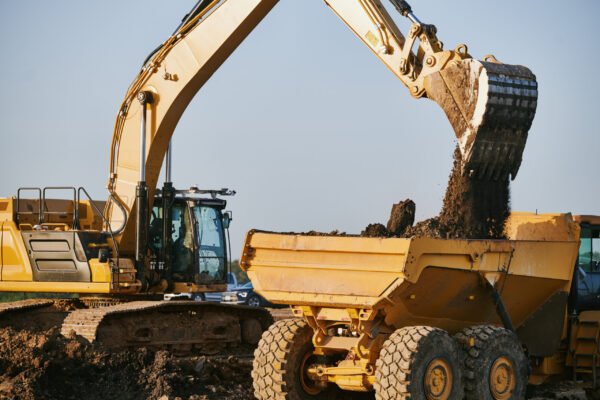
For years, autonomous construction equipment has been demonstrated at technology showcases, test grounds and selected pilot projects.
The more difficult question has been whether such machines can perform productive work alongside people and conventional equipment on an active commercial site.
Bedrock Robotics believes that threshold has now been crossed.
The San Francisco-based technology company has begun deploying excavators equipped with its autonomous system on customer projects, including a water treatment facility in Nevada, a major earthwork operation in Texas and a 1.2-million-cubic-yard civil sitework project with Zachry Construction Corporation.
The significance extends beyond an excavator moving without a person in the cab.
It represents a potential shift in how artificial intelligence is applied to physical construction work — from helping engineers and project managers make decisions to actually controlling the equipment performing the work.
Boris Sofman, Bedrock Robotics CEO and co-founder, described the development as part of a much broader transition, arguing that “the physical economy is the next great frontier for machine learning.”
For construction, that frontier is particularly significant because the industry’s productivity remains heavily dependent on the availability of skilled people and expensive machines.
Why the excavator is the starting point
Bedrock has deliberately started with excavators rather than attempting to automate an entire construction fleet simultaneously.
That makes commercial sense.
Excavators are among the most frequently used and operationally complex machines on many construction sites.
They are responsible for excavation, trenching, loading, grading and other earthmoving tasks that form the foundation of major civil engineering projects.
Bedrock estimates that excavators can account for roughly a quarter of a contractor’s equipment fleet.
They are also machines that require considerable operator experience.
The company says becoming proficient on an excavator can take five years or more, creating a particular challenge for contractors trying to maintain experienced operators as the construction workforce ages and demand for infrastructure grows.
The timing is significant.
Construction companies across major markets are facing a combination of infrastructure investment, labour shortages and pressure to complete increasingly complex projects faster.
Earthmoving is often among the first activities on a project, meaning delays at this stage can affect every operation that follows.
As Sofman put it, “while we have excavators moving earth independently today, we are moving toward coordinated fleets that self-orchestrate entire scopes of work.”
That ambition changes the role of the excavator from a standalone machine into a potential component of a larger autonomous production system.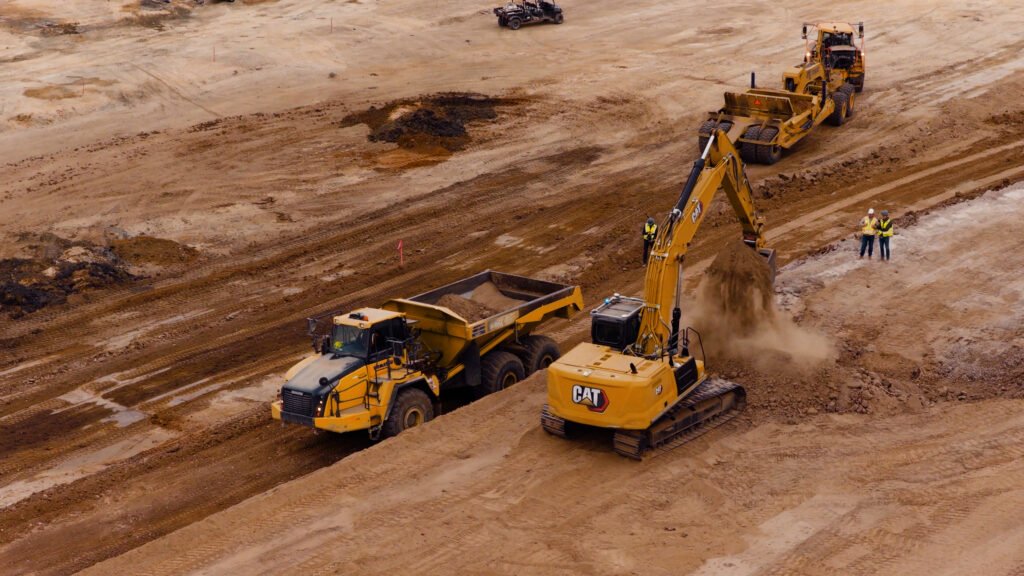
Retrofitting the machines contractors already own
One of the more commercially interesting elements of Bedrock’s approach is that its technology is designed to be installed on existing equipment.
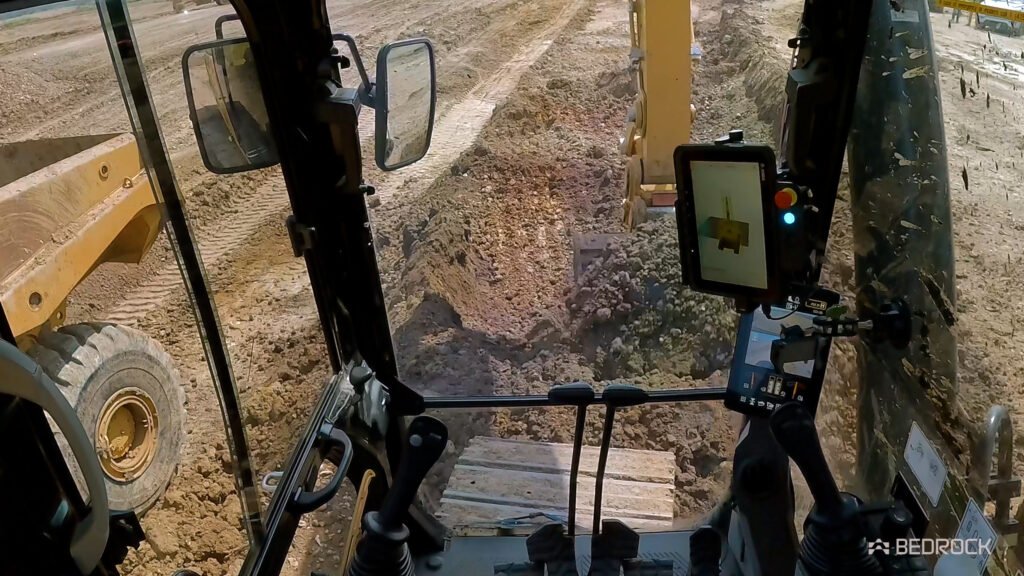
The company’s Bedrock Operator is a retrofit system combining sensors and onboard computing with software capable of perceiving the surrounding environment, planning machine movements and carrying out assigned tasks.
The concept avoids one of the biggest barriers to fleet modernisation: replacing an entire equipment fleet.
Instead, a contractor could potentially take machines already operating in its fleet and add autonomous capability.
Bedrock says the installation can be completed in a day and does not require permanent modifications to the underlying machine.
For equipment owners, this approach could prove important.
Construction fleets are typically built around substantial capital investments in excavators, loaders, dozers and trucks.
A technology that extends the capabilities of existing machines could therefore have a very different adoption curve from a completely new class of autonomous equipment.
It also raises the possibility of autonomy becoming another layer of construction technology — similar to telematics, machine control and fleet-management systems — rather than a reason to purchase entirely new machines.
Related on CCE NEWS
- Hyundai’s New HX210L: Why Earthmoving Contractors Should Pay Attention
- South Africa Has R395 Billion in Infrastructure Projects — But Can the Industry Deliver Them?
- LiuGong Brings a 27-Ton Electric Excavator to North America: Can the 924FE Challenge Diesel?
- Top Autonomous Construction Equipment Trends to Watch in 2026
From remote supervision to independent operation
The latest deployments follow approximately a year of testing on active construction sites under human supervision.
Bedrock says its machine-learning system has been trained using tens of thousands of hours of field data.
Once a site manager establishes the initial plan, the autonomous system is designed to allow the excavator to perceive its environment, plan movements and execute work independently.
This is an important distinction from conventional machine-control technology.
Machine-control systems can assist an operator with positioning, grade control and other tasks. Bedrock is attempting to move further up the automation chain, allowing the machine itself to make operational decisions within the defined work environment.
The objective is not simply to make an operator more productive.
It is to make the machine capable of performing the work.
For contractors, that distinction could ultimately translate into greater equipment utilisation and more predictable production.
Contractors see more than a technology experiment
The commercial deployments are also significant because Bedrock is testing the technology in partnership with established construction companies rather than treating autonomy as a laboratory exercise.
Sundt Construction is among the contractors working with Bedrock, with its machines deployed on a Nevada water treatment project.
Cade Rowley, CEO of Sundt Construction, highlighted the practical considerations driving contractor interest in the technology.
“Making schedules and costs more predictable, getting more consistent use out of our equipment, and allowing our skilled crews to focus on the work where their experience matters most” are among the challenges the company believes autonomous technology could help address, Rowley said.
That perspective is important.
For construction companies, artificial intelligence does not necessarily need to replace people to deliver value. It can instead be used to increase the amount of productive work generated from existing crews and equipment.
Rowley added that AI is creating opportunities in construction “both in the office and in the field,” suggesting that autonomy is becoming part of a broader digital transformation across the industry.
For an employee-owned contractor such as Sundt, the technology is also being framed as a tool to expand capacity rather than simply eliminate jobs.
Safety remains the biggest test
For autonomous construction equipment, productivity alone is not enough.
A construction site is an unpredictable environment populated by workers, trucks, machines, temporary structures and constantly changing work zones.
Bedrock says its autonomous excavators are designed to operate in normal site conditions without requiring physical barriers around the machine.
If a person or unauthorised object enters the machine’s defined safety area, the excavator automatically stops until the area is clear.
That safety architecture will be central to wider adoption.
Construction contractors are unlikely to accept autonomy simply because a machine can dig faster or work longer. Autonomous equipment must demonstrate predictable behaviour when conditions deviate from the planned workflow.
The industry’s real test will therefore be whether autonomous machines can maintain safe performance amid the messy reality of construction rather than within carefully controlled demonstrations.
Bedrock says its move to operator-out deployments followed a year of rigorous testing under human supervision, with safety treated as a fundamental requirement rather than an additional feature.
The construction labour problem
The push toward autonomy is occurring against a difficult labour backdrop.
Bedrock points to an ageing U.S. construction workforce, with around one-fifth of construction workers aged over 55. The company also cites estimates that more than 40% of the industry’s workforce could retire within five years.
For contractors, this creates a structural problem.
Infrastructure investment can increase demand for construction services, but additional projects cannot easily be delivered if companies cannot recruit enough experienced workers to operate the equipment required to build them.
Autonomous machines offer one possible response.
Rather than relying entirely on increasing the number of operators, contractors could potentially increase the productive capacity of existing fleets through automation.
That is particularly relevant to repetitive earthmoving operations where machine cycles can be highly structured.
The bigger opportunity is not one autonomous excavator
Bedrock’s excavator deployments are ultimately a stepping stone toward something considerably bigger.
The company’s stated ambition is to develop autonomous coordination across multiple machine types.
That could eventually involve excavators working alongside autonomous dump trucks, dozers and loaders, with software coordinating the machines as a single production system.
That is where autonomous construction could become much more transformative.
Consider a conventional earthmoving operation.
An excavator loads material into dump trucks. The trucks transport it. Dozers spread or push material. Graders and compactors then prepare the finished surface.
Today, each machine is generally operated and managed as a separate asset.
A future autonomous site could potentially coordinate those machines around a shared production plan.
The excavator could adjust its loading cycle according to truck availability. Trucks could be dispatched according to the excavator’s production rate. Dozers could respond to material placement. Fleet-management software could continuously optimise the sequence.
In such a scenario, the construction site begins to resemble a coordinated industrial production system rather than a collection of independently operated machines.
Sofman sees this as the longer-term objective, saying the technology could ultimately “fundamentally redefine not just the productivity of a single machine, but the very scale of what contractors” can achieve.
What does this mean for Africa?
The technology also deserves attention beyond the U.S. market.
African construction markets face a different set of conditions, but many of the underlying challenges are familiar: shortages of skilled equipment operators, pressure on project costs, large infrastructure requirements and the need to improve utilisation of expensive machinery.
Large road programmes, dams, mining infrastructure, industrial parks, airports, ports and energy projects all depend heavily on earthmoving equipment.
In many African markets, the issue is not necessarily the absence of machines.
It can be the difficulty of keeping those machines productive.
An autonomous retrofit could eventually offer contractors another way to increase machine utilisation without purchasing an entirely new fleet.
This could be particularly relevant to large contractors operating across multiple projects, where experienced operators are concentrated on the most demanding activities while more repetitive earthmoving tasks consume significant amounts of machine and labour hours.
However, African adoption is unlikely to be a simple copy of the U.S. model.
Construction sites across the continent can involve highly variable ground conditions, informal traffic patterns, mixed fleets, limited connectivity and different approaches to site management.
Autonomous equipment would therefore need to demonstrate reliability in precisely these environments.
There is also the question of economics.
The value proposition will ultimately depend on the cost of the autonomy system compared with operator costs, machine utilisation, downtime, fuel consumption, productivity improvements and the financial consequences of project delays.
For African contractors, where capital expenditure can be tightly constrained, the ability to retrofit existing equipment could therefore be more attractive than purchasing purpose-built autonomous machines.
The operator’s role may change rather than disappear
The arrival of autonomous excavation also raises an obvious question: what happens to equipment operators?
The more likely near-term answer is that their role changes.
Highly experienced operators could increasingly move toward supervising autonomous equipment, managing complex tasks and intervening when machines encounter situations outside their operating parameters.
That could allow one experienced professional to oversee more productive capacity than would be possible when operating a single machine manually.
For contractors struggling to recruit and retain skilled operators, this could become one of the strongest arguments for autonomy.
At the same time, the industry will need to invest in a new generation of skills around autonomous systems, machine diagnostics, data, fleet coordination and safety management.
The construction workforce may therefore become less dependent on manually controlling every machine while becoming more dependent on people capable of managing increasingly sophisticated equipment.
Bedrock’s Waymo connection
Bedrock’s ambitions are backed by a team with experience in another industry that has spent years attempting to solve a similar problem: autonomous driving.
The company’s founders and several early team members previously worked at Waymo, contributing to autonomous vehicle technology.
That experience gives Bedrock a foundation in machine perception, artificial intelligence, robotics, safety systems and large-scale autonomous operations.
But construction is fundamentally different from road driving.
A construction machine operates in environments that are constantly being created and modified. There are no permanent road lanes, traffic signals or fixed infrastructure defining every movement.
That makes the transition into construction particularly challenging — but also potentially valuable.
If autonomous systems can reliably handle the variability of construction sites, the technology could eventually extend across a much broader range of heavy equipment.
The next frontier: the autonomous job site
Founded in 2024, Bedrock Robotics has raised $350 million and is positioning its technology around a much larger opportunity than autonomous excavation.
The company’s longer-term objective is an autonomous construction ecosystem in which different machines communicate, coordinate and execute work as a connected fleet.
That vision remains ahead of today’s deployments.
But the commercial excavators now operating on live projects represent an important intermediate step.
The construction industry has spent years discussing autonomous equipment as a future possibility.
Bedrock’s latest move suggests that the conversation is beginning to change from whether construction equipment can become autonomous to where autonomy can deliver the greatest commercial value.
For contractors, equipment manufacturers and fleet owners, that could be the more important question.
The autonomous construction site may not arrive as one dramatic technological leap. It may begin with a single excavator, followed by another machine, and eventually a fleet capable of coordinating much of the earthmoving operation itself.
If that happens, the construction equipment industry could be heading toward a fundamental change in how machines are purchased, operated, managed and valued.
And the excavator may be where that transformation begins.
Also Read
- Top Autonomous Construction Equipment Trends to Watch in 2026
- Automation in Open-Pit Mining: How Autonomous Haulage Systems Are Changing Site Efficiency
- Epiroc Secures Major Order for Autonomous Electric Mining Rigs in Africa

- PV Guangzhou 2027 to Highlight Solar and Energy Storage Technologies - October 22, 2026
- Accurate and Reliable Measurement and Monitoring of Industrial Plant Water Treatment - October 21, 2026
- SODECA Highlights Industrial Ventilation Technology at Mega Clima Expo Kenya 2026 - October 14, 2026