
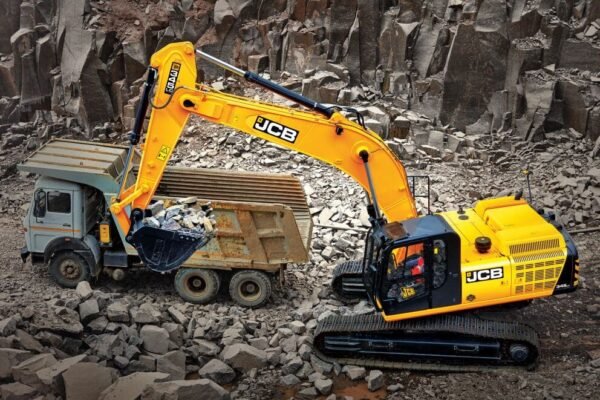
Ganatra Plant and Equipment, the authorised JCB dealer for Kenya and Uganda has introduced the JCB 345 LC heavy-duty excavator to both markets — putting a 34-tonne machine on East African ground at a moment when large-scale construction, quarrying, and road-building projects are pushing existing contractor fleets to their limits.
The launch took place on Saturday, 9 May 2026, and marks a deliberate response to the growing scale of infrastructure work underway across the region.
The 345 LC is JCB’s answer to a clear gap in the market: sites that have outgrown mid-range excavators but where the ecosystem of parts, service, and operator training has historically been thin for larger machines.
“The JCB 345 LC is the right machine for the scale of projects Kenya and Uganda are undertaking right now. We are proud to put it in our customers’ hands.” — Altaf Ganatra, Managing Director, Ganatra Plant & Equipment Ltd.
A Machine Built Around the JCB DIESELMAX
At the core of the 345 LC is JCB’s in-house DIESELMAX engine — a 7.2-litre, six-cylinder unit producing 165 kilowatts (221 horsepower) and 960 Newton-metres of peak torque.
What distinguishes this powertrain from most competitors is its provenance: JCB designs and manufactures the DIESELMAX entirely at its Derbyshire facility in the United Kingdom.
The practical implication is significant for contractors working in remote locations. Most equipment brands source their engines from third-party suppliers, creating split accountability when something fails on site.
With the DIESELMAX, the service and warranty chain runs from the cab to the crankshaft through a single manufacturer — a meaningful advantage when a breakdown in Turkana, Karamoja, or any similarly remote East African site can cost days of project time.
Hydraulics Designed for Heavy Cycles
The 345 LC runs a twin variable-flow piston pump hydraulic system in a negative-control configuration.
In practical terms, this means the machine responds quickly to operator inputs, maintains efficiency as work cycles intensify, and burns less fuel under varying loads compared to fixed-flow systems.
On contracts where fuel is a significant line item — and it almost always is in remote-site construction — that efficiency compounds into real cost savings over a project lifecycle.
Built for Quarrying and Hard-Ground Applications
The machine delivers a bucket tear-out force of 22,586 kg, making it well suited to quarrying, aggregate extraction, and hard-rock excavation.
JCB has reinforced both the boom and arm structures specifically to support demanding rock and aggregate operations — sectors that continue to expand across Kenya and Uganda as construction aggregate demand grows alongside urbanisation and infrastructure programmes.
Inside the cab, the 345 LC features vibration-dampening mounts, panoramic visibility, and digital monitoring systems.
The ergonomic control layout reflects the reality that operators on long shifts in demanding conditions perform better — and safer — in a well-designed working environment.
Key Technical Specifications
MACHINE SPECIFICATIONS AT A GLANCE
Why This Launch Matters for East Africa
Kenya’s infrastructure pipeline — roads across difficult terrain, dam construction, quarries supplying aggregate to an accelerating construction sector, and expanding mining activity — has for years demanded equipment at a scale that was either unavailable locally or inadequately supported.
The 345 LC launch by Ganatra addresses both gaps simultaneously: the machine itself and the dealer network behind it.
Uganda faces similar dynamics. Large earthmoving projects require large machines, and the availability of OEM-backed parts and service from a long-established dealer meaningfully changes the risk calculus for fleet managers and project financiers who must account for uptime when costing a contract.
The 590-litre fuel tank and 5,000-hour hydraulic service interval are not incidental specifications — they reflect deliberate engineering for markets where resupply and maintenance intervals are constrained by geography.
Also Read
Washington Blinks on Equipment Tariffs — But Africa Still Pays the Price
From British Icon to American Powerhouse: Inside JCB’s $500 Million Texas Megafactory

- PV Guangzhou 2027 to Highlight Solar and Energy Storage Technologies - October 22, 2026
- Accurate and Reliable Measurement and Monitoring of Industrial Plant Water Treatment - October 21, 2026
- SODECA Highlights Industrial Ventilation Technology at Mega Clima Expo Kenya 2026 - October 14, 2026