

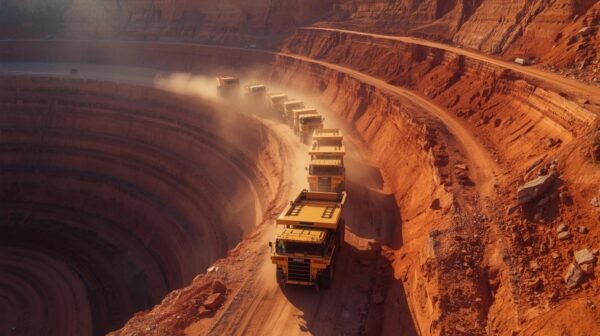
The open-pit mine of the twenty-first century is increasingly a site without human operators in the cab.
Across the world’s largest iron ore, copper, gold and coal operations, fleets of 300-tonne haul trucks are navigating precisely mapped pit roads, dispatching loads, avoiding hazards and returning to crusher dumps — all without a driver touching the wheel.
Autonomous Haulage Systems (AHS) have moved decisively from pilot project to industrial standard, and the numbers behind the transition are compelling enough to demand the attention of every mining executive, contractor and equipment procurer operating on the African continent and beyond.
The Technology Inside a Modern AHS
At its core, an Autonomous Haulage System fuses four technology layers: precision positioning, environmental sensing, onboard computation, and fleet-wide communications.
Each layer must perform flawlessly — and in real time — for a 300-tonne truck travelling at 50 km/h through an active pit to be considered safe.
Precision Positioning
High-precision GNSS (Global Navigation Satellite Systems), combined with inertial measurement units (IMUs), give modern autonomous trucks centimetre-level positional accuracy across vast pit floors.
Caterpillar’s MineStar Command architecture relies on this combination for path-following accuracy, and its 2023 white paper notes that approximately 90% of deployed autonomous mining trucks use this navigation approach.
The dependency on GNSS, however, is not without risk — experts have flagged increased solar activity, deliberate jamming and low-cost spoofing equipment as growing threats to signal reliability, making redundant positioning a key focus of next-generation system design.
Environmental Sensing: LiDAR, Radar and Computer Vision
LiDAR units mounted across the truck’s frame scan the operating environment at frequencies between 40 and 100 Hz, achieving positional accuracy to ±2 cm.
Alongside LiDAR, millimetre-wave radar operating at 77 GHz provides all-weather obstacle detection — critical during dust storms, fog or the reddish haze that characterises many open-pit operations at dawn.
Computer vision algorithms process camera feeds to classify potential hazards: light vehicles crossing haul roads, personnel on foot, fallen rock or edge erosion.
The three sensing modalities operate in parallel, feeding a redundant safety architecture that will halt the truck before any control logic conflict can escalate into an incident.
Fleet Management and Dispatch Integration
A solitary autonomous truck is a curiosity. Hundreds operating in coordinated unison are a productivity transformation.
Modern AHS platforms — Komatsu’s FrontRunner, Caterpillar’s MineStar Command, Hitachi’s AHS, and a growing cohort of Chinese-developed systems including CiDi, EACON and WAYTOUS — integrate directly with mine-wide fleet management software (FMS) to optimise loading sequences, route assignments, fuel routing, shovel synchronisation and dump-point queuing.
The FMS simultaneously coordinates manned and unmanned equipment, scheduling interactions at intersection points and controlling traffic flow across the full pit.
| “Our mining solutions rest on three pillars: automation, sustainability and interoperability.” — Brian Fox, SVP Mining Strategy & Innovation, Komatsu |
The Productivity and Cost Case
The commercial argument for AHS is built on four measurable pillars: operational hours, fuel savings, maintenance costs and total material moved. The cumulative evidence from deployments across Australia, North America, South America and increasingly Asia is now substantial enough to move beyond anecdotal claims.
These gains are not trivial in the context of open-pit economics. Haul truck operating costs typically represent 40–60% of total mining operating expense.
Even a 10% fuel reduction on a fleet of 50 trucks operating over a 365-day year translates into savings running into millions of dollars annually, depending on diesel price and haulage distance.
The continuous operation advantage — AHS trucks do not take shift breaks, require fatigue management interventions or call in sick — compounds these savings over the full production year.
At Komatsu’s flagship FrontRunner deployments, customers are collectively adding material to the cumulative haul total at a rate exceeding six million metric tonnes per day.
The 1,000th autonomous ultra-class haul truck commissioned by Komatsu in April 2026 — a 930E-5AT with a 290-tonne payload — was deployed at Barrick’s Nevada Gold Mines, marking AHS’s formal entry into large-scale gold mining in North America.
In a broader accounting exercise, FrontRunner was assessed to have generated approximately USD 2.4 billion in social impact globally in 2024 alone, using methodology developed jointly by the Capitals Coalition and Value Balancing Alliance.
| “Komatsu customers using FrontRunner have collectively moved more than 11.5 billion metric tonnes of material across some of the world’s most demanding mining environments.” |
The Global Leaders: Who Builds and Who Deploys AHS
The autonomous haulage market is dominated by two original equipment manufacturers (OEMs) that between them accounted for 74% of tracked autonomous truck brands globally as of late 2024, according to GlobalData.
Both are now racing to position for a dramatically expanded market over the remainder of the decade.
Komatsu FrontRunner
First to market in 2008, Komatsu’s FrontRunner remains the global reference standard. The system is deployed across North America, South America, Australia and Europe, spanning gold, copper, iron ore and coal operations.
The milestone of commissioning the 1,000th ultra-class autonomous truck in 2026 establishes Komatsu as the first OEM to cross that threshold.
FrontRunner’s integration with Modular Mining’s DISPATCH fleet management system gives operators a single-pane-of-glass view of manned and autonomous assets.
Komatsu has also demonstrated autonomous operation of an electric drive truck connected to a dynamic trolley line — an industry first that points toward electrified autonomous fleets as the next evolution.
Caterpillar MineStar Command for Hauling
Caterpillar entered commercial AHS deployment in 2013 and had 690 autonomous trucks in operation by the end of 2024.
At its 2025 Investor Day, Cat Resource Industries President Denise Johnson announced an ambition to triple that fleet to over 2,000 autonomous trucks by 2030 — a target that, if achieved, would represent one of the most dramatic technology deployment curves in mining history. The system has already accumulated more than 2.5 billion tonnes of haul.
Suncor’s oil sands operations in Canada serve as a notable reference site, with 140 autonomous trucks across two mines at the Base Plant and an additional 47 at Fort Hills.
China’s Rising AHS Platforms
Beyond the duopoly of Komatsu and Caterpillar, a cohort of Chinese AHS developers has emerged rapidly in the past three years.
CiDi Inc, listed on the Hong Kong Stock Exchange, grew revenue by 115.8% in 2025 to RMB 884.8 million, with autonomous mining trucks delivered and in delivery exceeding 1,500 units by February 2026 and cumulative autonomous driving mileage surpassing 16 million kilometres.
EACON Mining, Shanghai BOONRAY, TAGE Idriver and WAYTOUS are additional Chinese platforms scaling at pace.
In June 2024, a smart coal mining project in northwest China set a global record for autonomous driving in a mixed fleet environment — deploying 56 driverless trucks alongside more than 800 manned vehicles simultaneously.
These Chinese platforms are building on domestic scale to compete internationally, particularly in markets where OEM exclusivity agreements are not already in place.
Hitachi and the IoT-Connected Mine
Hitachi’s AHS platform differentiates through its deep IoT integration, using sensor-embedded equipment and a centralised digital control system that monitors equipment performance, environmental conditions and production data in real time.
The platform is particularly positioned for smart mine configurations, where the AHS is one component in a broader connected ecosystem that also includes autonomous drilling, real-time geological sensing and predictive maintenance analytics.
AHS in Africa: Emerging Deployments and Regional Opportunity
Africa’s mining sector is not yet a primary AHS deployment market on the scale of Australia or Latin America.
The continent’s open-pit operations in copper, gold, platinum, iron ore and coal are, however, increasingly on the radar of automation investment decisions — both from global miners operating African assets and from the OEMs seeking to grow their footprints beyond saturated markets.
South Africa’s mining industry contributes approximately 6% to nominal GDP and remains the continent’s most technology-intensive sector.
By early 2026, automation was shifting workforce demand at multiple South African sites, with autonomous haulage reducing idle time and generating demand for control room operators, maintenance specialists and software-literate technicians.
Mining technology firms Sandvik and Epiroc have both expanded autonomous haulage and drilling systems across African operations since late 2025.
Epiroc secured an order valued at nearly USD 41 million in 2026 for autonomous and electric Pit Viper blasthole drills — signalling a shift from pilot projects to full-fleet modernisation.
In the Democratic Republic of Congo, the Kamoa-Kakula copper complex operated by Ivanhoe Mines and Zijin Mining — one of the world’s fastest-growing copper operations — is targeting 500,000 tonnes of copper production per year from 2028.
Precision mining and automation are central to achieving that target, with engineers monitoring drilling performance, equipment health and ore movement in real time.
Workers who previously operated machinery underground are being retrained to manage systems and analyse production data — a model that African mining regulators and communities will need to engage with carefully.
For African open-pit operations — particularly large copper mines in Zambia and the DRC, gold operations in Ghana, Tanzania and Mali, and iron ore developments in Guinea — the AHS value proposition is sharpened by the specific conditions of African mining: remote locations with high logistics costs, labour costs that are rising relative to productivity benchmarks, challenging road conditions that benefit from consistent automated driving behaviour, and investor pressure to demonstrate improved safety records and ESG compliance.
Africa AHS Adoption
Key Enablers to Watch
Large-scale open-pit copper and iron ore operations with high haul cycle volumes present the clearest ROI case.
Rising African labour costs and productivity benchmarking from global operations are accelerating business case formation.
ESG and investor transparency requirements are driving demand for data-rich, auditable operations that AHS naturally supports.
5G network rollout across major African mining hubs is becoming a critical enabling infrastructure for real-time AHS communications.
Chinese AHS platform vendors may offer lower capital entry points than Western OEMs, potentially accelerating adoption in Tier 2 mining markets.
The Barriers: What Slows AHS Adoption
Honest analysis of AHS cannot overlook the substantial barriers that slow adoption, particularly in markets outside the established technology corridors of Australia, North America and Chile.
Capital Cost and Infrastructure Investment
AHS deployment is not simply a truck procurement decision.
It requires pit road redesign and regrading to meet autonomous operation tolerances, installation of road-side infrastructure (radar, communication nodes, safety berms), control room construction, integration of fleet management platforms, and extended commissioning periods during which productivity is disrupted.
For small and mid-sized mining operations, this capital stack can be prohibitive. The payback period that global majors achieve on AHS — typically three to five years at scale — is harder to replicate with smaller fleet sizes.
GNSS Dependency and Communication Reliability
The precision of modern AHS depends on reliable GNSS signal and low-latency communication infrastructure.
In remote African mining locations — many of which still operate on satellite communications with variable throughput — this dependency is a real operational risk.
Increased solar activity, deliberate signal interference and the cost of deploying GNSS correction services across vast mine sites add complexity and cost.
Next-generation systems are exploring sensor fusion approaches that reduce GNSS dependency, but commercially mature alternatives at the scale required for ultra-class truck fleets are not yet universally available.
Workforce Transition and Community Engagement
The transition from manned to autonomous haulage is, in political and social terms, a workforce reduction decision — even if operators prefer to describe it as a redeployment.
In African mining contexts, where mining employment carries significant community and government expectations, this transition demands proactive stakeholder engagement.
Local content regulations across Africa increasingly mandate skills localisation: AHS operators need to demonstrate that automation creates local technical employment (in control room operations, maintenance, software management and data analytics) to gain and maintain social licence.
Getting this narrative right is as operationally critical as any sensor calibration.
Mixed Fleet Complexity
Many African mines operate diverse fleets assembled over decades — multiple truck brands, vintage models and varying payload classes. AHS platforms are typically designed around specific OEM truck fleets, and interoperability across brands remains limited.
Deploying a Komatsu FrontRunner system on a site with a mixed Komatsu/Liebherr/Hitachi fleet, for example, requires complex custom engineering.
The MINExpo 2024 event in Las Vegas saw multiple OEMs and technology partners discussing interoperability frameworks, but commercially viable multi-brand autonomous orchestration at scale remains an open engineering challenge.
AHS and the Sustainability Equation
The environmental case for autonomous haulage has strengthened considerably as the mining industry faces intensifying investor and regulatory pressure on carbon intensity and environmental governance.
AHS systems optimise driving behaviour with a precision no human operator can consistently match: constant speed profiles, smooth acceleration and deceleration curves, and intelligent route selection that minimises fuel consumption per tonne moved.
Fuel efficiency gains of up to 12% have been documented with autonomous trucks relative to their manned equivalents, attributable to optimised driving patterns and intelligent route planning.
Extended tyre and brake life — a direct consequence of the smooth, consistent operation that AI-controlled trucks produce — further reduces per-tonne material and waste generation. For operations pursuing Net Zero pathways, AHS provides a measurable, auditable contribution to decarbonisation that can be reported against Scope 1 emissions targets.
The integration of AHS with electrified drivetrains is the next frontier. Komatsu has already demonstrated autonomous operation of an electric drive truck connected to a dynamic trolley line.
As battery-electric and hydrogen fuel cell powertrains scale up across the heavy equipment sector, the combination of electrification and autonomy — eliminating both the driver and the diesel — represents the ultimate efficiency and carbon reduction scenario for open-pit haulage.
| “The combination of electrification and autonomy — eliminating both the driver and the diesel — represents the ultimate efficiency scenario for open-pit haulage.” |
The Market Outlook: Where AHS Is Heading
The global AHS market was valued at USD 498 million in 2024 and is projected to grow to USD 903 million by 2031, representing a compound annual growth rate of 9.1%.
Open-pit mining accounted for over 63% of the mining robotics market share in 2025, driven by the need to automate hauling, drilling and excavation in bulk-commodity operations such as coal, iron ore and copper.
As of 2023, approximately 1,000 autonomous trucks were operational globally — a figure expected to at least double by 2026, based on the trajectory already visible in Caterpillar and Komatsu’s deployment curves.
Above-200-tonne payload trucks hold the largest share of the AHS market, a reflection of the segment’s suitability for the large-scale open-pit iron ore, copper and coal operations that generate the clearest economic case for automation.
Fully autonomous operation (as opposed to operator-assisted autonomy) is growing fastest, driven by maturation of LiDAR, GPS and AI-based fleet management systems.
North America leads deployment with over 35% of worldwide AHS installations as of 2024, followed by Australia.
Latin America — led by Codelco, BHP, Vale, Anglo American and Teck at operations including Gabriela Mistral, Escondida, Brucutu and Quellaveco — has become the most active growth region.
Africa’s trajectory will depend on a combination of commodity price environment, infrastructure investment, regulatory clarity and the speed at which OEMs adapt their commercial models for the specific capital constraints and operational conditions of African mining.
Conclusion: The Autonomous Pit is Already Here — Africa Must Engage
The autonomous open-pit mine is not a future scenario — it is an operating reality at dozens of the world’s most productive mining sites.
Komatsu has commissioned its 1,000th ultra-class autonomous truck. Caterpillar has tripling ambitions.
Chinese platforms are scaling at pace with commercial aggression.
The material evidence — 11.5 billion tonnes moved autonomously, 690 Cat trucks running, 56 driverless trucks in a single Chinese coal pit — is not projections. These are operational facts.
For Africa’s mining industry, the question is no longer whether autonomous haulage systems work.
The question is whether Africa’s mines, mining companies, regulators, equipment procurers and host communities are preparing for the operational, workforce and infrastructure transitions that AHS deployment requires.
The operations that engage with this technology proactively — building the internal competence, the stakeholder frameworks and the infrastructure prerequisites — will be positioned to realise the productivity, safety and sustainability dividends that AHS has already delivered elsewhere in the world.
For contractors and equipment buyers operating across Africa’s mining regions, the signal is unambiguous: autonomous haulage is the direction of travel.
Understanding the systems, the economics, the barriers and the deployment models is no longer optional knowledge — it is a fundamental requirement for competing and operating in the open-pit mining sector of the next decade.
Also Read
Best Heavy-Duty Dump Trucks for African Mining Sites
Radial vs. Bias OTR Tires: Which Is Better for Your Mining or Construction Fleet

- SODECA Highlights Industrial Ventilation Technology at Mega Clima Expo Kenya 2026 - October 14, 2026
- How They Were Built: Inside the Engineering of the Lesotho Highlands Water Project - October 11, 2026
- Africa’s Water Reuse Opportunity: Building the Infrastructure for a Water-Secure Future - September 28, 2026