

America’s construction market is entering a significant transition.
For much of the post-pandemic recovery, the biggest stories were factories, warehouses, offices, residential developments and other buildings. But the next phase of US construction growth is increasingly being shaped by something that sits behind those buildings: power.
The shift is being driven by the rapid expansion of data centers, artificial intelligence infrastructure, industrial electrification and continued investment in the country’s aging power network.
The result is a construction market in which generation, transmission, substations, electrical infrastructure and supporting civil works are becoming just as important as the buildings that ultimately consume the electricity.
A US construction market report points to this changing investment pattern.
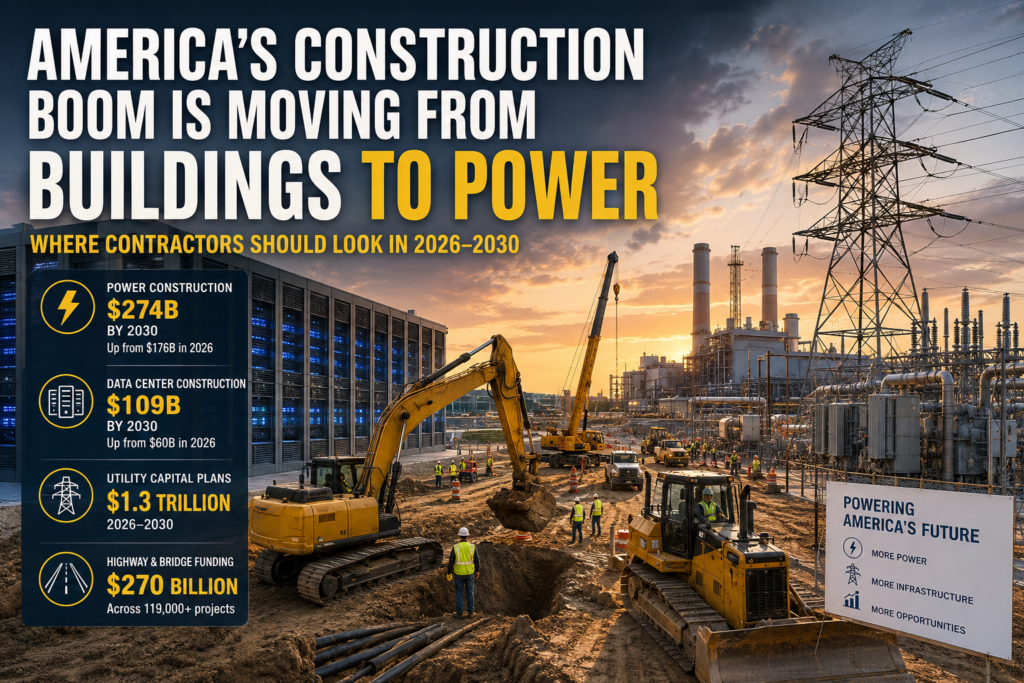
Power construction is forecast to rise from approximately $176 billion in 2026 to $274 billion by 2030, while data-center construction spending is projected to increase from about $60 billion in 2026 to $109 billion by 2030.
Utility five-year capital plans are also approaching $1.3 trillion for 2026–2030.
For contractors, equipment manufacturers and suppliers, that changes the question from simply where are the buildings being constructed? to a much bigger one:
Where will America build the infrastructure needed to power them?
AMERICA’S CONSTRUCTION BOOM
Moving From Buildings to Power | 2026–2030
Power by 2030
Data Centers
Utility Plans
Highways & Bridges
Power Generation • Grid • Substations • Data Centers • Heavy Civil
Excavators • Cranes • Dozers • Drilling Rigs • Trenching Equipment
Power is becoming the new construction bottleneck
The connection between data centers and power is particularly important.
AI applications require enormous computing capacity, and that computing capacity requires electricity.
As hyperscale data centers become larger, securing land is no longer enough. Developers increasingly need access to generation, transmission networks and substations before a project can move forward.
Goldman Sachs estimates that US data-center power demand could rise from 31 GW in 2025 to 41 GW in 2026 and 66 GW in 2027. That would make data centers an increasingly significant component of US electricity demand.
This is already influencing the construction industry.
PCL’s 2026 construction outlook identifies data centers, power and water infrastructure among the sectors reaching new highs. It also notes that power availability has become a major constraint on data-center expansion, with large projects facing lengthy grid-connection timelines.
The implication is important for contractors: the data-center boom is creating a second construction boom around it.
A data center needs the building itself, but it also needs substations, transmission connections, backup generation, cooling infrastructure, roads, water systems, electrical distribution and other supporting works.
That creates opportunities far beyond the general contractor building the data-center shell.
1. Power generation could become one of the biggest construction markets
The strongest opportunity identified in the report is power construction itself.
Spending is projected to increase from $176 billion in 2026 to $274 billion by 2030.
That represents a fundamental shift in where construction capital is going.
Utilities and private developers are being pushed to add generation capacity as electricity demand rises.
At the same time, data-center developers are increasingly exploring ways to secure power without waiting indefinitely for traditional grid connections.
Recent developments illustrate this trend. In Pennsylvania, for example, Alpha Compute announced plans for a 200-MW data-center campus linked to gas-fired power generation, with potential expansion to 1 GW.
The proposed project, including electrical infrastructure, is expected to cost about $500 million over several years.
For contractors, this means opportunities in:
- Power-plant construction
- Gas-fired generation
- Renewable-energy projects
- Battery and energy-storage infrastructure
- Electrical balance-of-plant work
- Site preparation
- Foundations
- Heavy civil construction
- Underground utilities
- Cooling and water infrastructure
The important point is that power generation is no longer simply an energy-sector story. It is becoming a construction-sector growth story.
2. Transmission and substations may be even more important
Building generation capacity is only part of the problem.
Electricity has to reach the customer.
That puts transmission lines, substations, transformers, switchgear and distribution infrastructure at the center of America’s next construction cycle.
The report’s projection of nearly $1.3 trillion in utility capital plans for 2026–2030 demonstrates the scale of the potential pipeline.
For contractors, this is an attractive market because it creates demand for specialized construction capabilities.
Transmission construction requires right-of-way work, access roads, foundations, drilling, excavation and heavy lifting. Substation construction requires civil works followed by highly specialized electrical installation.
It is also a market in which equipment demand can be substantial.
Contractors may require:
- Crawler cranes
- Truck cranes
- Excavators
- Dozers
- Wheel loaders
- Directional drilling equipment
- Foundation drilling rigs
- Aerial work platforms
- Trenching equipment
- Material-handling equipment
This could make transmission and grid construction an important growth market for equipment dealers as well as contractors.
Related Stories
- Where Hyundai Is Winning the Excavator Race: The Markets Driving Its Global Growth
- Why US Contractors Are Still Struggling to Find Skilled Workers in 2026
- US Construction Industry in 2026: Market Size, Spending, Equipment Trends and Major Projects
- Brazil’s Construction Industry Enters a New Structural Phase in 2026
3. Data centers will remain a major construction engine
The US report projects data-center construction spending rising from $60 billion in 2026 to $109 billion by 2030.
That alone makes data centers one of the most important construction markets in the country.
But the more interesting story is what happens around them.
Newmark’s 2026 US data-center outlook identifies a pipeline of approximately 160 GW of facilities under construction or announced, with vacancy at only 2%.
The sector’s expansion is therefore creating demand for a wide range of construction services.
Civil contractors are needed to prepare large sites. Excavation contractors build underground infrastructure. Concrete contractors construct foundations and equipment pads.
Mechanical contractors install cooling systems.
Electrical contractors handle power distribution. Specialized contractors install backup generation and other critical systems.
This means contractors do not necessarily need to be the company building the data-center structure to benefit from the boom.
The larger opportunity is to become part of the data-center infrastructure ecosystem.
4. The location of construction will increasingly follow power availability
One of the biggest consequences of this shift is geographical.
Historically, data-center developers could prioritize factors such as fiber connectivity, land availability and proximity to major population centers.
Power is now becoming equally important.
Goldman Sachs says only around 50%–60% of data-center capacity scheduled for the next one to two years is expected to come online on time, reflecting delays and cancellations.
That creates an incentive to move projects toward locations where electricity can be generated and delivered more easily.
It could also accelerate construction in secondary US markets.
Instead of concentrating entirely on established data-center hubs, developers may increasingly seek locations with available land, power generation potential, transmission capacity and favorable permitting environments.
For contractors, this means opportunity may not be limited to the traditional construction centers.
The next major equipment market could emerge wherever power, land and infrastructure converge.
5. Highways and bridges remain a major opportunity
The shift toward power does not mean traditional infrastructure construction is disappearing.
The report identifies approximately $270 billion in committed highway and bridge funding across more than 119,000 projects.
That represents a substantial pipeline for road contractors and equipment suppliers.
Highway construction also has a direct relationship with the new power economy.
Large power plants, data centers, factories and industrial developments require roads capable of handling construction traffic and long-term commercial activity.
That creates demand for excavation, grading, paving, drainage, bridges and site-access infrastructure.
For contractors that already own fleets of excavators, dozers, graders, pavers and rollers, infrastructure spending provides a more diversified opportunity alongside the fast-growing power market.
6. Manufacturing construction is becoming more selective
One of the most interesting findings in the report is that America’s industrial construction story is not moving uniformly upward.
Manufacturing construction spending is down about 17%, while year-to-date spending is down roughly 22%.
That is important because it challenges the simple narrative that America’s reshoring boom is lifting every type of factory construction.
Instead, investment is becoming more selective.
Some semiconductor and EV-related projects have weakened or moved beyond their most construction-intensive phases, while other areas — including defense and pharmaceutical manufacturing — continue to provide opportunities.
For contractors, the lesson is clear:
Do not treat US manufacturing as a single market.
The strongest opportunities may increasingly be concentrated in specific industries rather than broad industrial construction.
7. Contractors should watch the supporting infrastructure, not just the headline projects
The biggest construction opportunities of the next four years may not always be the most visible projects.
A new data center gets the headlines.
But the transmission line feeding it, the substation connecting it, the gas pipeline supplying its generation, the access road leading to it and the electrical infrastructure inside it can create a much broader construction ecosystem.
This is where smaller and specialized contractors could benefit.
PwC’s 2026 US engineering and construction outlook says capital is concentrating around AI-driven infrastructure, power and grid modernization, defense and large infrastructure projects. It also identifies labor scarcity and tariffs as major risks, with investors showing increasing interest in specialized service businesses.
That suggests a potentially important strategy for contractors:
specialization may become more valuable than scale alone.
Companies capable of delivering difficult electrical, mechanical, civil or infrastructure scopes could find themselves in a stronger position as project owners compete for limited contractor capacity.
The equipment market could benefit from the shift
The power-driven construction cycle is also significant for equipment manufacturers and dealers.
Power infrastructure requires heavy civil work before the electrical equipment is installed.
That means demand can spread across several equipment categories.
Excavators and dozers are needed for site development. Drilling equipment is required for foundations and utility installation. Cranes are needed to lift heavy electrical and mechanical components.
Wheel loaders handle aggregate and construction materials. Aerial platforms support installation and maintenance work.
The data-center boom adds another layer.
These facilities are highly mechanical and electrical projects, creating demand for equipment used in concrete construction, underground utilities, mechanical installation and site preparation.
The opportunity is therefore broader than simply selling machines to power companies.
The contractors building America’s power infrastructure will need machines.
Labor and procurement could become the next constraints
There is, however, a major challenge.
America cannot simply announce hundreds of billions of dollars of construction and expect the market to absorb it without friction.
Labor is already a concern across the construction industry. Equipment, electrical components and other critical materials can also face long procurement periods.
JLL’s 2026 US construction update says data-center-heavy markets are experiencing particularly strong cost pressures and scheduling challenges, with tariffs, energy prices and labor among the factors pushing costs higher.
That means contractors entering these markets will need to manage more than project execution.
They will need to secure skilled workers, equipment and critical materials early.
For equipment dealers, it could also mean a stronger market for rental fleets, used equipment and fleet replacement as contractors seek additional capacity without making every investment in new machines.
What contractors should watch through 2030
The US construction market is not entering a simple boom in which every sector rises together.
It is becoming more polarized.
The strongest areas to watch include:
- Power generation — projected to benefit from rising electricity demand.
- Transmission and grid infrastructure — essential for moving new generation to major loads.
- Substations and electrical infrastructure — critical to both data centers and broader grid modernization.
- Data centers — one of the fastest-growing building categories.
- Highways and bridges — supported by a large committed infrastructure pipeline.
- Defense and pharmaceutical manufacturing — more resilient areas within industrial construction.
- Specialized mechanical and electrical contracting — positioned to benefit from complex infrastructure projects.
- Heavy civil and site-development work — required across power, data-center and industrial projects.
The bigger picture: America’s next construction cycle will be built around electricity
The most important takeaway from the 2026–2030 outlook is not simply that power construction is growing.
It is that electricity is becoming the foundation of several other construction markets.
- AI needs data centers.
- Data centers need electricity.
- Electricity requires generation, transmission and distribution infrastructure.
That infrastructure requires roads, foundations, excavation, drilling, cranes, electrical contractors and specialized engineering.
The result is a construction multiplier.
America’s construction boom is therefore not necessarily moving away from buildings. Rather, the building boom is increasingly pulling a much larger infrastructure boom behind it.
For contractors, the opportunity is to follow the money upstream.
The companies that position themselves around power generation, grid modernization, data-center infrastructure, heavy civil construction and specialized electrical and mechanical work could be among the best placed to benefit through 2030.
And for construction equipment manufacturers and dealers, the message is equally clear:
The next major equipment cycle in the United States may not be driven by another wave of offices or warehouses. It could be driven by the infrastructure America needs to keep the lights on.
Also Read
- Why America’s Grid Expansion Is Creating a New Construction Boom
- Why US Contractors Are Still Struggling to Find Skilled Workers in 2026
- Africa’s Solar Boom Is Much Bigger Than Previously Thought
- Where Hyundai Is Winning the Excavator Race: The Markets Driving Its Global Growth

- How They Were Built: Inside the Engineering of the Lesotho Highlands Water Project - October 11, 2026
- Africa’s Water Reuse Opportunity: Building the Infrastructure for a Water-Secure Future - September 28, 2026
- Why Water Reuse Is Becoming a Business Imperative for African Industry - September 28, 2026