

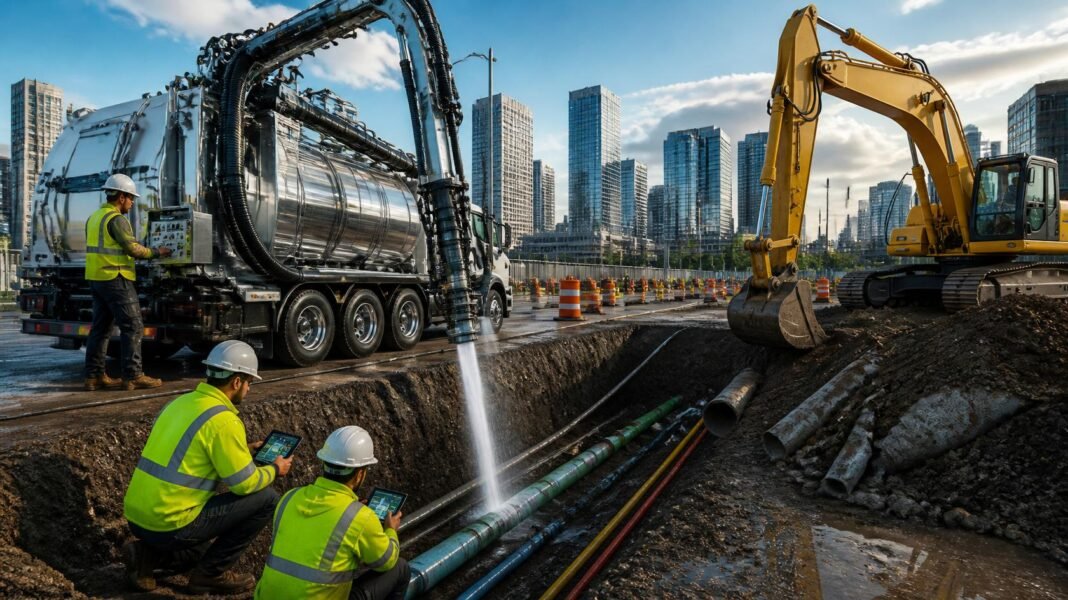
For most of the last century, digging near a buried pipe, cable, or fibre line meant one thing: risk.
A backhoe bucket or a mechanical trencher cannot tell the difference between compacted soil and a gas main, and the result, when things go wrong, is a damaged utility, a shut-down site, and sometimes a life-threatening incident.
Hydro excavation has emerged as the industry’s answer to that problem, and it is no longer a niche service reserved for cautious utility companies.
It is becoming the default method for exposing, protecting, and working around underground infrastructure, and the shift is reshaping how construction, energy, and municipal projects are planned and priced.
How Hydro Excavation Works
The process pairs two simple forces. A high-pressure water stream, typically delivered at 2,000 to 3,500 PSI through a handheld wand, is directed into the ground to break compacted soil into a loose slurry without disturbing whatever is buried in it.
A powerful vacuum system, driven by a fan or a positive-displacement blower generating airflow in excess of 5,000 cubic feet per minute, then lifts that slurry through a hose and into an onboard debris tank mounted on a truck or trailer.
Because the cutting action comes from water rather than steel, pipes, cables, tree roots, and fibre-optic lines are exposed intact rather than struck.
Some manufacturers now offer air-excavation variants that use compressed air instead of water, useful where moisture-sensitive soils or freezing conditions make water impractical.
The Case Against Traditional Excavation
Mechanical digging remains faster for large-volume earthmoving, but its blind-spot problem has become expensive.
Industry damage-reporting data compiled by North American utility-safety bodies attributes roughly a third of all underground utility strikes directly to excavation practice, with tens of thousands of documented incidents recorded annually and the cost per incident climbing faster than general construction inflation.
Beyond the direct repair bill, a struck line brings regulatory penalties, work stoppages, emergency response costs, and reputational damage for the contractor involved.
Hydro excavation providers routinely point out that a single avoided utility strike can cover the cost of the equipment used to avoid it — a calculation that is increasingly persuading procurement teams to specify non-destructive methods before mechanical ones.
Market Growth: The Numbers Behind the Shift
Multiple industry market-research houses tracking hydrovac trucks and vacuum-excavation services this year put the global market in the low-to-mid single-digit billions of dollars, with most forecasts converging on annual growth rates of roughly 5% to 8% through the early 2030s.
The estimates vary by scope — some cover only hydrovac vehicles, others the broader vacuum-excavation services category including air excavation and utility-locating work — but the direction is consistent across every source: steady, regulation-driven expansion rather than a short-term spike.
North America remains the largest regional market on the strength of established safety codes, with Europe and a fast-growing Asia-Pacific region following as urban utility networks there become denser and more congested.
Fleet data reinforces the trend. Providers report that mid-size units in the 1,000 to 1,500 gallon range now dominate new orders, replacement cycles for ageing trucks have accelerated over the past few years, and municipal contracts account for close to half of total demand in mature markets — a sign that hydro excavation has moved from a specialist oilfield tool to a standard municipal-works asset.
Technology Driving the Next Generation of Hydrovacs
Four developments stand out as manufacturers compete on more than tank size and pump pressure:
- Electrification and hybrid drivetrains — a growing share of new equipment launches are electric or diesel-electric hybrid units, aimed at cutting fuel costs, noise, and emissions for work in residential streets and city centres.
- Digital mapping and GPS integration — GIS and GPS-linked controls are increasingly standard, letting crews cross-reference excavation points against utility-locate data in real time and log as-built records automatically.
- Water recycling and reclamation — onboard filtration and reclaimer systems separate slurry into reusable water and dry spoil, cutting freshwater consumption, reducing disposal-site trips, and in some designs allowing the excavated soil to be used directly as backfill.
- Remote and semi-automated booms — remote-controlled excavation arms keep operators further from the excavation face, and sensor-assisted pressure controls that automatically ease off near a detected utility line are moving from pilot projects into commercial fleets.
Cold-climate performance has also improved, with heated-water systems now able to cut through frozen ground that would otherwise halt a winter project, extending the operating season in regions that previously shut down excavation work for months at a time.
Regulatory Push: Safety Rules Are Rewriting the Rulebook
Regulation is the strongest single driver behind adoption. Occupational safety authorities in North America and equivalent bodies across the European Union increasingly favour or mandate non-destructive methods before any mechanical trenching near known utility corridors, and a growing number of jurisdictions require potholing — a small, precise hydro-excavated test hole — to confirm the exact position of buried assets before larger works begin.
As city authorities and utility owners tighten permitting requirements, contractors that cannot offer non-destructive digging risk being excluded from tender shortlists altogether, turning what was once a value-added service into a baseline qualification for utility and municipal contracts.
Where Hydro Excavation Is Being Used
The application list has broadened well beyond its original oil-and-gas roots. Utility companies use it for potholing and daylighting before trenching; telecom operators rely on it to expose fibre routes without severing them; municipalities use it for sewer, stormwater, and water-main maintenance; and general contractors increasingly specify it for foundation and piling work in congested urban sites where a mechanical excavator’s swing radius or vibration would threaten neighbouring structures.
Confined-space and indoor excavation, slot trenching for cable installation, and hazardous-material or contaminated-soil removal round out a service list that touches almost every phase of infrastructure delivery.
The Africa Angle: A Market Poised for Adoption
Africa and the wider Middle East region remain the smallest hydro excavation markets globally today, but the underlying drivers are building quickly.
Kenya, South Africa, and other markets covered by CCE News are running parallel programmes of urban densification, fibre and telecom rollout, and utility network expansion — the exact conditions that pushed North American and European contractors toward non-destructive digging in the first place.
As East and Southern African cities extend water, power, and fibre networks through increasingly congested urban cores, and as regional infrastructure financiers begin to attach international safety standards to project funding, demand for hydrovac and vacuum-excavation services on the continent is likely to grow from a low base but at a meaningfully faster pace than in already-mature markets.
Contractors that build hydro excavation capability now stand to gain an edge on tenders that increasingly reference international non-destructive-digging standards.
Challenges Still Facing the Industry
The technology is not without friction. Upfront equipment costs remain well above those of a conventional excavator, and operator training requirements — covering pressure control, soil assessment, and disposal compliance — add to onboarding time.
Disposal of the water-and-soil slurry remains logistically complex, since many jurisdictions require designated dumping or treatment sites rather than open disposal, and industry surveys consistently find that a large share of contractors still underestimate the method’s benefits simply because of limited exposure to it.
Addressing that awareness gap, alongside continued cost reductions as fleets scale, will determine how quickly adoption spreads beyond the markets where regulation already makes non-destructive digging effectively mandatory.
Outlook
None of this points to the disappearance of mechanical excavation — bulk earthmoving, large-scale grading, and open-cut work will continue to rely on excavators and bulldozers for the foreseeable future.
What is changing is the default choice for any digging that happens near a buried asset.
As regulators tighten utility-protection rules, as digital mapping makes precise excavation easier to plan, and as electrification brings down the operating cost of hydrovac fleets, non-destructive digging is shifting from a specialist safety measure to a standard line item in infrastructure budgets — in North America and Europe today, and increasingly in the fast-urbanising markets of Africa and Asia in the years ahead.
Also Read
- Wastewater Infrastructure in Africa: The Equipment Driving Next-Gen Utilities
- Why progressive cavity pumps are essential for wastewater and sludge management
- Global construction news pltform

With years of experience covering infrastructure projects, equipment, and engineering solutions, Yvonne brings in-depth analysis and practical insights to contractors, engineers, and industry stakeholders.
She is passionate about highlighting sustainable construction practices and the latest advancements that drive efficiency and safety on worksites.
- Why America’s Grid Expansion Is Creating a New Construction Boom - July 31, 2026
- U.S. Housing Starts Surge 19% in June, Signalling Strong Construction Activity Despite Decline in Building Permits - July 23, 2026
- 10 Benefits of Smart Buildings: How Intelligent Buildings Are Transforming Commercial Real Estate - July 21, 2026
